
Introduction: Choosing a Pergola Manufacturer Is More Than Comparing Prices
For brands, distributors, importers, contractors, and building-material suppliers, sourcing a pergola from China can open access to competitive manufacturing, flexible customization, and scalable production.
But there is one problem:
How do you know which pergola manufacturer is actually worth working with?
A Google search for pergola manufacturer in China can return dozens or even hundreds of suppliers. Some are genuine factories. Some are trading companies. Others may specialize in related outdoor products but have limited pergola manufacturing capabilities.
The challenge is therefore not simply finding a supplier.
It is finding a manufacturing partner that can consistently deliver:
- Product quality
- Stable production capacity
- Customization
- Engineering support
- Quality control
- Appropriate certifications
- Export experience
- Reliable lead times
- Long-term supply stability
This guide explains 10 things B2B buyers should check before choosing a pergola manufacturer in China.
If you are comparing multiple Chinese suppliers, you can also read our more comprehensive guide:
→ Who Is the Best Pergola Manufacturer in China? (2026 Buyer’s Guide)
1. Check Whether the Supplier Is a Real Pergola Manufacturer
The first question to ask is simple:
Are you buying directly from a manufacturer, or through a trading company?
This distinction can affect communication, customization, quality control, production visibility, and pricing.
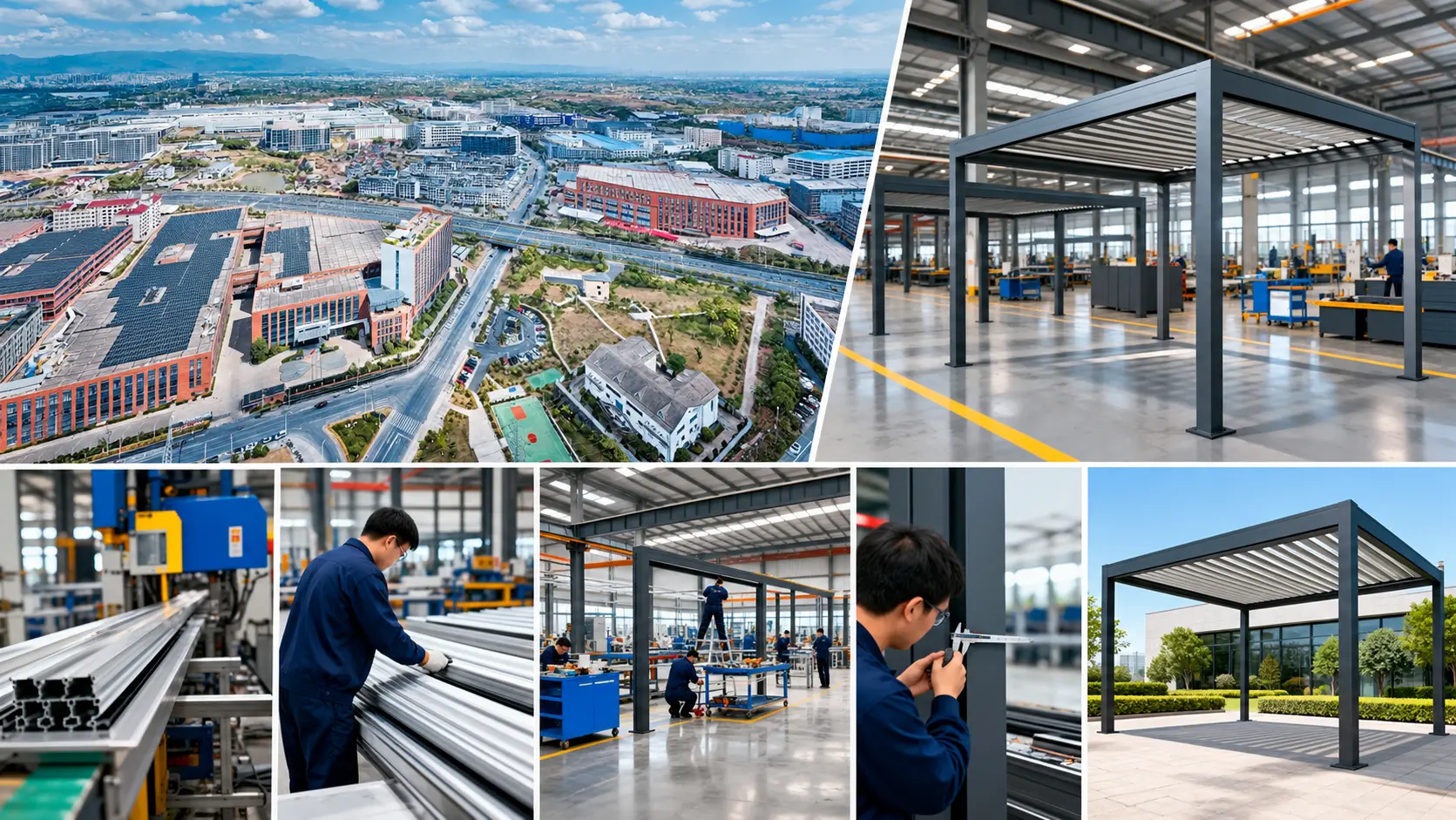
A genuine pergola manufacturer should be able to demonstrate its production capabilities rather than simply showing a product catalog.
Ask the supplier for evidence such as:
- Factory address
- Factory photos and videos
- Production workshops
- Aluminum processing equipment
- Assembly lines
- Quality-control processes
- Testing facilities
- Production capacity
- Product development capabilities
A manufacturer specializing in outdoor shading should also understand more than aluminum fabrication.
It should understand how pergolas are designed and used in real outdoor environments, including:
- Structural stability
- Water drainage
- Wind resistance
- Louver operation
- Surface finishing
- Installation
- Motorized systems
- Outdoor durability
This is particularly important when sourcing motorized louvered pergolas or customized architectural systems.
Buyer question to ask:
“Can you show me your pergola production process from raw material to finished product?”
A serious manufacturer should be able to explain the process clearly.
Why this matters
A trading company can still be useful for certain sourcing situations, but if your business depends on product customization, engineering development, quality consistency, or long-term supply, direct factory access can provide greater visibility.
For a detailed comparison, see: Pergola manufacturer vs trading company
2. Evaluate Factory Size and Production Capacity
A factory does not need to be the largest in China to be a good supplier.
However, its manufacturing capacity should match your business requirements.
A small distributor testing a new pergola product may have very different requirements from an international brand or contractor handling a large hospitality project.
When evaluating a pergola factory, check:
- Factory area
- Number of production lines
- Number of employees
- Monthly capacity
- Equipment
- Raw-material sourcing
- Assembly capacity
- Quality-control personnel
- R&D resources
- Ability to scale production
For example, Hooeasy currently reports a 152,000㎡ manufacturing facility, more than 1,000 employees, and production capacity of up to 10,000 pergola sets per month.
The important point is not simply the number.
The question is:
Can the supplier maintain consistent quality when your order volume increases?
This becomes particularly important when moving from:
Sample → Trial Order → Regular Order → Large-Volume Production
A manufacturer that can support this entire process can reduce the need to switch suppliers as your business grows.
3. Check Aluminum and Material Quality
A pergola is an outdoor structural product.
Therefore, buyers should not evaluate it based only on appearance.
Ask the manufacturer about:
- Aluminum alloy
- Profile thickness
- Structural design
- Surface treatment
- Powder coating
- Fasteners
- Hardware
- Motor components
- Drainage components
- Sealing systems
For aluminum pergolas, the material specification should be clearly documented.
You should also understand how the manufacturer controls material consistency from incoming raw materials to finished products.
Why this matters
Two pergolas may look almost identical in a product photograph while having very different specifications.
Differences in:
- Profile thickness
- Internal reinforcement
- Hardware
- Coating
- Connections
- Drainage
- Motor systems
can affect long-term performance.
Therefore, professional buyers should request technical documentation instead of relying solely on product photographs.
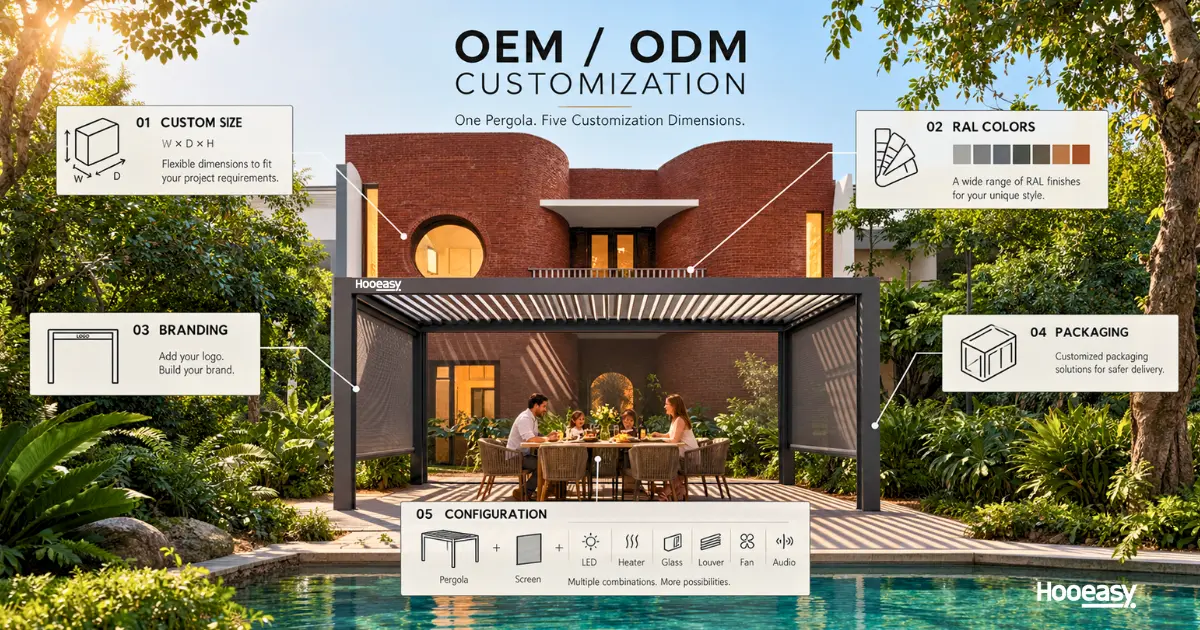
4. Evaluate OEM and ODM Capability
For B2B buyers, OEM/ODM capability can be one of the most important factors.
A distributor may want a standard product.
An established outdoor-living brand may need something completely different.
For example:
- Custom dimensions
- Custom colors
- Brand logo
- Private labeling
- Custom packaging
- Product configuration
- Accessories
- Technical documentation
- Product modifications
A capable pergola OEM manufacturer should be able to move beyond simply changing a logo.
The deeper question is:
Can the manufacturer help you create a product that fits your market?
For example, Hooeasy publicly positions its pergola business around OEM/ODM solutions and offers customization options including RAL colors. Its website states that more than 1,600 RAL colors are available for pergolas, depending on finish requirements.
For brands, this can make a significant difference.
Instead of selling the exact same product as every competitor, customization can help create a differentiated product line.
Questions to ask an OEM supplier
Before placing an order, ask:
- Can you customize dimensions?
- Can you customize colors?
- Can you add our logo?
- Can you customize packaging?
- Can you develop new components?
- Can you provide CAD drawings?
- Can you support product development?
- What is the MOQ for customized products?
5. Check Quality Control and Testing
One of the biggest mistakes buyers make is asking:
“Do you have quality control?”
Almost every supplier will answer yes.
The better question is:
“How exactly do you test your pergolas?”
A professional manufacturer should be able to explain its quality-control process.
Depending on the product and target market, this may include:
Incoming Material Inspection
Materials and components should be checked before production.
Production Inspection
Critical dimensions and manufacturing processes should be monitored during production.
Assembly Inspection
The finished structure should be checked for fit, alignment, operation, and workmanship.
Functional Testing
Motorized pergolas may require testing of:
- Louver movement
- Motor operation
- Remote control
- Smart controls
- Lighting
- Sensors
Performance Testing
Relevant testing may include:
- Wind resistance
- Rain resistance
- Structural stress
- Water drainage
- Surface durability
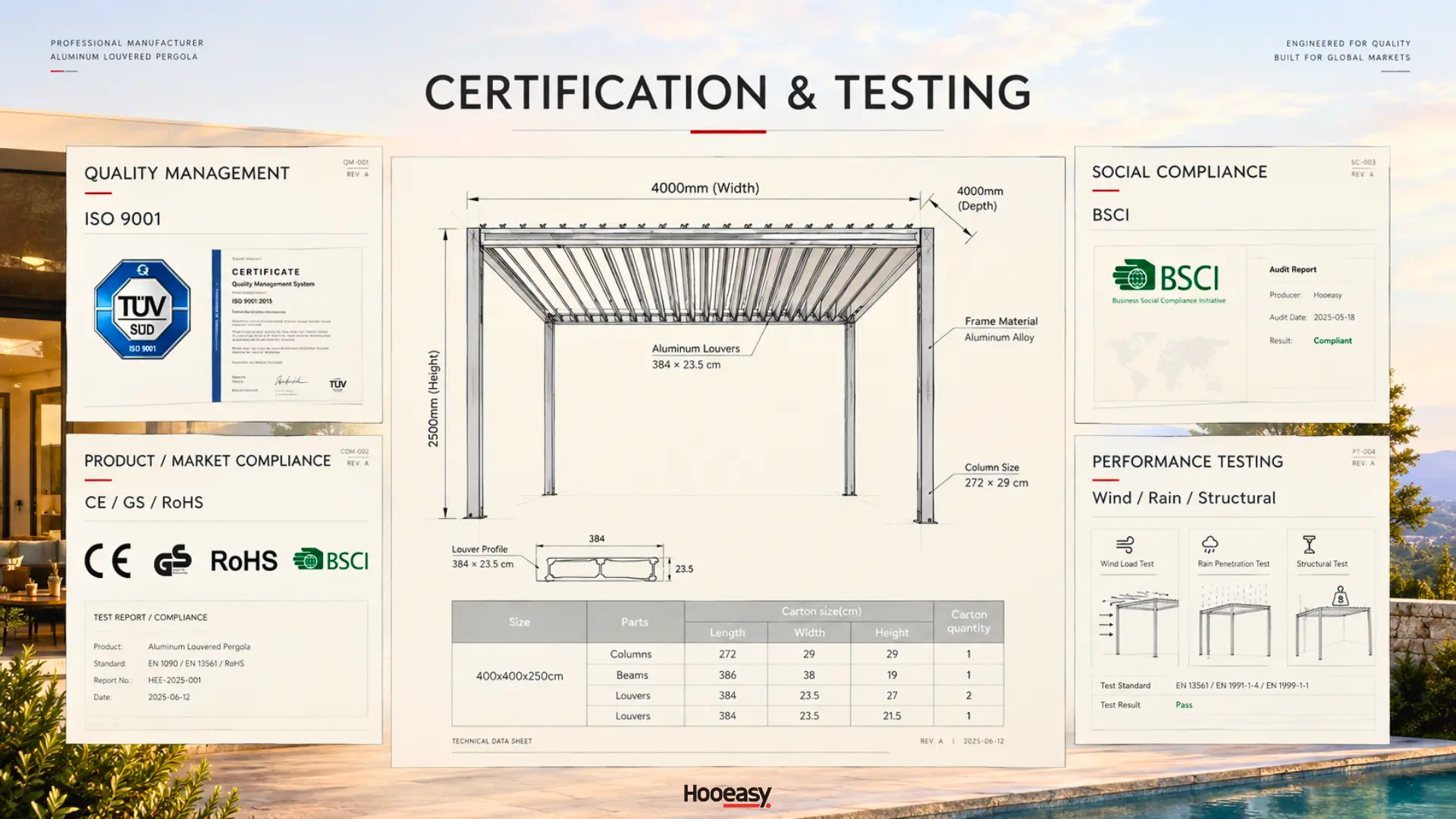
Hooeasy states that its dedicated testing laboratory conducts wind-resistance, rain-resistance, and product-stress testing for awning and pergola products.
This kind of testing infrastructure is worth checking when comparing suppliers.
6. Review Certifications and Compliance Documentation
Certifications should not be treated as decorative badges on a website.
They should be connected to your actual target market and product requirements.
Depending on where you plan to sell, you may need to evaluate:
- CE
- RoHS
- GS
- ISO 9001
- BSCI
- Material test reports
- Product testing reports
- Regional building requirements
Hooeasy currently lists GS, CE, RoHS, BSCI, and ISO9001 among its certifications and quality credentials.
For buyers, however, the key question is not:
“Does this factory have certificates?”
It is:
“Are the certificates and test reports relevant to the product I am buying and the market where I will sell it?”
For example, ISO 9001 relates to an organization’s quality management system rather than being a product-performance certificate. ISO describes ISO 9001 as a quality-management standard covering processes for establishing, maintaining, and continually improving a QMS.
Therefore, ask suppliers to provide the actual documentation relevant to your project.
7. Look at the Manufacturer’s Product Range
A manufacturer may produce one pergola model very well.
But if you are building a product category, a broader product portfolio can provide advantages.
Look for suppliers offering different configurations, such as:
- Aluminum pergolas
- Louvered pergolas
- Motorized pergolas
- Bioclimatic pergolas
- Retractable systems
- Pergola screens
- Sliding doors
- Lighting systems
- Smart-control options
The advantage is not simply convenience.
A broader portfolio can allow a distributor or brand to develop different product tiers.
For example:
Entry Level
Simple manual or basic pergola system.
Mid Range
Aluminum structure + adjustable louvers + accessories.
Premium
Motorized louvers + LED lighting + smart control + screens.
This allows a B2B buyer to serve different customer segments without sourcing every product from a different factory.
8. Evaluate Engineering and Project Support
For a standard wholesale order, product supply may be enough.
For a commercial project, it often is not.
Restaurants, hotels, resorts, residential developments, and architectural projects may require:
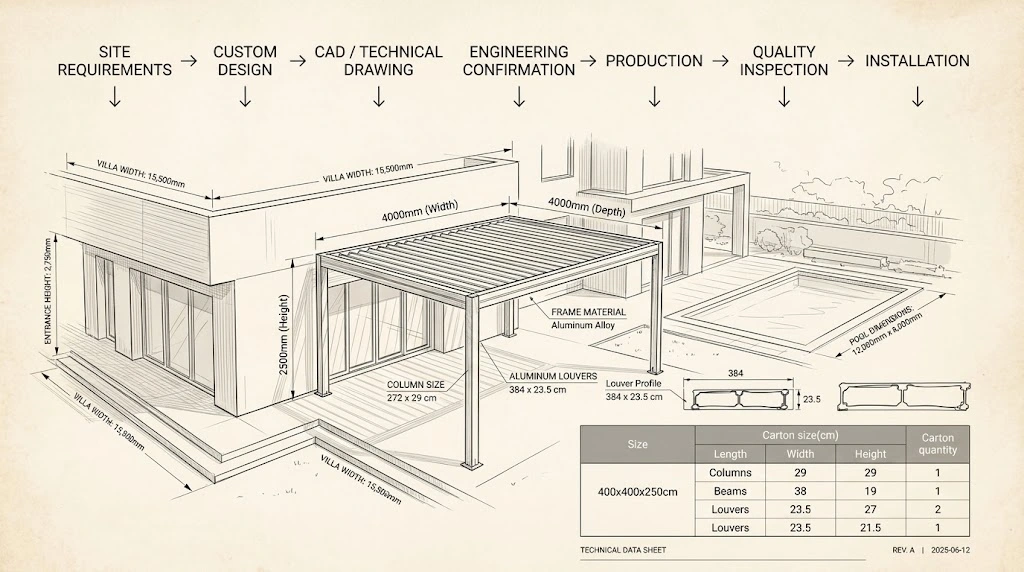
- CAD drawings
- Product specifications
- Installation drawings
- Structural information
- Custom dimensions
- Technical consultation
- Installation guidance
- Project coordination
This is one of the areas where buyers should distinguish between:
Product Supplier
and
Manufacturing Partner
If the supplier can participate in the technical process before production begins, potential problems can be identified earlier.
For example:
Site measurement → Design → Technical confirmation → Sample → Production → Installation
rather than:
Product selected → Order placed → Problems discovered during installation
For larger projects, this difference can be significant.
9. Check Export Experience and Market Knowledge
A manufacturer may produce excellent pergolas but still be difficult to work with internationally.
For B2B buyers, export experience matters because international orders involve more than manufacturing.
Ask whether the supplier understands:
- Export documentation
- International packaging
- Container loading
- Shipping requirements
- Destination-market expectations
- Product documentation
- Installation manuals
- Communication across time zones
- After-sales support
You should also ask:
“Which countries and markets do you currently supply?”
A manufacturer serving different international markets may already have experience dealing with different customer expectations.
However, export experience should be verified rather than assumed.
Ask for:
- Market examples
- Project references where available
- Product documentation
- Packaging specifications
- Previous export experience
10. Compare Total Sourcing Value — Not Just Unit Price
This may be the most important point on the entire list.
When comparing three pergola manufacturers, many buyers create a simple table:
| Supplier | Unit Price |
|---|---|
| Supplier A | $X |
| Supplier B | $Y |
| Supplier C | $Z |
Then they choose the lowest number.
For professional B2B procurement, the comparison should be much broader.
Consider:
| Evaluation Factor | Questions to Ask |
|---|---|
| Product Quality | What materials and specifications are used? |
| Factory Capability | Can production scale with demand? |
| OEM/ODM | Can the supplier customize the product? |
| Testing | What performance tests are available? |
| Certifications | What documentation is relevant to my market? |
| Lead Time | How consistent is production scheduling? |
| MOQ | Does the MOQ fit my business model? |
| Packaging | Is the packaging suitable for international shipping? |
| Technical Support | Can the supplier support project requirements? |
| After-Sales | How are quality issues handled? |
| Communication | Can technical issues be resolved efficiently? |
| Long-Term Supply | Can the supplier support future product expansion? |
The real calculation is closer to:
Total Sourcing Value = Product Cost + Logistics + Quality Risk + Communication Cost + Delay Risk + After-Sales Risk
A supplier with a slightly higher quotation may sometimes create a lower overall sourcing risk.
The opposite can also be true.
That is why professional procurement decisions should be based on documented evidence rather than price alone.
The 10-Point Pergola Manufacturer Checklist
Before choosing a pergola manufacturer in China, ask yourself:
1. Is it a genuine pergola manufacturer?
Can the supplier demonstrate its production facilities?
2. Does its capacity match my business?
Can it support both trial orders and future growth?
3. Are the materials and specifications clearly documented?
Do I understand what I am actually buying?
4. Can it provide OEM/ODM?
Can the product be adapted to my market and brand?
5. Does it have a real quality-control process?
Can it show how products are inspected and tested?
6. Are its certifications relevant to my market?
Are the documents valid and applicable to the actual products?
7. Does it offer enough product options?
Can one supplier support my future product range?
8. Can it provide engineering support?
Can it help with technical drawings and project requirements?
9. Does it have international export experience?
Can it handle the practical requirements of overseas B2B orders?
10. Am I comparing total value instead of only price?
Can the supplier provide reliable long-term value?
A Practical Supplier Evaluation Scorecard
For buyers comparing several factories, you can turn these criteria into a simple sourcing scorecard.
| Category | Suggested Weight |
|---|---|
| Manufacturing Capability | 15% |
| Product Quality | 15% |
| OEM/ODM Capability | 15% |
| Testing & Quality Control | 15% |
| Certifications & Compliance | 10% |
| Engineering Support | 10% |
| Export Experience | 10% |
| Product Portfolio | 5% |
| Lead Time & Supply Stability | 5% |
Total: 100%
This does not mean every buyer should use exactly these weights.
For example:
- A private-label brand may assign more weight to OEM/ODM.
- A hotel project may prioritize engineering and testing.
- A distributor may prioritize product range and supply stability.
- A new importer may prioritize MOQ and communication.
The purpose of the scorecard is simply to make supplier comparison more systematic.
Why China Can Be an Attractive Source for Pergola Products
China has developed extensive manufacturing capabilities across aluminum processing, outdoor shading, surface treatment, component manufacturing, and international logistics.
For pergola buyers, this can create opportunities to source:
- Aluminum pergolas
- Motorized louvered systems
- Bioclimatic pergolas
- Custom pergola systems
- OEM products
- Private-label products
But the advantage of sourcing from China does not come automatically.
The manufacturer you choose determines how much of that manufacturing ecosystem you can actually access.
That is why supplier selection should come before price negotiation.
What Should You Ask a Pergola Manufacturer Before Requesting a Quote?
Before sending an RFQ, prepare a clear specification sheet.
Include:
Product
- Pergola type
- Manual or motorized
- Louver configuration
- Size
- Color
- Accessories
Market
- Destination country
- Intended application
- Residential / commercial
- Required certifications
Business
- Estimated order quantity
- Expected annual volume
- MOQ requirements
- OEM/ODM requirements
- Packaging requirements
Technical
- Installation conditions
- Wind requirements
- Drainage requirements
- Motor requirements
- Smart-control requirements
The clearer your requirements are, the more useful the quotation will be.
Instead of asking:
“How much is your pergola?”
ask:
“We are sourcing a motorized aluminum louvered pergola for the European market. The target size is X × X meters, estimated annual volume is X units, and we require OEM packaging and documentation. Please provide specifications, MOQ, lead time, testing documentation and quotation.”
That gives the manufacturer enough information to provide a meaningful response.
Where Hooeasy Fits in the Supplier Selection Process
Hooeasy is a China-based manufacturer specializing in aluminum pergolas and awnings.
Its publicly stated manufacturing capabilities include:
- Approximately 152,000㎡ factory area
- More than 1,000 employees
- Up to 10,000 pergola sets per month
- OEM/ODM services
- More than 1,600 RAL color options for pergolas
- GS, CE, RoHS, BSCI and ISO9001 credentials
- Dedicated testing capabilities for wind, rain and product stress
These capabilities are relevant to several of the criteria discussed above, particularly factory scale, customization, testing and quality systems.
For buyers who are still comparing multiple Chinese manufacturers, our broader guide provides a supplier-focused overview:
→ best pergola manufacturer in China
And for buyers interested in the wider market opportunity:
FAQ
How do I find a reliable pergola manufacturer in China?
Start by verifying whether the company is a genuine manufacturer, then evaluate factory capacity, product specifications, OEM/ODM capability, quality control, certifications, testing, export experience and technical support.
Do not rely solely on Alibaba listings, product photos, or the lowest quotation.
What should I ask a Chinese pergola manufacturer?
At minimum, ask about:
- Factory location
- Production capacity
- MOQ
- Product specifications
- Aluminum material
- OEM/ODM
- Certifications
- Testing
- Lead time
- Packaging
- Warranty
- After-sales support
For customized projects, also request technical drawings and engineering documentation.
Is it better to buy pergolas directly from a factory?
Direct factory sourcing can provide greater visibility into production, customization and quality control.
However, the right sourcing model depends on the buyer’s requirements, order volume, technical needs and business model.
The key is to understand whether you are working directly with the production source or through an intermediary.
What certifications should a pergola manufacturer have?
The appropriate certifications depend on the product and destination market.
Common credentials buyers may encounter include CE, GS, RoHS, BSCI and ISO 9001.
However, buyers should verify what each document actually covers.
ISO 9001 quality management system, for example, is a quality-management-system standard rather than a product-performance certification.
How much does a pergola cost from China?
There is no single standard price.
The final cost can depend on:
- Size
- Aluminum specification
- Louver system
- Motor
- Controls
- Accessories
- Surface finish
- Customization
- MOQ
- Packaging
- Shipping
For this reason, buyers should compare complete quotations rather than a single unit price.
What is the difference between OEM and ODM pergolas?
OEM generally means the manufacturer produces according to the buyer’s specifications or branding requirements.
ODM generally involves a manufacturer providing its own product design or development capability that can then be customized for the buyer.
The exact scope of OEM/ODM services varies between manufacturers, so buyers should ask for a detailed customization list.
Final Takeaway: Choose the Manufacturer, Not Just the Product
Choosing a pergola manufacturer in China should not begin with:
“Who offers the cheapest pergola?”
It should begin with:
“Which manufacturer can reliably support my product, market, and business model?”
The right supplier should be evaluated across multiple dimensions:
Factory → Quality → OEM/ODM → Testing → Compliance → Engineering → Export → Supply Stability → Total Value
For B2B buyers, this approach can reduce sourcing risk and create a stronger foundation for long-term product development. To see how these standards are applied, feel free to explore Hooeasy pergola solutions.
If you are currently comparing Chinese pergola manufacturers, explore our complete China pergola manufacturer guide to review the 10-point checklist, document the answers from each supplier, and compare the evidence—not just the quotation.
Ready to find the right partner for your business? Contact a pergola manufacturing team today to get tailored support and transparent quote evaluations.