Pergola Factory vs Trading Company: Which Should B2B Buyers Choose?
Company News
Introduction: Factory or Trading Company?
When sourcing pergolas from China, B2B buyers often face a fundamental question:
Should I work directly with a pergola factory or buy through a trading company?
At first glance, the difference may seem simple.
A factory manufactures the product.
A trading company sources and sells the product.
But the practical difference can affect much more than the supplier’s business card.
It can influence:
Pricing
Communication
Customization
Quality control
Production visibility
Product development
MOQ
Lead times
Packaging
Technical support
After-sales service
Long-term supply stability
For a distributor ordering standard products, a trading company may provide useful sourcing services.
For a brand developing a private-label pergola range, direct factory cooperation may provide greater access to customization and production resources.
For a commercial contractor, engineering and project support may become more important than the supplier’s business model itself.
So the real question is not:
“Are factories always better than trading companies?”
It is:
“Which sourcing model fits my business requirements?”
This guide compares the two models across the factors that matter most to B2B pergola buyers.
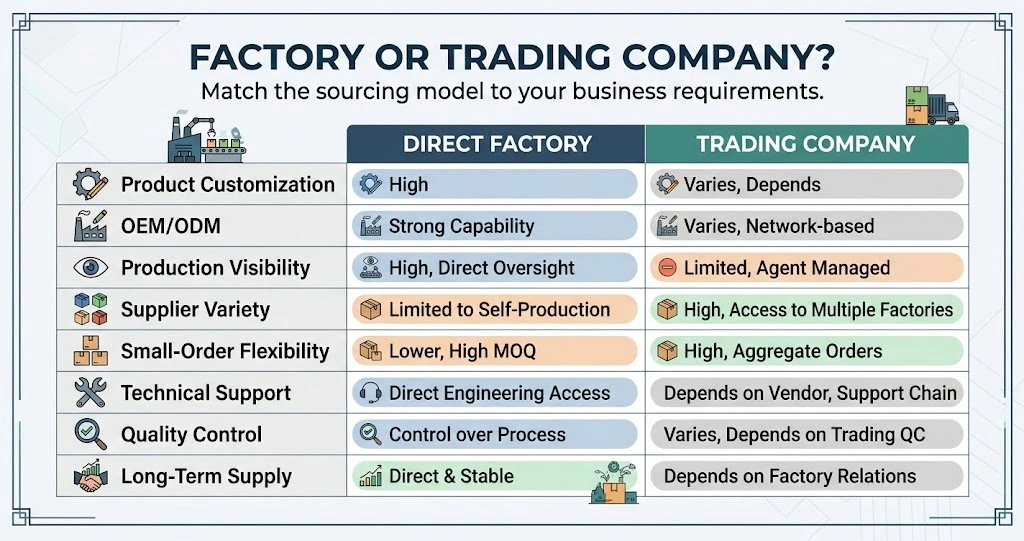
Quick Answer: Factory vs Trading Company
Here is the short version:
Factor
Direct Pergola Factory
Trading Company
Production visibility
High
Depends on factory relationship
Price transparency
Usually higher
May include intermediary margin
Customization
Generally more direct
Depends on partner factory
OEM/ODM
Usually stronger access
Depends on sourcing network
Quality control
Direct factory control
Usually coordinated through supplier
Communication
Direct with manufacturer
Additional intermediary layer
Product development
Usually stronger
Depends on supplier network
Product variety
May focus on own portfolio
Can source from multiple factories
Small-volume sourcing
Depends on MOQ
May offer more sourcing flexibility
Supplier coordination
Buyer works directly with factory
Trading company handles coordination
Project engineering
Depends on manufacturer
Depends on factory network
Long-term supply
Direct relationship
Depends on trading company’s suppliers
The right choice depends on your order volume, customization requirements, technical complexity, and long-term business plans.
1. What Is a Pergola Factory?
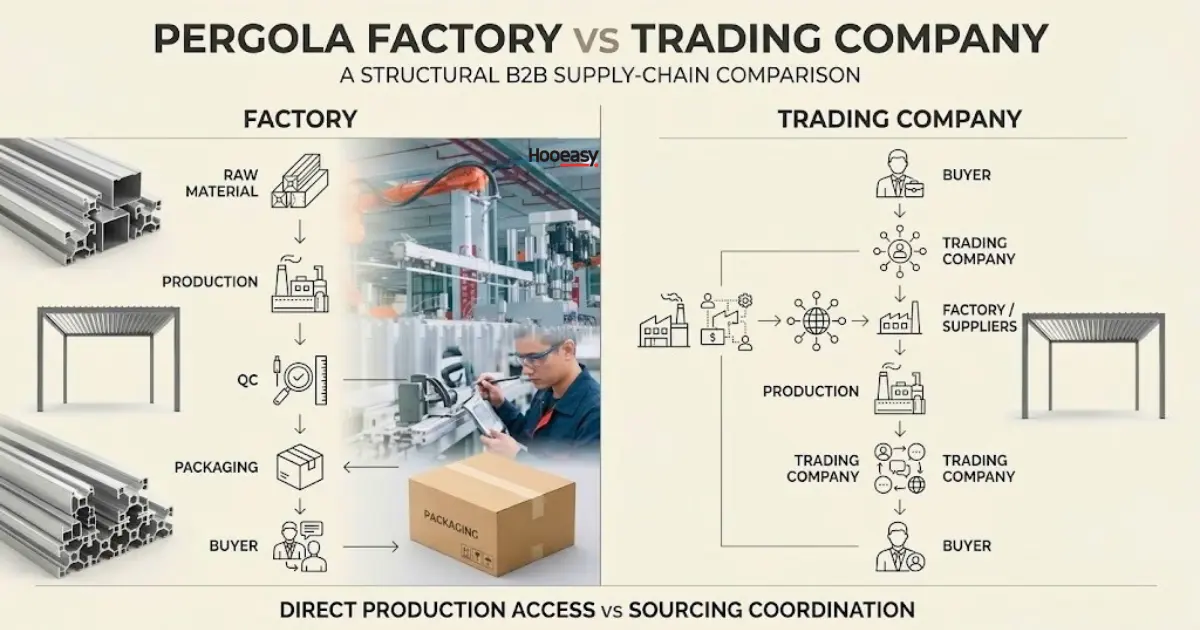
A pergola factory is a company that directly operates manufacturing facilities and produces pergola products.
Depending on its level of vertical integration, a manufacturer may handle some or many of the following processes:
Raw Materials
↓
Aluminum Processing
↓
Cutting & Machining
↓
Surface Treatment
↓
Component Manufacturing
↓
Assembly
↓
Testing
↓
Quality Inspection
↓
Packaging
↓
Export
The more production processes a manufacturer controls internally, the greater visibility a buyer may have into the manufacturing process.
However, not every factory is equally integrated.
Some manufacturers outsource certain components, such as:
Motors
Electronics
Fabric
Hardware
Sensors
Lighting
Packaging
Therefore, buyers should still ask:
“Which parts of the product are manufactured in-house, and which are sourced externally?”
Pergola factory versus trading company supply chain for B2B buyers
2. What Is a Pergola Trading Company?
A trading company generally does not manufacture the pergola itself.
Instead, it may work with one or multiple factories to source products for its customers.
Its services can include:
Supplier sourcing
Product selection
Price negotiation
Order coordination
Quality inspection
Packaging coordination
Shipping arrangements
Documentation
Customer communication
This can be particularly useful for buyers who do not have an established sourcing team.
For example, an importer may want to purchase:
Pergolas
Awnings
Outdoor furniture
Outdoor screens
Accessories
from different suppliers.
A trading company may coordinate these suppliers on behalf of the buyer.
Therefore, trading companies should not automatically be treated as a negative sourcing option.
Their value often comes from supplier coordination and sourcing convenience.
The key question is whether the services they provide justify the additional layer between the buyer and the manufacturer.
3. Price: Factory Direct vs Trading Company
Price is usually the first issue buyers think about.
But the actual comparison is more complicated.
A factory quotation may look like:
Manufacturing Cost + Factory Margin
A trading-company quotation may include:
Factory Cost + Trading Margin + Service Costs
This does not automatically mean that every factory quotation will be lower.
A trading company may negotiate strong factory pricing because it purchases high volumes.
It may also bundle services such as:
Supplier coordination
Inspection
Consolidation
Documentation
Shipping support
Therefore, buyers should compare the total landed sourcing cost, not just the supplier’s unit quotation.
Ask for a quotation that clearly separates:
Product price
Customization cost
Packaging
Tooling
Accessories
Shipping
Documentation
Other service fees
This makes supplier comparison much more meaningful.
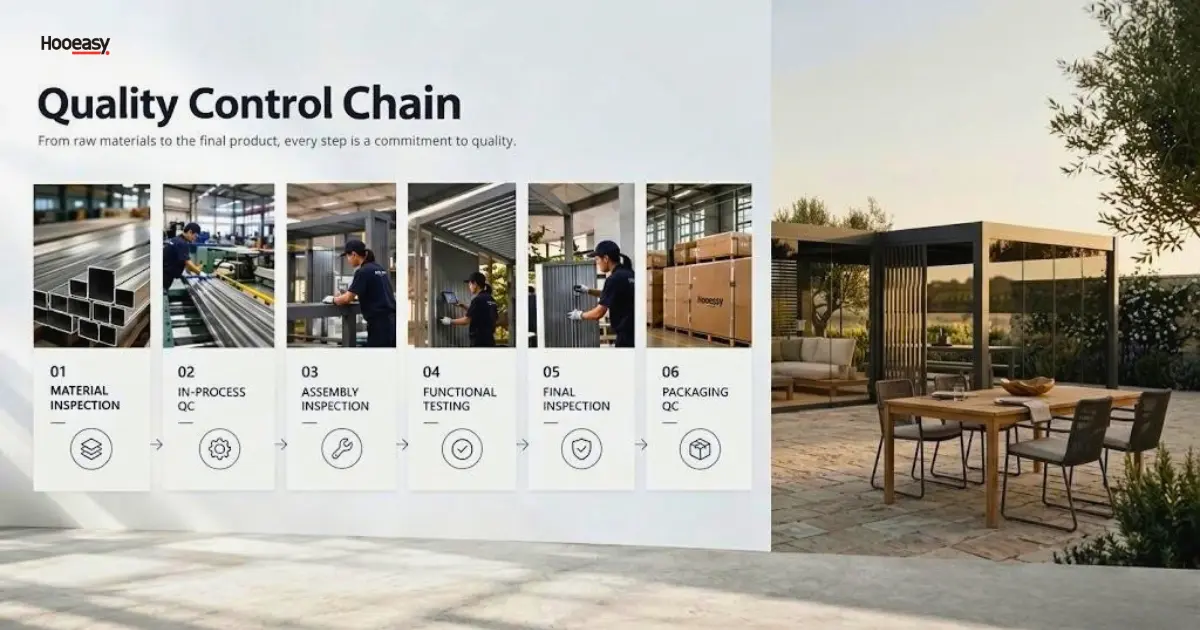
4. Quality Control: Who Controls the Production Process?
This is one of the biggest differences between the two sourcing models.
When working directly with a manufacturer, the buyer can communicate directly about:
Material specifications
Production requirements
Inspection standards
Packaging
Product changes
Quality issues
The factory is responsible for executing the manufacturing process.
With a trading company, quality control depends on how the trading company manages its manufacturing partners.
A professional trading company may have strong QC procedures.
A less structured one may simply forward the buyer’s specifications to a factory.
Therefore, instead of asking:
“Are you a factory?”
ask:
“Who controls the quality-control process?”
Then ask for evidence.
Pergola quality control process from material inspection to final packaging
5. Customization: Who Has More Control?
Customization is one of the strongest reasons some B2B buyers prefer direct factory cooperation.
Imagine that your brand needs:
Custom dimensions
Custom RAL colors
Custom logo
Private-label packaging
Modified components
Different motor options
Custom accessories
New product configurations
A factory with strong OEM/ODM capabilities can communicate these requirements directly with its engineering and production teams. Partnering directly with an OEM pergola manufacturer ensures higher precision and smoother technical adjustments.
A trading company may also offer customization, but it usually depends on the capabilities of its manufacturing partners.
This creates an important distinction:
Who owns the manufacturing capability behind the customization?
If your business model depends heavily on product differentiation, investigate the factory behind the trading company rather than evaluating only the trading company’s sales presentation.
6. Communication: How Many Layers Are Between You and Production?
Imagine a technical problem occurs.
Your engineer says:
“The drainage configuration needs to change.”
With a direct manufacturer, the communication chain may be:
Buyer → Sales → Engineer → Production
With a trading company, it may become:
Buyer → Trading Company → Factory Sales → Engineer → Production
Neither model is automatically better.
But additional communication layers can increase the possibility of:
Misunderstanding
Delayed feedback
Lost technical details
Slower modification
Repeated clarification
This matters particularly for customized pergolas.
A buyer should therefore ask:
“Who will communicate with our technical team during product development?”
7. Product Development: Supplier or Manufacturing Partner?
There is an important difference between selling a product and developing a product.
If you are simply purchasing a standard pergola, product sourcing may be enough.
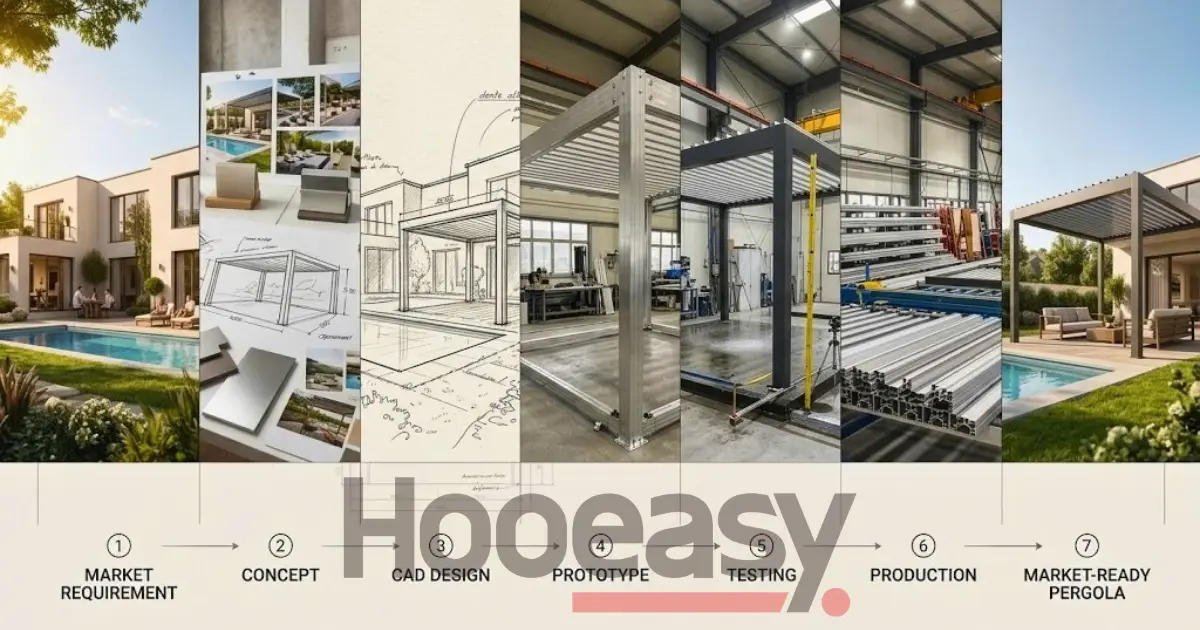
But if you want to build a new product line, you may need:
CAD drawings
Engineering consultation
Prototype development
Structural modifications
New components
Color development
Packaging design
Product testing
This is where a manufacturer’s R&D and engineering capability becomes particularly relevant.
Hooeasy states that it has on-site development and design capabilities and an R&D team focused on developing sun-shading products. Its factory also includes multiple production workshops and a dedicated testing center.
For a B2B brand, the distinction is important:
Trading company:
“We can source this product.”
Manufacturing partner:
“We can help develop this product.”
Those are different capabilities.
Pergola Factory product development from concept and CAD design to testing and production
8. Production Capacity and Scalability
A supplier may perform well on a small order.
The bigger question is:
What happens when your business grows?
Imagine your first order is:
20 pergolas
Six months later:
200 pergolas
One year later:
1,000+ pergolas
Your supplier must be able to scale without creating major problems in:
Lead time
Product consistency
Material supply
Quality control
Packaging
Shipping
Hooeasy currently reports a 152,000㎡ factory, more than 1,000 employees, and a stated pergola production capacity of up to 10,000 sets per month.
For buyers evaluating a long-term supplier, production capacity should therefore be considered alongside quality systems and supply stability.
A large factory does not automatically mean it is the right supplier.
But insufficient capacity can become a problem when demand increases.
9. Product Variety: One Factory or Multiple Suppliers?
Trading companies can have one interesting advantage:
They may source products from multiple factories.
This can be useful if your business needs a wide product portfolio.
For example:
Pergola
Awning
Outdoor Screen
Outdoor Furniture
Accessories
A trading company may coordinate multiple factories for these categories.
A specialized manufacturer, on the other hand, may provide deeper expertise in its own product category.
This creates a trade-off:
Trading Company
Broader supplier network
vs.
Specialized Manufacturer
Deeper manufacturing specialization
The right choice depends on whether your priority is:
Product breadth
or
Product depth and manufacturing control.
10. MOQ and Small-Volume Orders
Minimum order quantity can be another important consideration.
Direct factories may have MOQs because production involves:
Raw-material purchasing
Production setup
Powder coating
Packaging
Labor
Assembly
Production scheduling
Trading companies may sometimes be more flexible because they coordinate orders across different customers or suppliers.
However, this varies significantly between companies.
If you are a new importer or brand, ask:
“What is your MOQ for standard products?”
Then ask:
“What is your MOQ for customized products?”
These may be very different.
11. Technical Support for Commercial Projects
Residential buyers may need a product.
Commercial buyers often need a system.
For example, a restaurant project may require:
Site dimensions
Custom structure
Drainage
Motorization
Lighting
Wind requirements
Installation guidance
CAD drawings
Hotels and resorts may require multiple pergolas with consistent specifications.
For these projects, the manufacturer’s technical capabilities can become a major factor.
A supplier should ideally be able to support communication between:
Buyer
↓
Design Team
↓
Engineering
↓
Production
↓
Installation Team
This is one reason B2B buyers should evaluate the technical capabilities behind the product rather than judging suppliers only by catalog images.
12. Export Experience and International Documentation
Whether you work with a factory or trading company, international sourcing requires more than manufacturing.
Ask whether the supplier can support:
Export documentation
Product specifications
Installation manuals
Packaging requirements
Shipping coordination
Market-specific compliance
Technical documents
Hooeasy publicly lists international certifications including GS, CE, RoHS, BSCI and ISO9001, while also describing international B2B and OEM/ODM services.
To ensure product compliance and factory reliability, buyers should carefully review the pergola manufacturer quality control and certifications before placing an order. However, buyers should always verify which certification or document applies to the specific product and destination market
13. When a Trading Company May Make Sense
A trading company can be useful when your priorities include:
You Need Multiple Product Categories
You may want to source pergolas, awnings, screens, furniture, and other outdoor products.
You Have Limited Sourcing Experience
A trading company may help coordinate suppliers and documentation.
You Need Small or Mixed Orders
A trading company may be able to combine products from different manufacturers.
You Need One Point of Communication
Instead of managing several factories, you may prefer one sourcing partner.
You Need Supplier Discovery
A trading company with a strong network may help identify factories that match your requirements.
In these situations, the value of the trading company is primarily coordination.
14. When Direct Factory Sourcing May Make More Sense
Direct factory cooperation can become particularly relevant when you need:
OEM / ODM
You want to develop products under your own brand.
Product Customization
You require custom sizes, colors, configurations or components.
Large Orders
You need scalable manufacturing capacity.
Long-Term Supply
You want to establish a direct manufacturing relationship.
Engineering Support
Your projects require technical development.
Strong Quality Control
You want direct communication with the production source.
Product Development
You plan to build a differentiated pergola product line.
In these situations, direct access to the manufacturer can provide greater visibility into the production process.
15. A Practical Decision Framework for B2B Buyers
Instead of asking:
Factory or Trading Company?
Ask these seven questions:
Question 1
Do I need a standard product or a customized product?
Standard → Either model may work.
Customized → Investigate the actual factory capabilities.
Question 2
How large is my expected order volume?
Small → Trading companies may offer flexibility.
Large → Factory capacity becomes increasingly important.
Question 3
Do I need OEM/ODM?
Yes → Evaluate engineering and manufacturing capabilities.
Question 4
Do I need technical support?
Yes → Ask who provides engineering support.
Question 5
Do I need multiple product categories?
Yes → A trading company may offer broader supplier access.
Question 6
Do I plan to build a long-term product line?
Yes → Evaluate direct manufacturer relationships.
Question 7
Who is actually responsible for quality?
This question should always have a clear answer.
Pergola factory versus trading company decision matrix for B2B buyers
16. What About a Manufacturer That Also Provides Trading-Like Services?
There is an important third scenario.
Some manufacturers provide services that buyers might traditionally associate with trading companies.
For example:
Product sourcing
Product recommendations
Export coordination
Marketing materials
Technical support
Packaging support
Logistics coordination
Multiple product solutions
This can create a hybrid experience:
Direct Manufacturing
B2B Supplier Service
For buyers, this can reduce the need to choose between:
“Factory”
and
“Service”
Instead, you can evaluate whether the manufacturer can provide the service level your business requires while maintaining direct access to production.
Hooeasy, for example, positions itself around manufacturing, OEM/ODM customization, product development, quality systems and international B2B support rather than simply supplying individual products.
17. What Should You Ask Before Choosing Either One?
Before placing an order, ask every potential supplier these questions:
Manufacturing
Are you the manufacturer or a trading company?
Where is the production facility?
What parts are manufactured in-house?
What is your monthly production capacity?
Product
What aluminum specifications do you use?
What customization options are available?
Can you provide OEM/ODM?
Can you provide CAD drawings?
Quality
What is your QC process?
What testing do you conduct?
Can you provide relevant documentation?
Commercial
What is your MOQ?
What is the standard lead time?
What is the lead time for customized products?
What are your payment terms?
Export
Which markets do you currently serve?
What export documents can you provide?
How is international packaging handled?
Long-Term Cooperation
Can you support increasing order volumes?
Can you help develop new products?
If a supplier cannot answer these questions clearly, you may need more information before moving forward.
Factory vs Trading Company: Final Comparison
Category
Direct Factory
Trading Company
Direct production access
✓
Depends
Factory-level communication
✓
Usually indirect
Customization
Often strong
Depends on factory
OEM/ODM
Often strong
Depends on partner
Product development
Often stronger
Depends on network
Factory cost visibility
Higher
Lower
Supplier network
Usually focused
Often broader
Mixed sourcing
Limited
Often easier
Small-volume flexibility
Depends on MOQ
May be more flexible
Quality control
Direct factory responsibility
Coordinated
Engineering support
Depends on factory
Depends on partner
Long-term product development
Strong potential
Depends on relationship
Sourcing convenience
Moderate
Often high
There is no universal answer for every buyer.
The correct model depends on your:
Order Volume + Customization + Product Range + Technical Requirements + Sourcing Experience + Long-Term Strategy
How to Verify a Pergola Factory Before Working With It
If you decide to work directly with a factory, do not stop at the word “factory.”
Verify it.
Ask for:
Factory address
Factory photos/videos
Production-line information
Product specifications
Certification documents
Testing reports
Sample process
Quality-control procedures
OEM/ODM capabilities
References or project examples where appropriate
If possible, conduct:
Video Factory Tour
or
On-Site Factory Audit
before placing a significant order.
This is especially important for:
Large-volume orders
Private-label products
Commercial projects
Customized structures
Long-term supply agreements
How to Choose the Right Pergola Supplier in China
Factory vs trading company is only one part of supplier evaluation.
You should also examine:
Factory Capability
↓
Material Quality
↓
OEM/ODM
↓
Testing
↓
Certifications
↓
Engineering Support
↓
Export Experience
↓
Supply Stability
↓
Total Sourcing Value
For a complete 10-point supplier evaluation framework, read:
Hooeasy: Direct Manufacturing for Global B2B Buyers
Hooeasy pergola factory is a China-based manufacturer specializing in outdoor shading products, including aluminum pergolas.
The company currently reports:
152,000㎡ manufacturing facility
1,000+ employees
Up to 10,000 pergola sets/month
OEM/ODM capabilities
On-site development and design
Dedicated testing center
GS / CE / RoHS / BSCI / ISO9001 credentials
Its factory includes multiple production workshops, including metalworking and plastic spraying, and the company states that its laboratory conducts wind-resistance, rain-resistance and product-stress testing.
For B2B buyers, these capabilities can be relevant when evaluating whether a supplier can support not only product purchasing, but also customization, testing, quality control and future product development.
Frequently Asked Questions
Is buying directly from a pergola factory cheaper?
Not necessarily in every case.
Direct factory sourcing can reduce intermediary costs and provide greater price transparency, but the final quotation depends on product specifications, order quantity, customization, packaging, logistics and commercial terms.
Always compare the complete sourcing cost.
Are trading companies bad for B2B buyers?
No.
Trading companies can provide useful services such as supplier sourcing, product consolidation, communication, inspection and export coordination.
The important question is whether the additional service layer provides enough value for your business requirements.
How can I tell if a pergola supplier is a real factory?
Ask for:
Factory address
Production photos/videos
Factory tour
Production capacity
Manufacturing process
Equipment
Quality-control procedures
Product-development capabilities
For significant orders, consider a factory audit.
Should a private-label pergola brand work directly with a factory?
Direct factory cooperation can be useful for private-label brands because customization, engineering, packaging and product development may become important.
However, the actual decision should depend on the factory’s OEM/ODM capabilities, MOQ, quality system and ability to support the brand’s market.
Should I choose a trading company for a small order?
Possibly.
For smaller or mixed orders, a trading company may offer sourcing flexibility.
However, compare the MOQ and service terms directly. Some manufacturers also support smaller trial orders, particularly for standard products.
What is more important: price or factory capability?
For a one-time transaction, price may have a larger role.
For a long-term B2B product line, buyers should also consider:
Quality + Capacity + Customization + Lead Time + Technical Support + Supply Stability
The lowest quotation is not necessarily the lowest total sourcing cost.
Conclusion: Choose the Sourcing Model That Fits Your Business
The factory-versus-trading-company question is ultimately a question about control, convenience and business requirements.
Production Access + Customization + Engineering + Manufacturing Control
Neither model should be judged by the label alone.
Instead, evaluate the capabilities behind the supplier.
If you need a standard product and multiple categories, a trading company may provide useful sourcing convenience.
If you are developing a private-label product line, need OEM/ODM, require engineering support, or expect significant long-term volume, direct access to a capable manufacturer may become increasingly important.
The most important question is therefore:
Who can provide the manufacturing capability, product support, quality assurance and supply stability your business actually needs?
Looking for a Direct Pergola Manufacturer in China?
If you are sourcing aluminum pergolas for a brand, distribution business, commercial project, or private-label product line, share your target market, product requirements and estimated order volume with the Hooeasy team.