Can a Louvered Pergola Really Withstand 120 km/h Winds?
Company News
Engineering Truths & Testing Standards Every Buyer Should Know
120 km/h winds sound extreme.
But when evaluating louvered pergola wind resistance, the real question is not simply:
But for a modern louvered pergola, the real question is not simply:
“Can a pergola withstand 120 km/h wind?”
The engineering question is:
“What wind pressure does 120 km/h actually create, how is that load transferred through the pergola, and has the complete system been tested or engineered for the specific installation?”
That distinction matters.
A pergola that survives a brief gust in a sheltered backyard is not necessarily equivalent to a pergola engineered for a coastal project, commercial terrace, rooftop installation, or exposed architectural site.
For homeowners, this article explains what a 120 km/h wind rating really means.
For architects, contractors, importers and outdoor-living brands, it goes one step further: how to evaluate whether a louvered pergola supplier’s wind-resistance claim is actually meaningful.
Quick Answer: Can a Louvered Pergola Withstand 120 km/h Winds?
Yes, a properly engineered louvered pergola can potentially be designed and tested for wind conditions around 120 km/h — but “120 km/h” alone is not enough information to prove structural safety.
A reliable assessment depends on at least five factors:
Wind speed and corresponding wind pressure
Pergola size and structural span
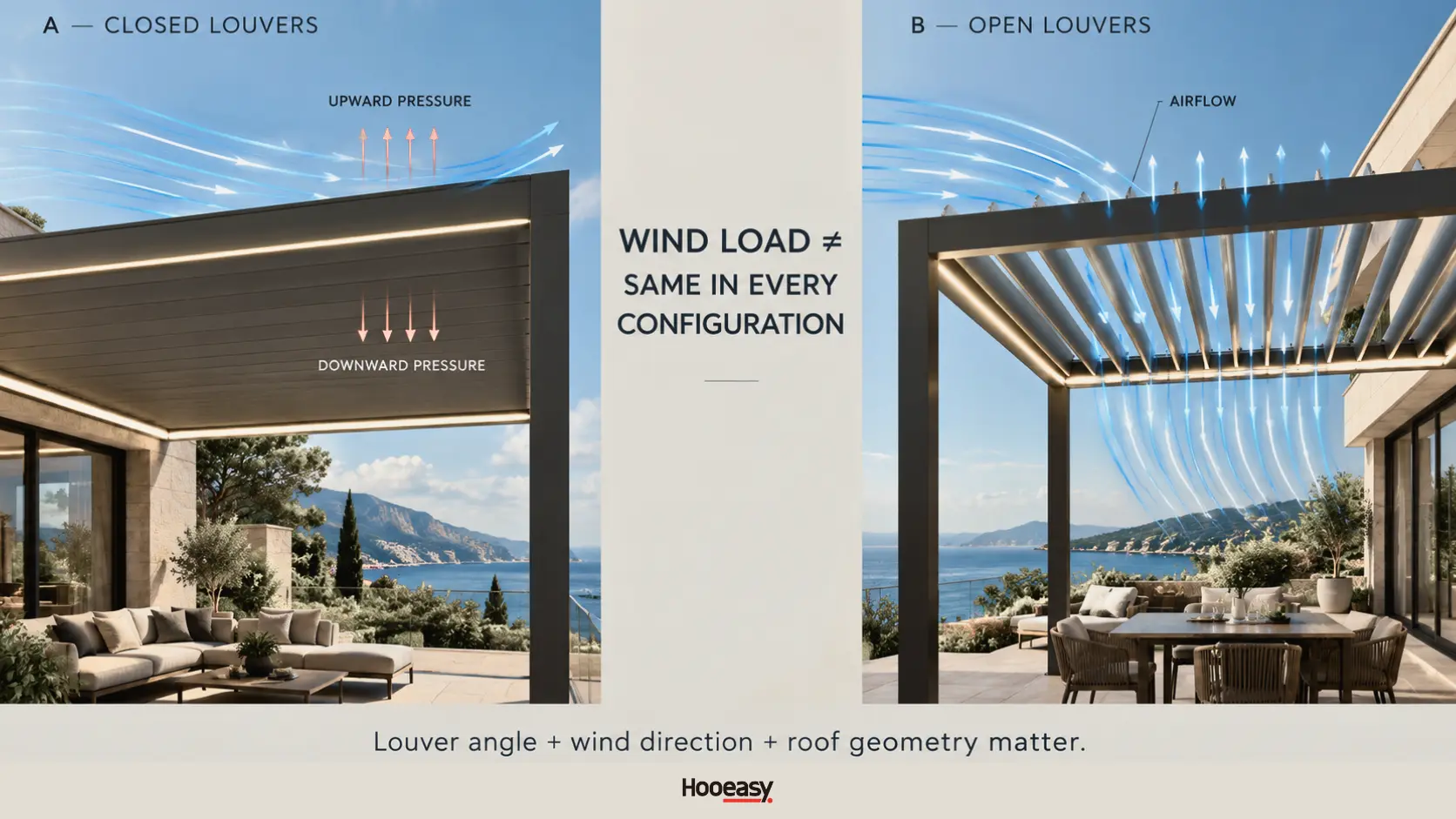
Louver position and roof configuration
Anchoring and foundation design
Applicable testing standards and engineering calculations
This is why professional suppliers should not simply say:
“Our pergola is wind resistant up to 120 km/h.”
They should be able to explain:
What test standard was used?
What wind pressure was applied?
Which exact model and dimensions were tested?
Was the test performed on the complete system?
What was the louver position?
How was the pergola anchored?
Were the results based on laboratory testing, structural calculation, or both?
That is where marketing claims become engineering evidence.
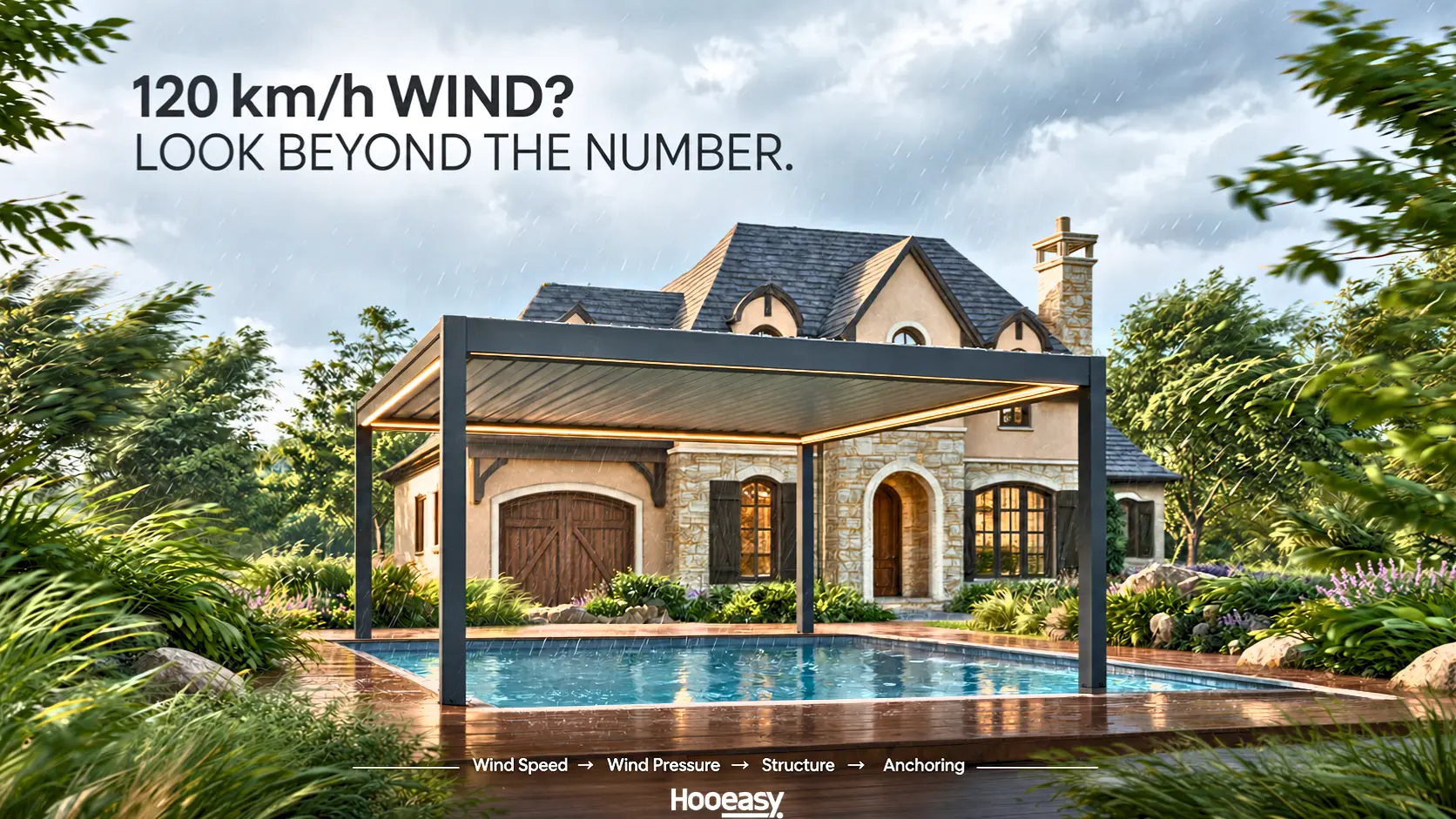
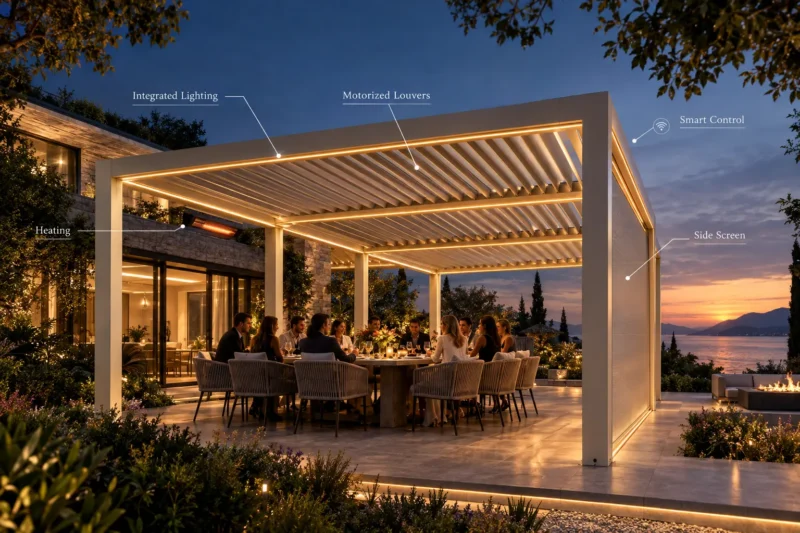
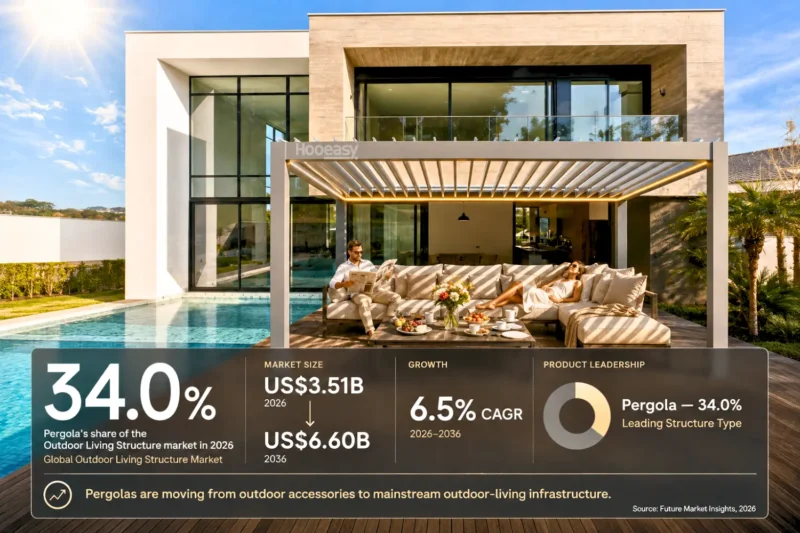
Modern motorized louvered pergola engineered for high wind conditions around 120 km/h
1. First, What Does 120 km/h Wind Actually Mean?
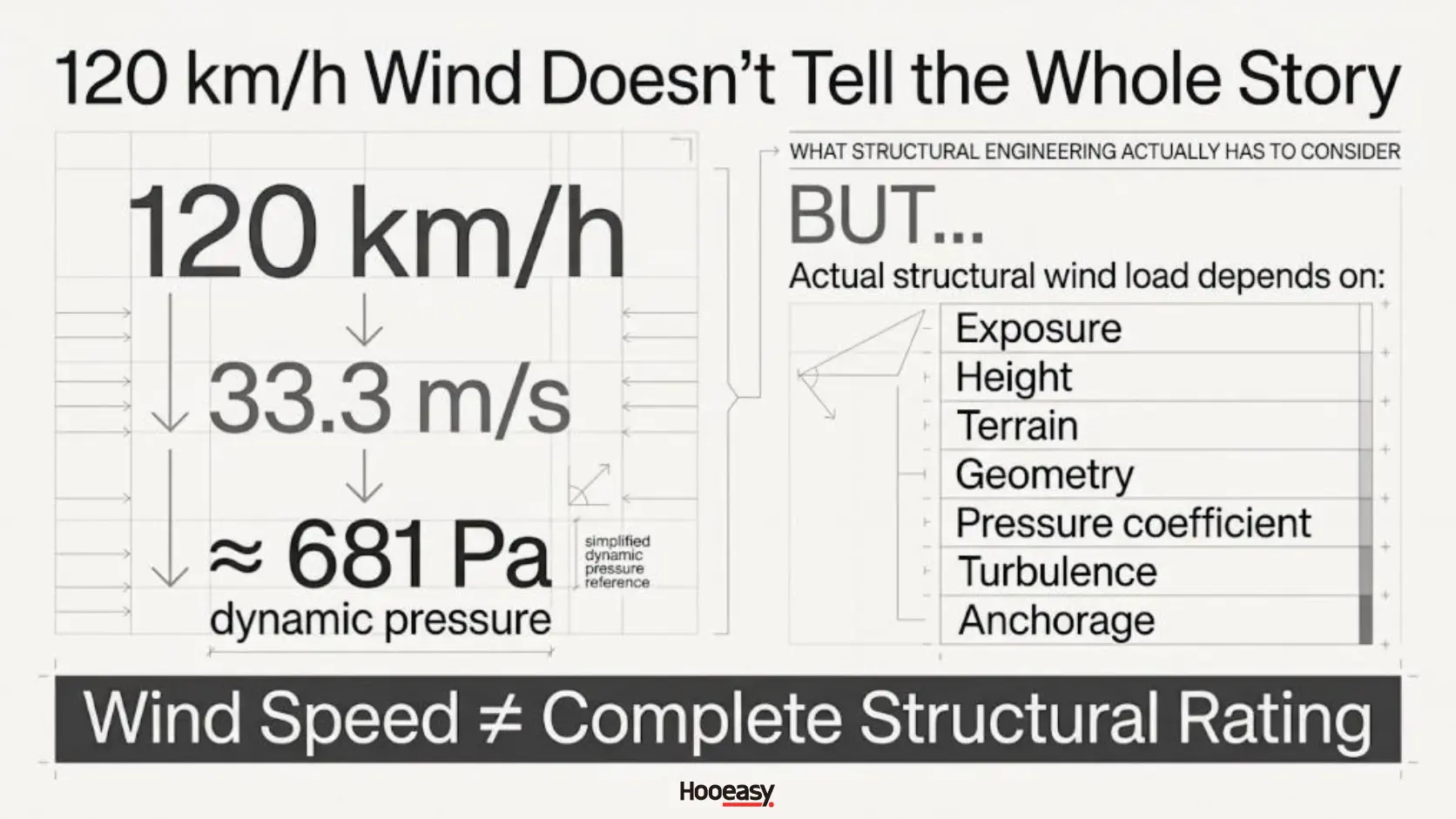
120 km/h equals approximately:
33.3 m/s
At first glance, wind speed appears to be the easiest way to describe wind resistance.
But structures do not “feel” wind speed directly.
They experience wind pressure.
A simplified dynamic-pressure relationship is:
q ≈ 0.613 × V²
where:
q = dynamic wind pressure in N/m²
V = wind speed in m/s
At 120 km/h:
V ≈ 33.3 m/s
Therefore:
q ≈ 0.613 × 33.3² ≈ 681 N/m²
This is a useful engineering reference point — but it should not be interpreted as saying that every pergola exposed to 120 km/h automatically experiences exactly 681 N/m² of design load.
Why?
Because actual structural wind loads depend on factors including:
exposure
terrain
height
building location
geometry
pressure coefficients
turbulence
roof configuration
surrounding structures
local wind codes
This is exactly why professional structural design uses wind-load standards rather than simply converting a headline wind speed into a product rating.
EN 13561 is a European standard covering performance requirements, including safety, for external blinds and awnings. The 2015 edition includes Pergola awnings within its scope.
This makes it highly relevant when evaluating pergola systems.
However, there is an important engineering nuance.
EN 13561 does NOT mean:
“Every pergola certified under EN 13561 can withstand any wind speed.”
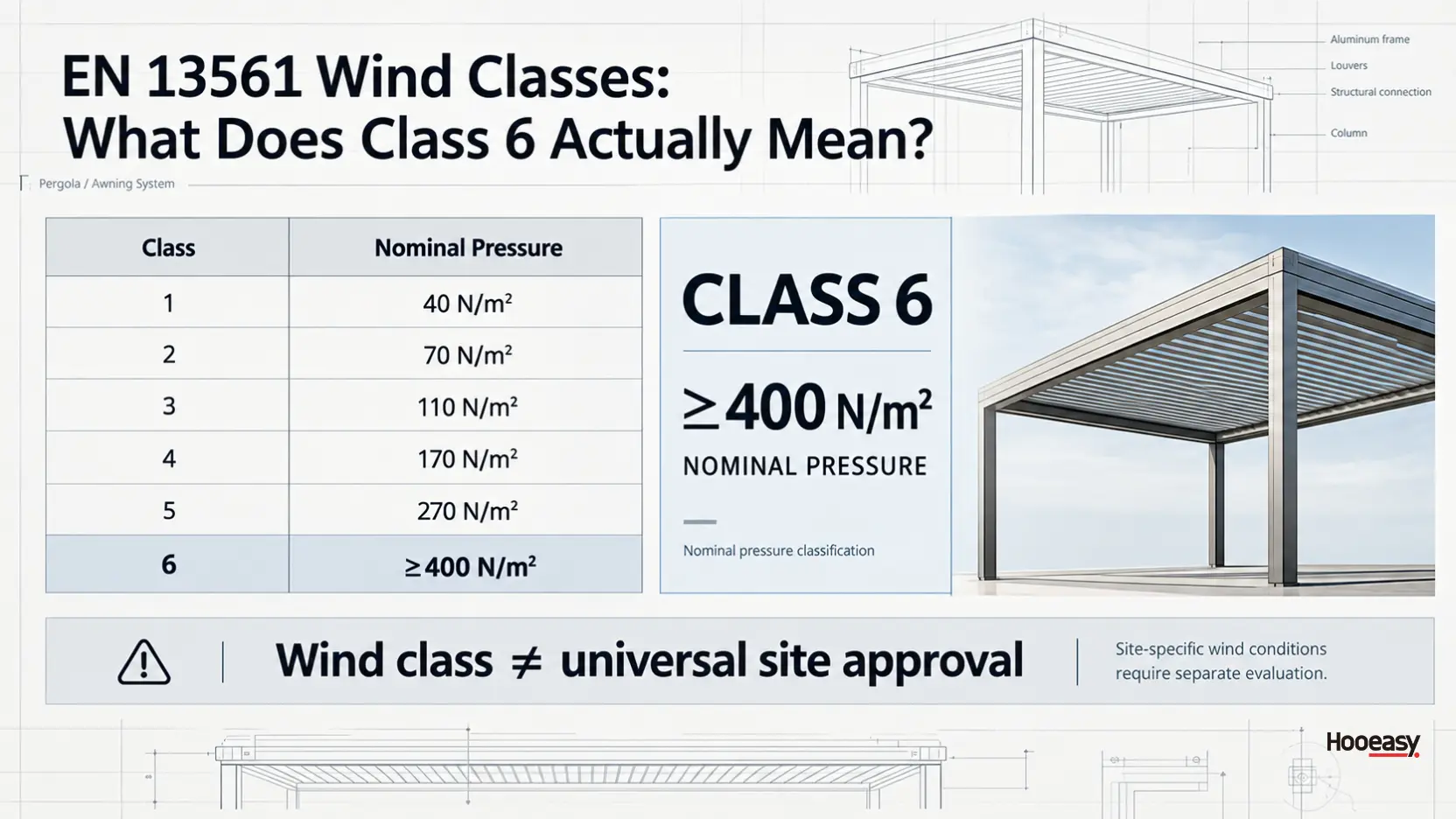
The standard uses wind-resistance classes based on nominal and safety wind pressure.
For the 2015 standard, the wind-resistance classes extend from Class 0 to Class 6, with Class 6 corresponding to a nominal pressure of 400 N/m² or greater and a safety pressure of 480 N/m². Classes 4–6 are permitted for pergola awnings and certain externally guided products.
That is much more meaningful than simply printing:
“120 km/h Wind Resistant.”
5. Why You Shouldn’t Convert EN 13561 Class Directly Into km/h
This is where many online articles oversimplify engineering.
You may see someone write:
“Class X = XX km/h.”
Be careful.
Wind pressure depends on more than velocity alone.
EN 13561 defines performance through pressure values, while actual wind loading on a structure depends on aerodynamic and installation factors.
The European regulatory framework explicitly distinguishes performance classes for pergola awnings by wind-load pressure. Commission Delegated Regulation (EU) 2019/1188 sets out the corresponding pressure ranges for classes 0–6.
For a B2B buyer, this leads to a simple rule:
Ask for the pressure value and test configuration, not only the wind-speed headline.
EN 13561 wind resistance classes and nominal pressure levels for pergola awnings
6. What Does a Real Wind Test Look Like?
A meaningful wind-resistance test is not simply placing a handheld anemometer beside a pergola and waiting for a windy day.
Standardized testing applies controlled loads to the product.
For EN 13561, wind resistance is assessed through the relevant test methodology, including EN 1932. The standard evaluates whether the product maintains its required performance under specified pressure conditions.
A serious test should identify:
1. Test sample
What exact pergola was tested?
For example:
model
dimensions
span
height
louver specification
material
accessories
2. Test configuration
Was it:
freestanding?
wall-mounted?
attached to a specific substrate?
tested with specific anchors?
3. Load condition
What pressure was applied?
4. Performance result
Did the structure:
remain functional?
deform?
experience component failure?
experience connection failure?
5. Test boundaries
What was not covered?
This final question is often ignored.
And it is extremely important.
7. The Biggest Mistake: Confusing Product Testing With Installation Safety
Imagine two pergolas with exactly the same aluminum profile.
Pergola A is installed on:
reinforced concrete + correctly designed anchors
Pergola B is installed on:
thin paving + inadequate fixing
They are not equivalent structures.
The pergola itself may be identical.
The installed structural system is not.
EN 13561 explicitly does not cover the structural part to which a pergola awning is fixed.
That means the following can become critical:
substrate
concrete thickness
anchor type
anchor spacing
edge distance
foundation dimensions
post spacing
wall structure
local building code
This is why professional suppliers should provide installation guidance rather than only a product brochure.
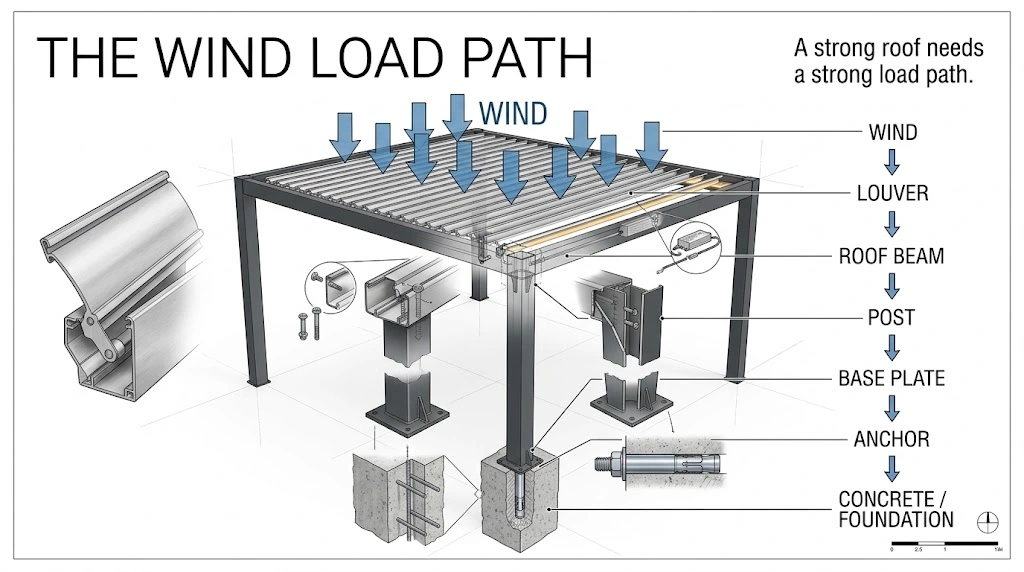
Structural load path showing how wind forces transfer from pergola louvers to anchors and foundation
8. What Makes a Louvered Pergola Stronger?
When comparing suppliers, don’t focus only on the thickness of the aluminum.
A better approach is to evaluate the entire structural system.
8.1 Aluminum Profile Design
Structural performance depends on:
alloy
temper
profile geometry
wall thickness
section modulus
span
connection method
A thicker profile is not automatically better if the overall geometry is poorly designed.
For large pergolas, profile optimization becomes particularly important because longer spans create different structural demands.
8.2 Beam-to-Post Connections
Corners are critical.
Wind loads create forces that travel through:
Roof → Beam → Corner Joint → Post
Weak connection design can compromise the performance of otherwise strong profiles.
B2B buyers should ask:
How are the primary structural connections designed and tested?
8.3 Louver Connection System
The louvers are exposed directly to wind.
Their:
cross-section
pivot mechanism
end connection
bearing points
rotation hardware
all contribute to system performance.
A premium pergola therefore needs more than a visually impressive blade.
It needs a mechanically reliable connection system.
8.4 Base Plates and Anchors
A strong structure still needs a strong connection to the ground.
Ask the supplier:
What anchor type is specified?
What concrete strength is assumed?
What anchor spacing is required?
Is the installation freestanding or wall-mounted?
Is structural engineering required for the foundation?
This is particularly important for:
coastal properties, rooftops, commercial terraces and exposed sites.
9. Does a 120 km/h Wind Rating Mean the Pergola Can Stay Open During a Storm?
Not necessarily.
This is one of the most important consumer safety distinctions.
A manufacturer’s maximum wind specification should always be interpreted together with its:
operating instructions
louver position requirements
weather-control logic
installation conditions
local wind exposure
structural design
A pergola may be structurally engineered for a certain pressure level while the recommended operating condition during severe weather is different.
For motorized systems, an integrated wind sensor can help automatically adjust or close the louvers when wind conditions change.
But:
Automation is not a substitute for structural engineering.
A wind sensor is a control feature.
The frame, louvers, connections and anchors are the structural system.
10. Why Wind Speed Alone Is a Poor Way to Compare Pergola Suppliers
Imagine Supplier A says:
“Wind resistant up to 120 km/h.”
Supplier B says:
“Tested to 400 Pa nominal wind pressure under EN 13561 methodology, with defined model dimensions and installation configuration.”
Which one sounds more technical?
The second statement.
And this is exactly how professional B2B buyers should evaluate outdoor-living suppliers.
Instead of asking:
“How many km/h can it withstand?”
Ask:
“What pressure was tested?”
“According to which standard?”
“Which exact configuration?”
“What were the dimensions?”
“How was it anchored?”
“Can you provide the test report?”
That is the difference between marketing language and procurement-grade technical information.
11. A Practical Wind-Resistance Checklist for Pergola Buyers
If you’re purchasing a pergola for your home, start with these five questions.
Consumer Checklist
1. What is the manufacturer’s maximum wind specification?
Don’t rely only on marketplace listings.
Check the technical documentation.
2. Is the specification based on testing or calculation?
Ideally, you should know which.
3. What louver position does the rating apply to?
Closed, open or another defined configuration?
4. What installation conditions are required?
The same pergola may perform differently depending on the foundation and anchoring.
5. What should I do when severe weather is forecast?
Follow the manufacturer’s operating instructions.
12. B2B Buyer Checklist: What Should You Request From a Pergola Supplier?
For importers, contractors, architects, and private-label brands seeking premium aluminum pergola solutions, the checklist should go further.
Ask the supplier for:
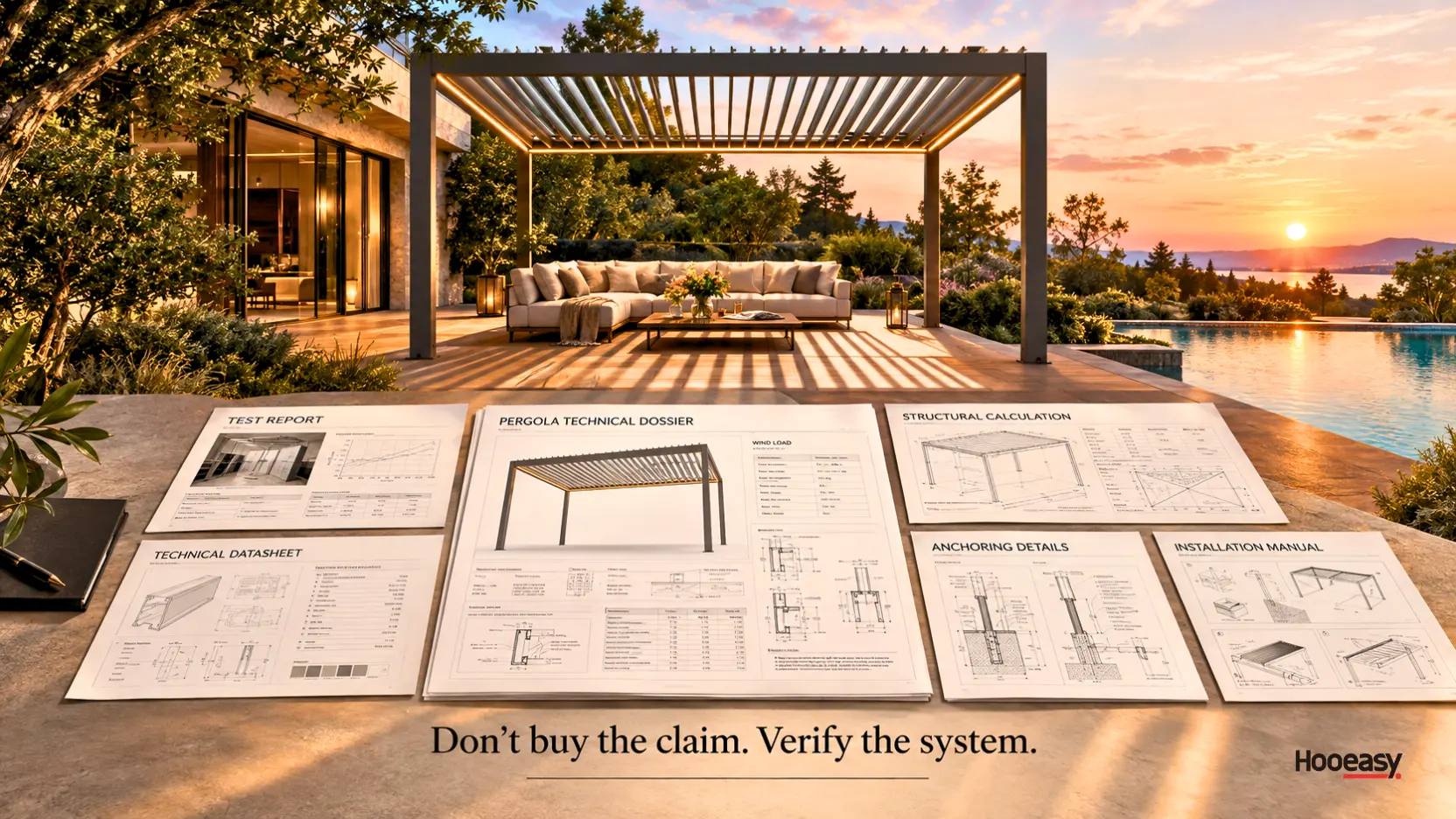
① Technical Datasheet
Including:
profile dimensions
material
dimensions
maximum span
louver specifications
motor system
② Wind-Resistance Test Report
Including:
test standard
pressure
class
tested dimensions
test configuration
test result
③ Structural Calculation
Particularly for:
large spans
commercial projects
rooftop projects
high-exposure locations
④ Installation Manual
Including:
anchor specifications
foundation requirements
fixing details
allowable configurations
⑤ Product Configuration Matrix
This is particularly useful for brands and distributors.
It should clarify:
Which model + size + configuration = which performance level?
B2B pergola supplier technical due diligence checklist for wind resistance
13. What About Coastal Areas?
Coastal projects deserve additional attention.
Wind is not the only issue.
A coastal pergola may also face:
salt exposure
humidity
corrosion
stronger gusts
turbulence
higher exposure
sand and airborne contaminants
Therefore, a “high wind resistance” claim does not automatically mean:
“ideal for every coastal environment.”
B2B buyers should separately evaluate:
Wind performance
Corrosion resistance
Surface treatment
Hardware material
Drainage
Maintenance requirements
This is particularly important for hotels, restaurants, resorts and premium residential developments.
14. What About Snow?
Wind is only one environmental load.
For colder markets, you also need to ask:
What is the pergola’s snow-load design?
Snow can create a fundamentally different loading condition because the load may remain on the roof rather than acting as a short-duration gust.
A pergola designed for a high wind load should therefore not automatically be assumed to have an equivalent snow-load capacity.
For projects in:
Germany
Austria
Switzerland
Northern Europe
Canada
northern United States
snow-load requirements may need to be evaluated separately according to local structural codes.
This is another reason why professional suppliers should provide project-specific engineering support rather than one universal number.
15. Why Large Pergolas Need More Engineering Than Small Residential Pergolas
Consider two pergolas:
Pergola A
3 × 3 m
Pergola B
6 × 6 m
They may use the same aluminum alloy.
But they do not necessarily have the same structural requirements.
As dimensions increase:
spans increase
bending moments change
deflection becomes more important
connection forces increase
foundation requirements can change
wind-exposed area increases
This is why professional B2B suppliers should be able to provide size-specific technical information.
A single “maximum wind speed” displayed on a website is not enough for a large architectural project.
16. The Engineering Truth Behind “120 km/h”
So, can a louvered pergola withstand 120 km/h wind?
The honest engineering answer is:
It depends on the complete system and the specific design conditions.
120 km/h is a useful high-wind reference point.
But it does not independently prove:
structural safety
anchoring safety
suitability for every site
suitability for every pergola size
suitability for every louver position
suitability for every wind direction
compliance with every local building regulation
The more professional question is:
What wind pressure can the complete pergola system resist under a defined test or engineering condition?
That’s the number procurement teams should care about.
is demonstrating a much stronger engineering system than a supplier that simply publishes:
“120 km/h Wind Resistant.”
For private-label brands and distributors, this matters even more.
Your customers may eventually ask:
“What wind speed is this pergola rated for?”
If your supplier cannot provide the technical evidence behind the answer, your brand inherits that risk.
18. Why Hooeasy Takes a System-Level Approach to Pergola Performance
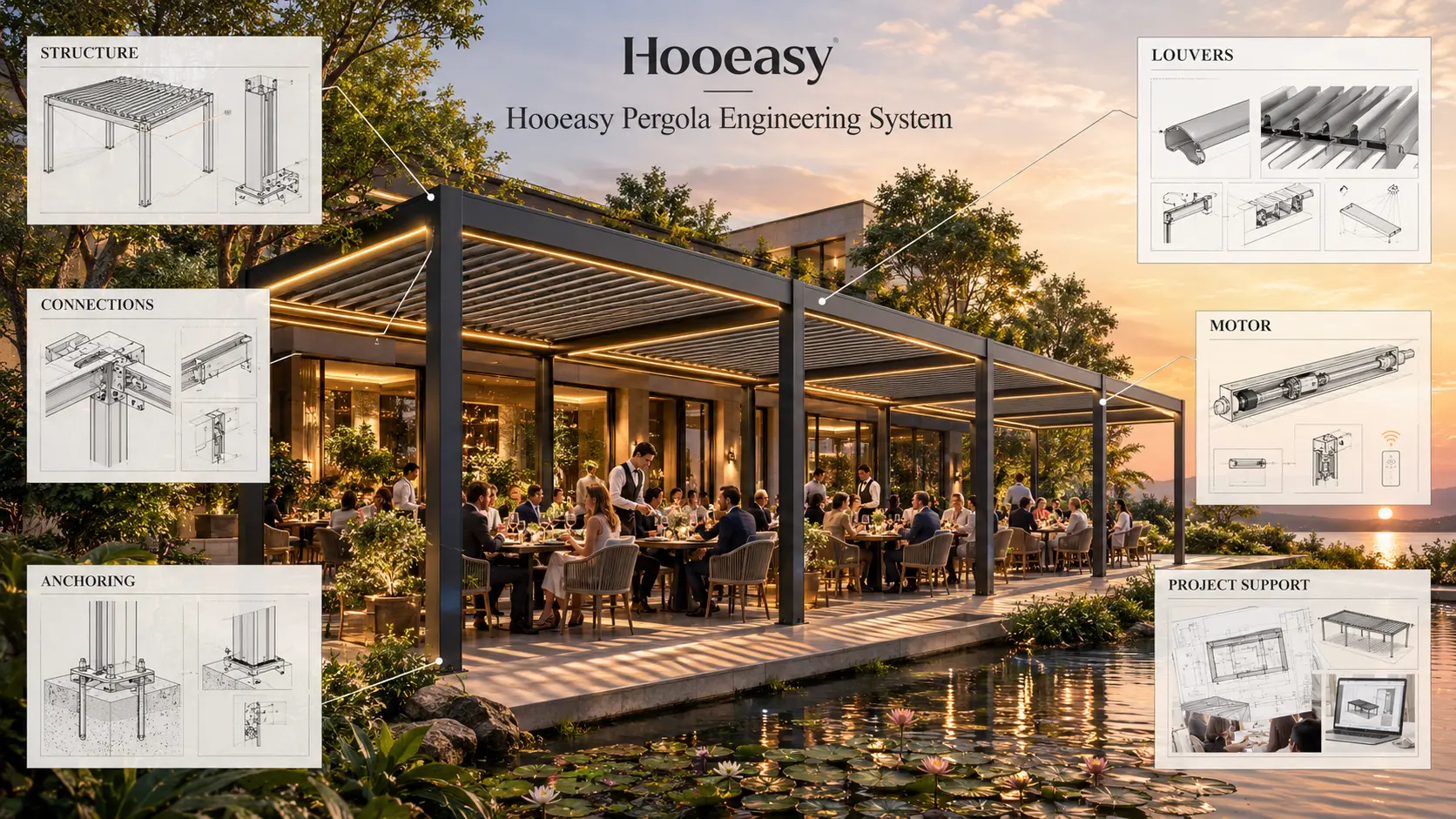
As a professional Hooeasy pergola manufacturer, we believe pergola performance should be understood as more than an aluminum frame.
A professional outdoor-living solution needs to connect:
Structural Design
↓
Material Selection
↓
Louver System
↓
Motor & Control
↓
Connection Design
↓
Anchoring
↓
Installation
↓
Project Conditions
This is particularly important when a pergola moves from a private residential application into:
commercial terraces
restaurants
hotels
resorts
residential developments
architectural projects
distributor portfolios
private-label programs
For B2B customers, the objective is not simply to source a pergola.
It is to source a repeatable, technically supportable outdoor-living system.
Hooeasy louvered pergola engineering system covering structure louvers connections motor anchoring and project support
19. FAQ: Louvered Pergola Wind Resistance
Can a pergola withstand 120 km/h winds?
A properly engineered pergola may be designed and tested for high-wind conditions around 120 km/h, but the actual allowable wind condition depends on the product configuration, wind pressure, installation, anchoring and local structural requirements.
Is 120 km/h the same as 120 km/h wind pressure?
No.
120 km/h is wind speed. Structural design uses wind pressure and other factors to determine actual loads.
What is EN 13561?
EN 13561 is a European standard covering performance and safety requirements for external blinds and awnings, including pergola awnings. It defines wind-resistance performance through pressure-based classes.
Is EN 13561 enough to prove that a pergola is safe?
Not necessarily.
The standard provides a product-performance framework, but the structural part to which a pergola is fixed is outside its scope. Site conditions, foundations, anchors and local structural requirements still matter.
Is Wind Class 6 equivalent to 120 km/h?
It should not be treated as a direct one-to-one conversion.
Wind class is defined by pressure, while actual wind loading depends on multiple engineering factors.
What should I ask a pergola supplier before buying?
Ask for the technical datasheet, applicable wind-resistance test information, tested configuration, structural calculations where relevant, anchoring requirements and installation instructions.
Are larger pergolas more difficult to engineer for wind?
Generally, yes.
Larger spans and greater exposed areas can increase structural demands and make connection, deflection and foundation design more important.
20. The Bottom Line
A pergola that claims:
“120 km/h Wind Resistant”
may sound impressive.
But for a serious buyer, that is only the beginning of the conversation.
The real questions are:
120 km/h under what conditions?
What pressure?
What test standard?
What pergola dimensions?
What louver position?
What anchoring system?
What foundation?
What installation environment?
What engineering calculation supports the claim?
That’s the difference between a wind-resistance number and a credible engineering specification.
For homeowners, this helps you make a safer and more informed purchase.
For architects and contractors, it helps you evaluate project suitability.
For importers, distributors and private-label brands, it gives you a framework for comparing suppliers beyond price.
Because in professional pergola sourcing, the strongest answer isn’t:
“Yes, it can withstand 120 km/h.”
It is:
“Here is the test. Here is the pressure. Here is the configuration. Here is the load path. And here are the installation conditions.”
That is engineering you can actually evaluate.
Want to Source a High-Performance Louvered Pergola?
If you’re a:
Pergola brand
Importer
Building-material distributor
Contractor
Architect
Outdoor-living retailer
Hospitality project developer
and you’re evaluating motorized aluminum louvered pergola suppliers, don’t compare suppliers by product photos alone.
Request the technical specifications, wind-resistance documentation, configuration options and installation requirements for your target market.
Talk to Hooeasy about OEM/ODM louvered pergola solutions and project-specific requirements.