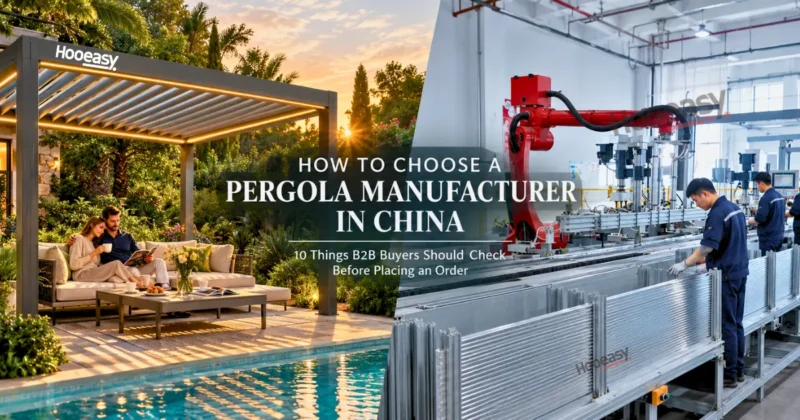
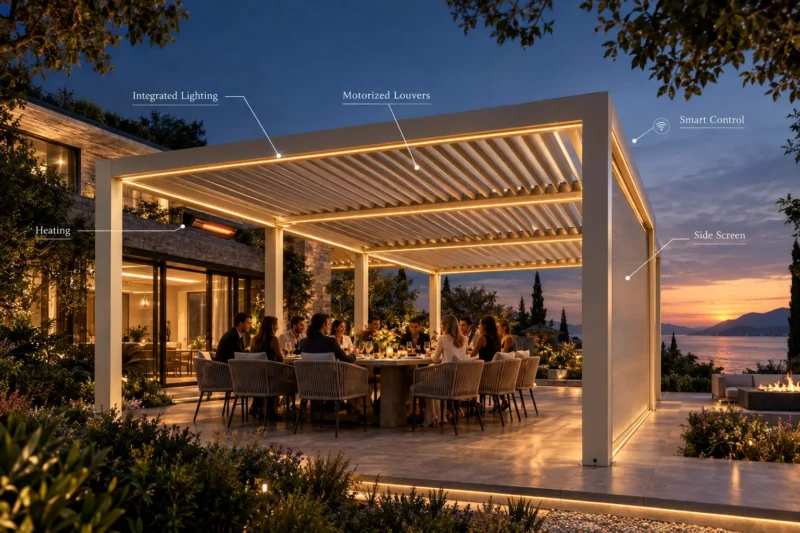
Choosing the right pergola factory is about more than finding a supplier with attractive products and competitive prices. For importers, distributors, contractors, and outdoor-living brands, the right manufacturing partner must deliver consistent quality, reliable production, technical support, and customization at scale.
For importers, distributors, building-material suppliers, contractors, and outdoor-living brands, the right manufacturing partner must be able to deliver consistent quality, reliable production, technical support, and customization at scale.
This is particularly important when sourcing from a pergola factory in China, where suppliers may differ significantly in their manufacturing processes, engineering resources, testing capabilities, and quality-management systems.
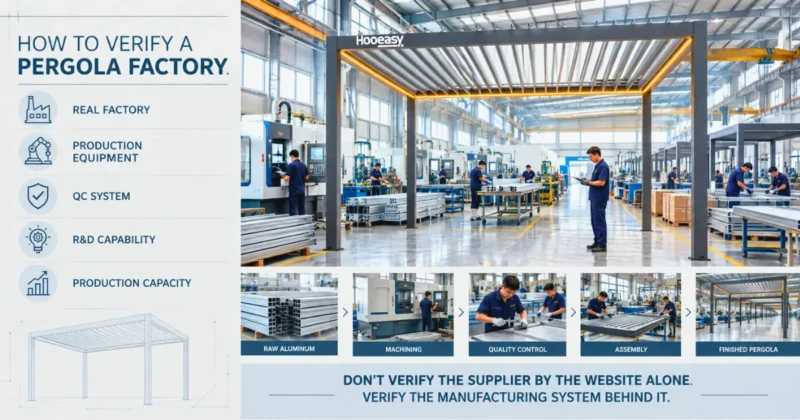
A professional aluminum pergola factory should do more than assemble aluminum components. It should have a structured manufacturing process that connects material processing, surface finishing, engineering, assembly, testing, inspection, and delivery.
So, what makes a good pergola factory?
There are 12 key capabilities B2B buyers should evaluate before choosing a long-term manufacturing partner.
What Is a Pergola Factory?
A pergola factory is a manufacturing facility that produces pergola systems through processes such as material preparation, aluminum profile processing, component fabrication, surface finishing, assembly, quality inspection, and packaging.
Depending on its manufacturing model, a pergola factory may also provide product engineering, OEM/ODM customization, motorized louver integration, performance testing, and technical support.
However, not every supplier performs all these processes in-house.
For B2B buyers, the important question is not simply whether a company sells pergolas. It is which manufacturing capabilities the company controls, how those capabilities are managed, and what evidence supports its claims.
An effective factory evaluation should therefore look beyond the product catalog and examine the complete manufacturing system.
The 12 Factory Capabilities at a Glance
| No. | Factory Capability | What Buyers Should Verify |
|---|---|---|
| 1 | Manufacturing scale | Facility layout and production resources |
| 2 | Aluminum processing | Cutting, drilling, machining and dimensional accuracy |
| 3 | Surface finishing | Powder-coating process and finish consistency |
| 4 | R&D and engineering | Drawings, product development and customization |
| 5 | Component integration | Louvers, motors, controls and accessories |
| 6 | Assembly capability | Fit, alignment and repeatability |
| 7 | Quality control | Incoming, in-process and final inspections |
| 8 | Testing laboratory | Relevant test equipment and documented results |
| 9 | Production planning | Capacity, scheduling and lead-time management |
| 10 | OEM/ODM capability | Product customization and brand support |
| 11 | Packaging and logistics | Product protection and shipment preparation |
| 12 | After-sales support | Spare parts, documentation and technical assistance |
Let’s examine each capability in detail.
1. Manufacturing Scale and Facility Management
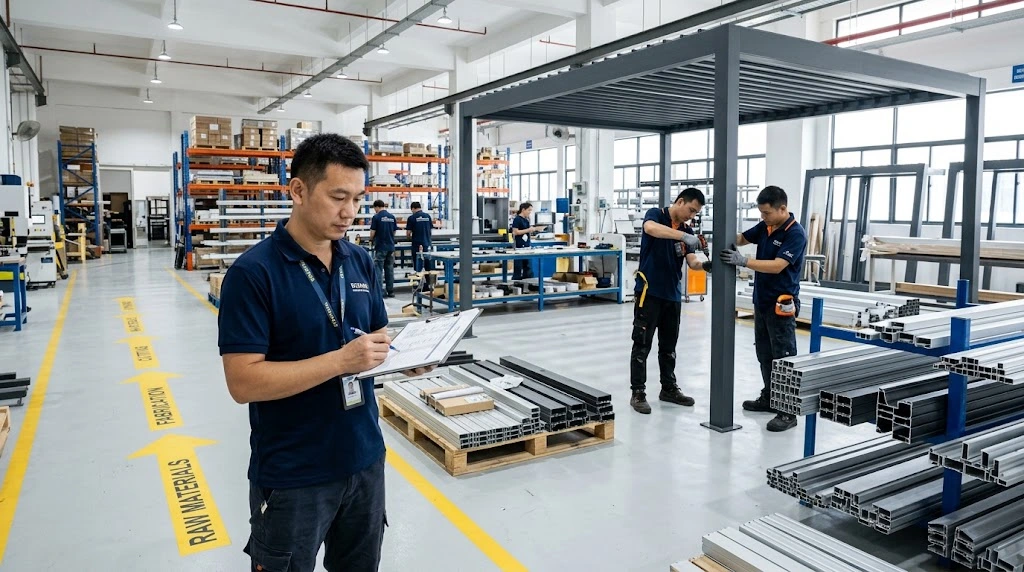
A professional pergola factory needs sufficient space and resources to organize manufacturing efficiently.
However, factory size alone does not guarantee product quality. A large building with poorly organized workflows may be less effective than a smaller facility with disciplined production management.
When evaluating a pergola factory in China, buyers should look at how the facility supports the entire manufacturing process.
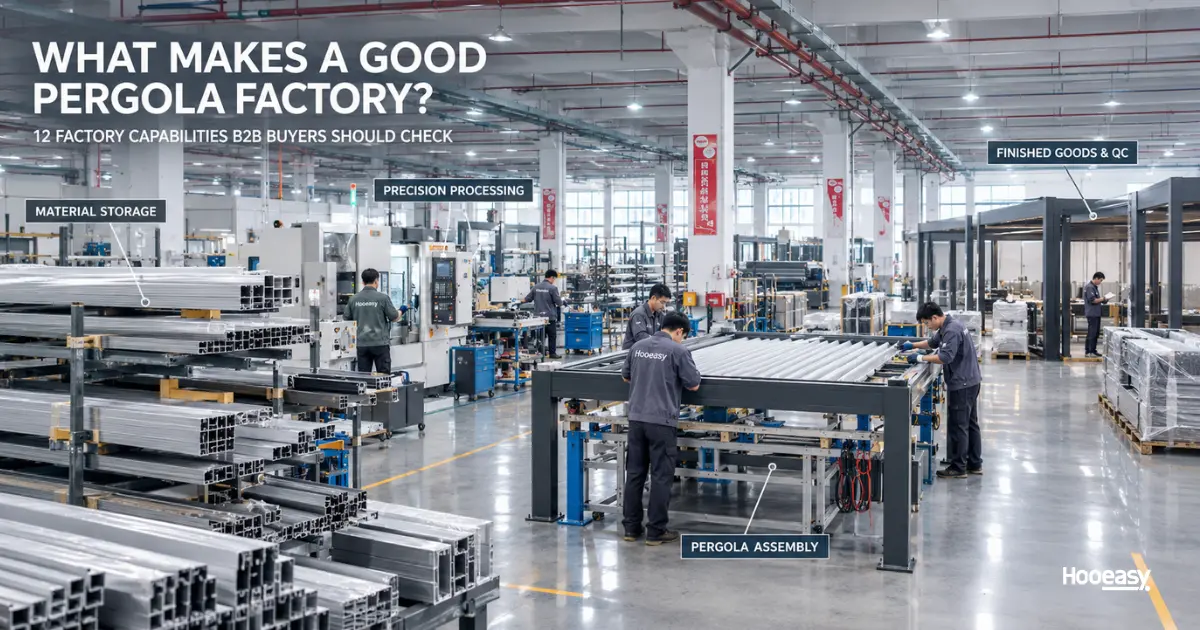
Key areas to examine include:
Raw-material storage
Aluminum processing areas
Component storage
Surface-finishing operations
Assembly workstations
Quality-inspection areas
Finished-goods storage
Packaging and dispatch
A well-organized facility helps reduce unnecessary material movement, improve production visibility, and manage the transition between manufacturing stages.
What should buyers request?
Ask for a factory tour, production-area photographs, a facility overview, and an explanation of how materials move from receiving to finished goods.
For larger orders, a live video tour or independent factory audit can provide additional evidence.
The principle: A factory’s real value is not measured by floor space alone, but by how effectively that space supports consistent manufacturing.
Hooeasy in practice
Hooeasy reports a manufacturing facility covering 152,000 m². This provides a useful starting point for understanding its manufacturing scale, but buyers should evaluate the actual production areas, equipment, workflows, and relevant capacity for their intended product. For more details, you can review Hooeasy’s manufacturing capabilities.
2. Aluminum Processing Capability
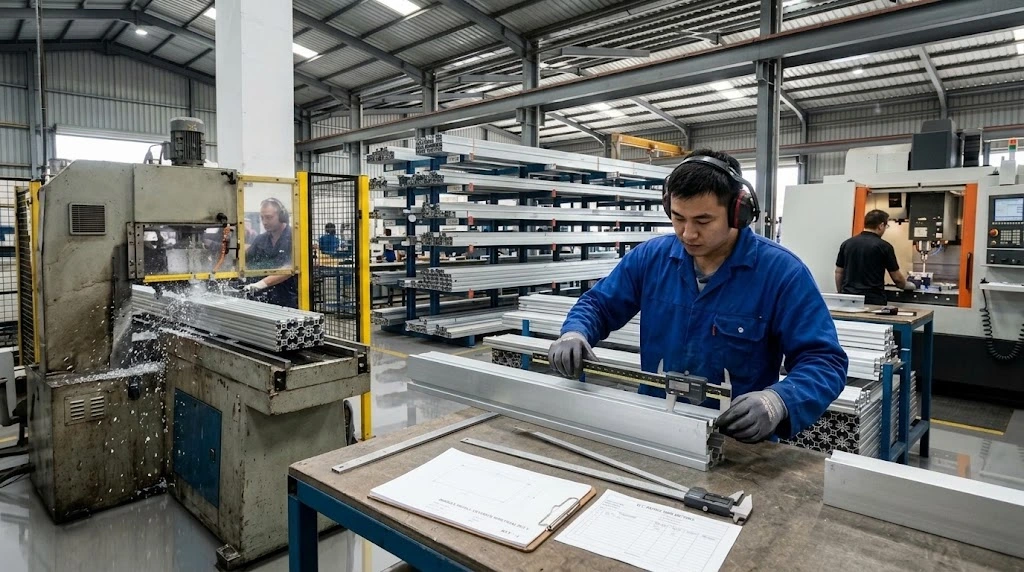
Aluminum processing is one of the fundamental capabilities of an aluminum pergola factory.
The accuracy of the frame, connections, and moving components depends partly on the quality of the underlying processing operations.
Depending on the product design and manufacturing model, these operations may include:
Aluminum profile cutting
Drilling and milling
Precision machining
Hole positioning
Component preparation
Dimensional inspection
Deburring and edge finishing
Processing accuracy affects more than appearance.
It can influence frame alignment, component fit, assembly efficiency, louver movement, and installation requirements.
When evaluating aluminum pergola systems or motorized louvered pergolas, even small dimensional inconsistencies may complicate the alignment of moving components or the installation of motors and accessories.
What should buyers verify?
Ask the factory which aluminum-processing operations are performed in-house and which are outsourced.
Then request evidence such as:
Photographs or videos of relevant machinery
Sample component drawings
Dimensional inspection records
Process-control procedures
Examples of finished aluminum components
Do not assume that every factory owns every machine. The key is to understand how the supplier controls the processes that affect your product.
3. Powder Coating and Surface-Finishing Control
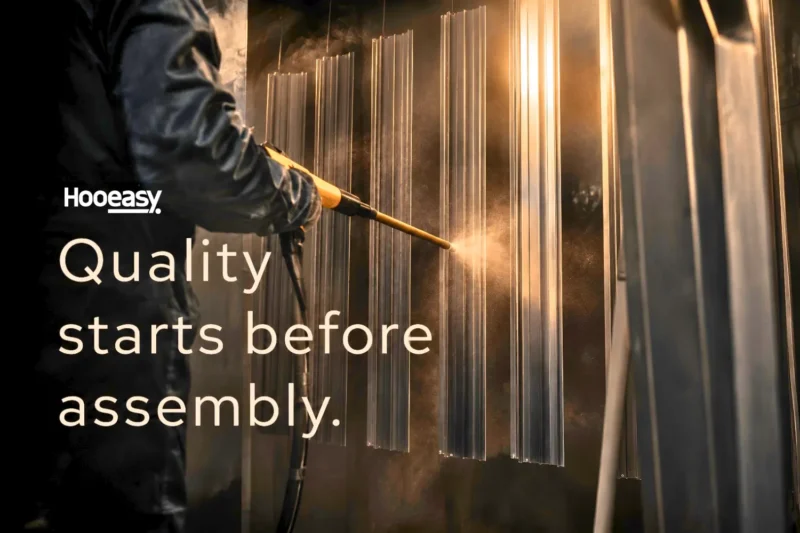
The surface finish of a pergola influences its appearance, durability, and suitability for different outdoor environments.
A professional aluminum pergola factory should be able to explain how surface finishing is managed, whether the process is performed in-house or through a qualified external partner.
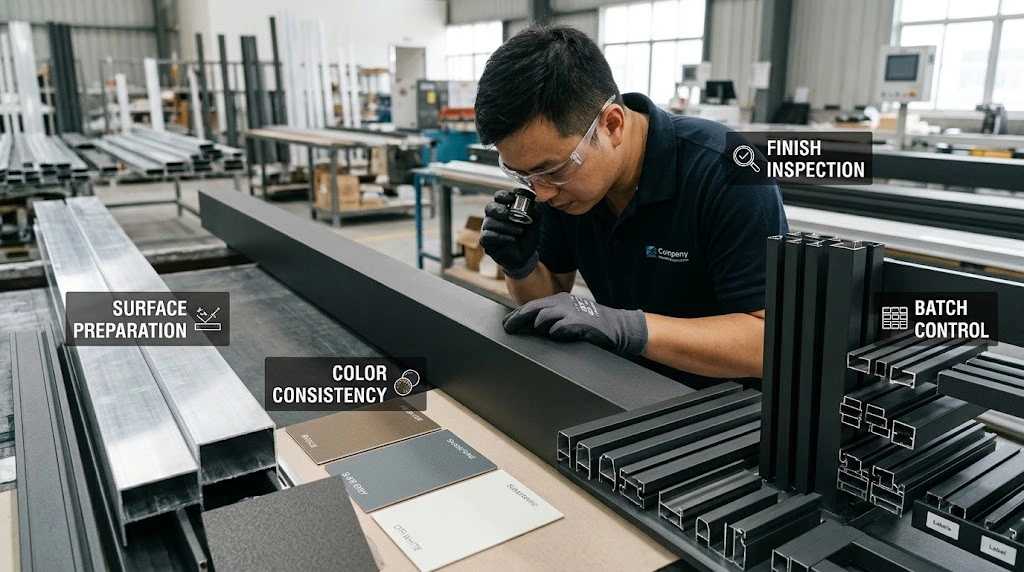
Important considerations include:
Surface preparation
Coating specifications
Color consistency
Coating thickness requirements
Surface appearance
Adhesion and other relevant performance checks
Protection during handling and packaging
Powder coating is particularly relevant for aluminum pergolas because buyers may require consistent colors across multiple units or production batches.
For brands and distributors, inconsistent finishes can create problems when products are displayed together, installed in the same project, or reordered months later.
What should buyers request?
Ask for the agreed finish specification, available color options, sample approval procedures, and applicable coating-inspection records.
If a project has specific corrosion-resistance or environmental requirements, request the relevant test documentation instead of relying on a general claim that a finish is “weatherproof.”
The principle: A premium finish is not simply a color choice. It is a controlled specification that must be reproduced consistently.
4. R&D and Engineering Capability
A pergola factory’s R&D capability determines how effectively it can respond to changing product requirements.
For B2B customers, especially brands, distributors, and project contractors, engineering support can be as important as manufacturing capacity.
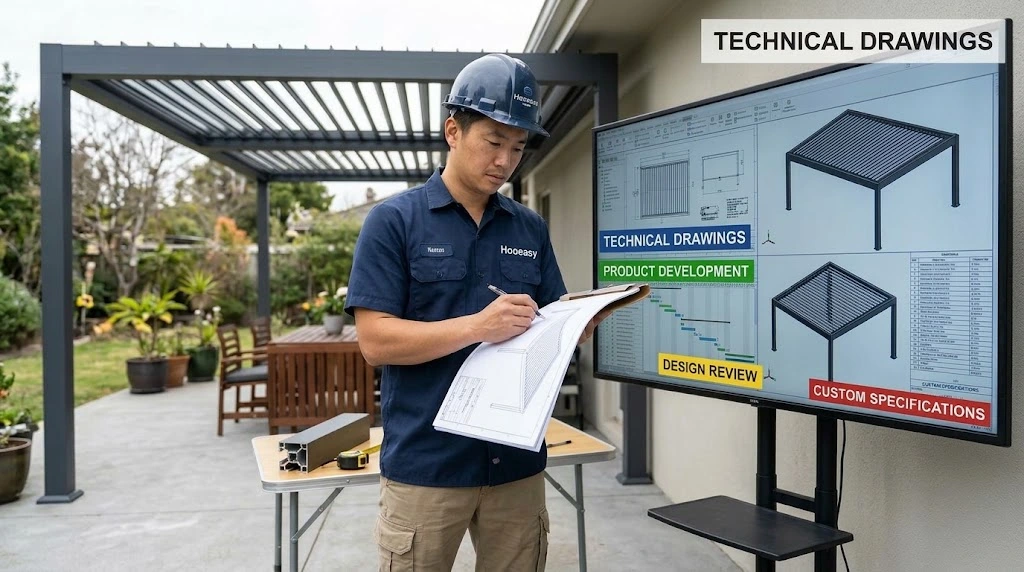
A factory with relevant engineering resources may be better positioned to support:
Product drawings
Dimension adjustments
Component integration
Product configuration
Design modifications
Prototype development
Installation considerations
Technical problem-solving
The actual scope of these services varies between factories, so buyers should ask specific questions rather than relying on the term “R&D.”
For example:
Can the factory modify an existing pergola configuration to fit a project’s dimensions? Can it review component compatibility? Can it provide drawings for approval before production?
These are more useful questions than simply asking whether the supplier has an engineering team.
What should buyers request?
Ask for an anonymized example of a product-development project, a technical drawing, a customization workflow, or a sample approval process.
This helps establish whether the factory can translate a requirement into a manufacturable product during OEM/ODM pergola product development .
5. Component Integration for Motorized Pergola Systems
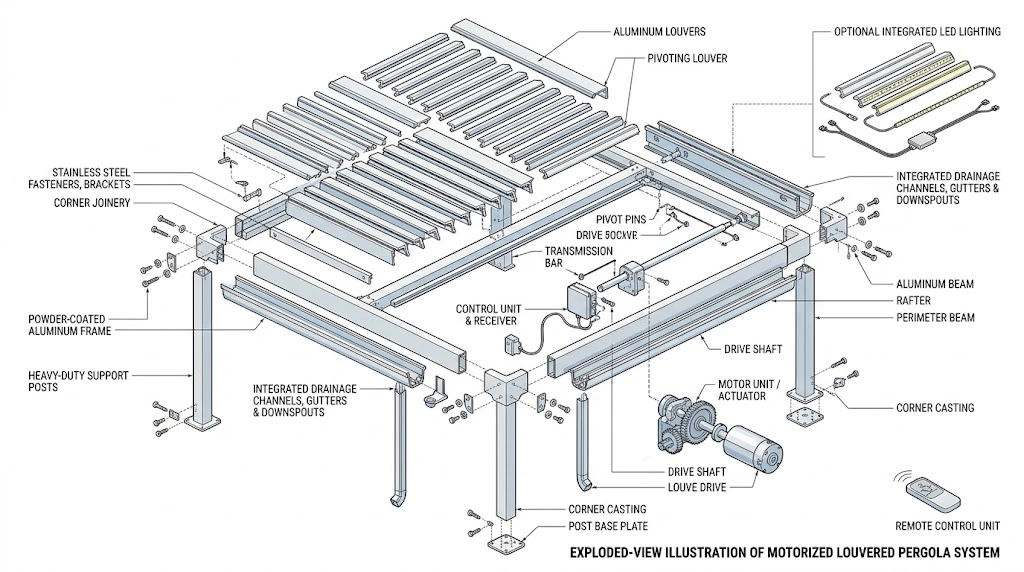
A motorized pergola is a coordinated system rather than a collection of unrelated components.
Depending on the design, it may include aluminum frames, adjustable louvers, motors, control units, wiring, drainage channels, fasteners, lighting, sensors, and accessories.
A professional pergola factory should understand how the relevant components fit together and how their compatibility is verified.
Buyers should pay particular attention to:
Louver alignment and movement
Motor and control-system compatibility
Electrical connections
Drainage integration
Fastener specifications
Accessory compatibility
Maintenance and replacement requirements
A supplier may purchase motors or other components from specialist manufacturers. This is not inherently a weakness.
What matters is whether the factory can specify, integrate, inspect, and support the complete system.
What should buyers request?
Ask for the bill of materials or an equivalent component specification, relevant technical documentation, functional-test procedures, and information about replacement parts.
For projects requiring smart controls, clarify compatibility with the intended control platform before production begins.
6. Assembly Capability and Manufacturing Consistency
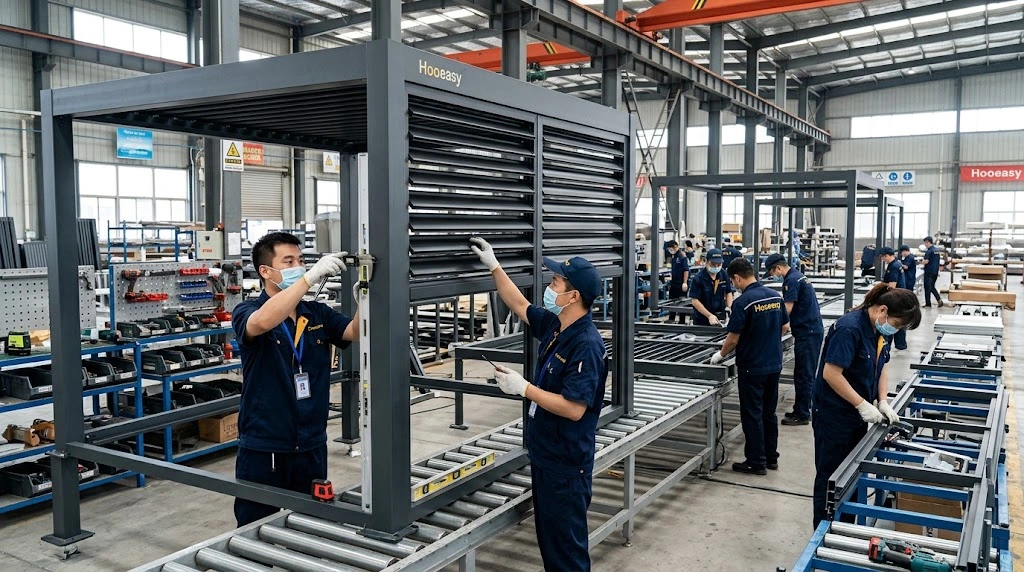
A factory may have good materials and suitable processing equipment but still struggle to deliver a consistent finished product if its assembly process is poorly controlled.
Pergola assembly requires components to fit together according to the intended design and specifications.
Relevant checks may include:
Frame alignment
Connection accuracy
Louver positioning
Motor installation
Fastener installation
Drainage connections
Accessory fit
Final dimensional checks
For B2B buyers, assembly consistency matters because differences between units can create installation delays, additional labor, and customer complaints.
This is particularly relevant when an importer or distributor purchases the same model repeatedly.
The first shipment may establish the specification, but subsequent production runs must maintain it.
What should buyers request?
Ask for assembly instructions, inspection checkpoints, sample units, and evidence of how nonconforming components are identified and corrected.
For a new product, request an approved pre-production sample and confirm that the bulk order will follow the same agreed specifications.
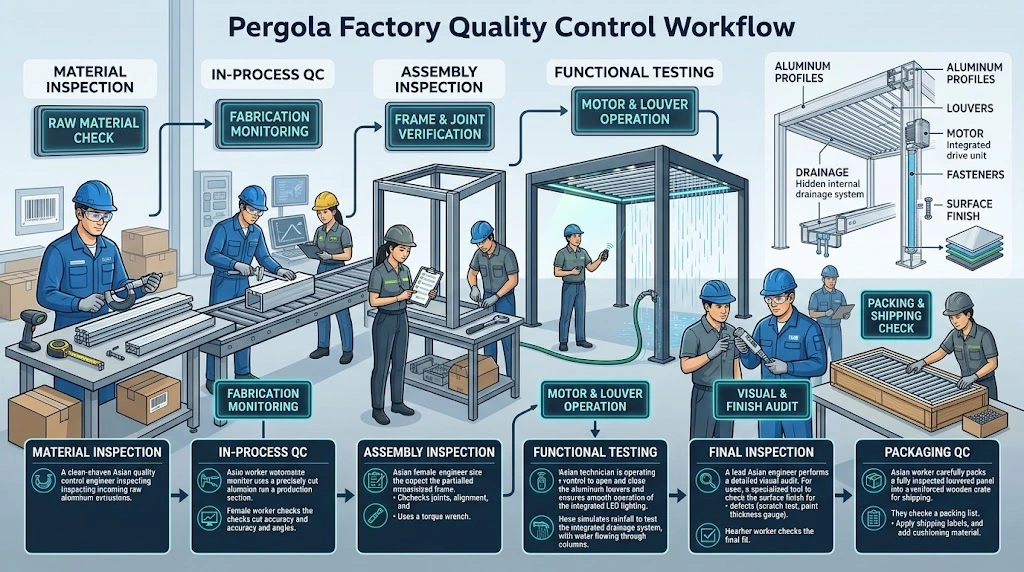
7. A Structured Quality-Control System
Quality control should not begin only when the pergola is finished.
A professional factory needs defined inspection points throughout the manufacturing process.
A typical quality-control framework may include six stages.
01
Incoming Material Inspection
Check incoming materials and components against agreed specifications.
02
In-Process Inspection
Monitor machining accuracy, component dimensions and finishing quality.
03
Assembly Inspection
Verify fit, alignment, connections and installation of components.
04
Functional Testing
Check relevant motorized and mechanical functions.
05
Final Inspection
Inspect the completed unit against approved product and order requirements.
06
Packaging Inspection
Confirm product protection, accessories, labels and packaging specifications.
The specific checkpoints will depend on the product, manufacturing model, and customer requirements. Buyers should verify which inspections the factory actually performs.
What should buyers request?
Quality-control procedures
Inspection checklists
Sample inspection records
Nonconformance-handling procedures
Final inspection reports
Traceability information where applicable
A supplier’s statement that it has a QC department is not sufficient by itself. The buyer should understand what the team checks and how inspection results are documented.
The principle: Quality is not a final checkpoint. It is a manufacturing discipline.
8. Testing Laboratory and Product-Performance Verification
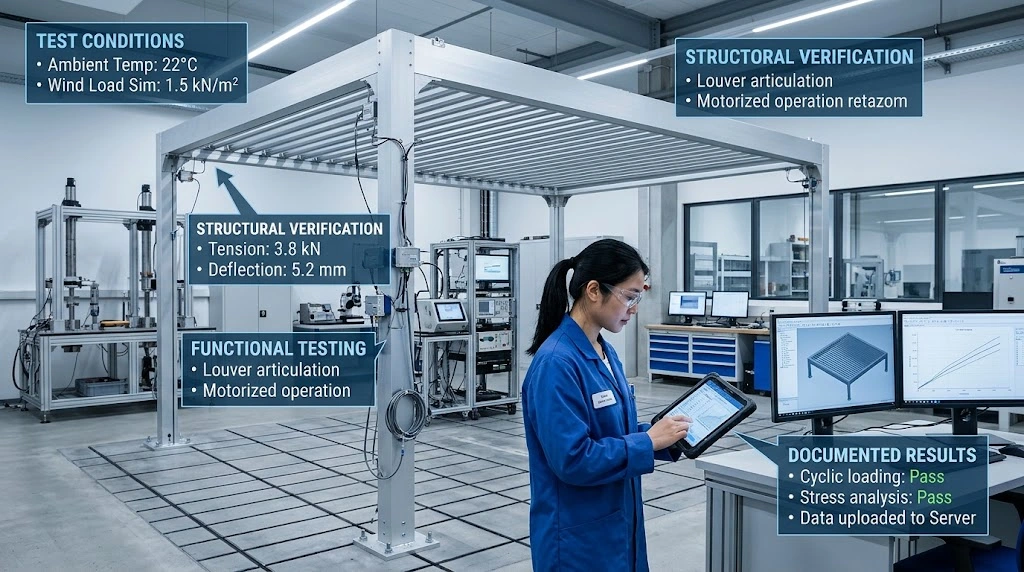
Testing capabilities help a manufacturer evaluate whether a pergola meets defined performance requirements.
For B2B buyers, this is especially important when the product will be sold into markets with specific structural, weather, or electrical requirements.
Depending on the design, applicable testing may cover:
Structural performance
Relevant structural tests or engineering assessments based on the product design and intended installation.
Wind resistance
Verification under defined test conditions, including the applicable configuration, anchoring arrangement, and test method.
Rain and drainage performance
Evaluation of water management, drainage paths, and leakage under specified test conditions.
Motor and electrical functions
Functional testing and applicable electrical-safety documentation for motorized systems.
A testing laboratory can support product development and internal quality checks. However, an internal test is not automatically equivalent to independent certification or third-party laboratory testing.
Buyers should distinguish between the two.
What should buyers request?
Ask for the relevant test report, test conditions, tested model, applicable standard, and issuing organization where relevant.
Confirm that the evidence applies to the actual product configuration being purchased.
Hooeasy in practice
Hooeasy reports having a testing laboratory supporting its awning and pergola products. Buyers evaluating a specific pergola should request the relevant testing information and verify the scope of the reported results, particularly regarding pergola testing and quality verification.
9. Production Planning and Capacity Management
Production capacity is not simply the maximum number of units a factory claims it can produce.
For a B2B buyer, the more important question is whether the manufacturer can meet the required quantity, specifications, and delivery schedule consistently.
A factory’s effective capacity depends on several factors:
Available equipment
Production-line organization
Labor and technical resources
Component availability
Product complexity
Changeover time
Quality requirements
Existing order commitments
Seasonal demand
For example, a factory may have sufficient overall capacity but still need additional time for a highly customized order involving special dimensions, colors, motors, or packaging.
Therefore, buyers should distinguish between theoretical maximum capacity and the production capacity available for their specific order.
What should buyers request?
Ask for:
Typical lead time
MOQ
Production schedule
Capacity assumptions
Peak-season planning
Material procurement arrangements
Procedures for managing production delays
For repeat orders, also discuss how specifications and production records are maintained between batches.
Hooeasy in practice
Hooeasy reports a pergola production capacity of up to 10,000 sets per month. Buyers should confirm the relevant model, product mix, customization level, and available production schedule when evaluating a specific project.
This is more useful than treating a maximum capacity figure as a guarantee for every order.
10. OEM/ODM Customization Capability
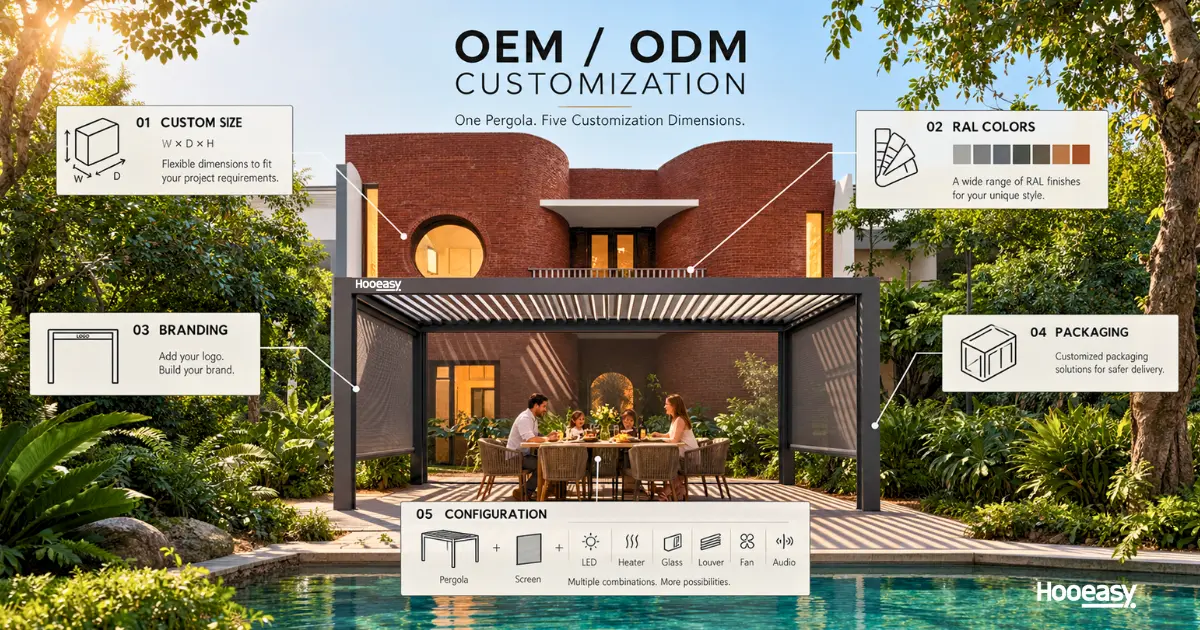
For outdoor-living brands and distributors, product customization can be a major reason to choose a manufacturing partner.
However, OEM/ODM capabilities vary considerably between suppliers.
Some factories may offer branding and packaging changes, while others may also support product configuration, engineering changes, and development work.
Buyers should clarify which level of customization is available.
| Customization Level | Examples |
|---|---|
| Branding | Logo, labels and packaging |
| Appearance | RAL colors and surface finishes |
| Configuration | Motor, lighting and accessory options |
| Dimensions | Product sizing within supported design limits |
| Engineering | Technical modifications and design development |
| Product development | Prototypes and customized specifications |
Not every modification is technically feasible or commercially practical. Structural changes may require engineering review, additional testing, new tooling, or minimum order quantities.
A capable OEM/ODM partner should explain these trade-offs clearly.
What should buyers request?
Ask for a customization matrix, sample approval process, technical drawings, tooling requirements where applicable, and a clear statement of which specifications can be modified.
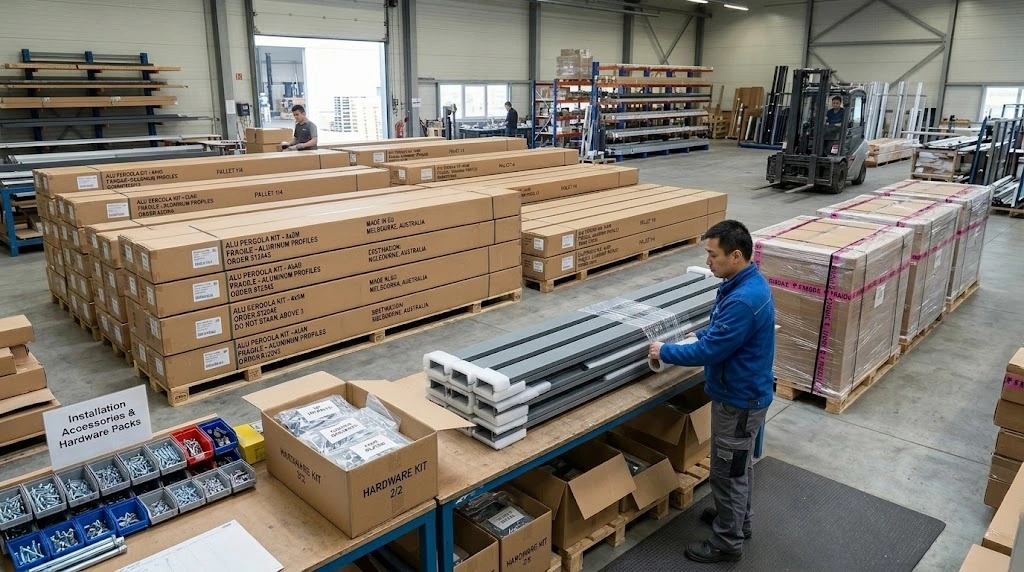
11. Packaging and Export Logistics
Even a well-manufactured pergola can arrive damaged if packaging and shipment preparation are inadequate.
Packaging is therefore part of product quality, not simply the final step before delivery.
A professional pergola factory should understand the requirements of transporting long aluminum profiles, finished surfaces, mechanical components, motors, accessories, and installation hardware.
Buyers should evaluate:
Protection of coated surfaces
Protection of corners and edges
Separation of components
Hardware identification
Accessory completeness
Carton or package labeling
Loading arrangements
Packing-list accuracy
Destination-market packaging requirements
For private-label customers, packaging may also need to meet specific branding, labeling, and retail requirements.
What should buyers request?
Ask for packaging photographs, packaging specifications, a sample packing list, and confirmation of how components are identified and protected.
For major orders, agree on the packaging standard and inspection requirements before production begins.
12. After-Sales Support and Spare-Parts Management
A manufacturing partnership does not end when the order leaves the factory.
For distributors, contractors, and outdoor-living brands, the ability to obtain replacement parts and technical information can affect long-term customer satisfaction.
This is especially relevant for motorized pergola systems, which may contain moving components, motors, control units, and accessories.
Before placing an order, buyers should clarify:
Warranty coverage
Spare-motor availability
Replacement louver availability
Component identification
Installation documentation
Troubleshooting guidance
Technical support arrangements
Lead times for replacement parts
Procedures for handling product issues
These details should be discussed before the commercial agreement is finalized.
What should buyers request?
Ask for written warranty terms, a spare-parts policy, installation manuals, technical documentation, and the process for submitting a claim.
A strong manufacturing partner should make the responsibilities and support arrangements clear rather than leaving them undefined until a problem occurs.
The principle: A product is only part of the customer relationship. Support determines how well that product can be maintained over time.
How to Evaluate a Pergola Factory in China: A Practical Buyer Scorecard
The 12 capabilities above can be turned into a supplier-evaluation framework.
Use the following scorecard to compare shortlisted factories.
Pergola Factory Evaluation Checklist
Mark each capability after reviewing the relevant evidence. A checked item means the evidence has been reviewed, not merely promised.
Evidence reviewed
0/12
1. Manufacturing scale
Factory layout, production areas and resources
2. Aluminum processing
Relevant machinery, dimensional checks and process control
3. Surface finishing
Finish specifications and quality records
4. R&D and engineering
Technical drawings and customization workflow
5. Component integration
Component specifications and compatibility checks
6. Assembly
Assembly procedures and fit checks
7. Quality control
Inspection procedures and records
8. Testing
Relevant reports and documented test conditions
9. Production planning
Capacity assumptions and lead-time commitments
10. OEM/ODM
Customization scope and sample approval
11. Packaging and logistics
Packaging specification and packing records
12. After-sales
Warranty, spare parts and technical support
A checklist does not replace a factory audit, but it helps buyers ask more specific questions and compare suppliers on a consistent basis.
For major purchases, combine the scorecard with sample evaluation, document verification, a factory visit or third-party inspection, and clear contractual specifications.
How Hooeasy Approaches Pergola Manufacturing
A useful way to evaluate a manufacturing partner is to compare its publicly stated capabilities with the evidence available for the actual product and order.
Hooeasy reports a 152,000 m² manufacturing facility, pergola production capacity of up to 10,000 sets per month, R&D resources, and a testing laboratory supporting its product range.
These are relevant starting points for B2B buyers evaluating Hooeasy as a potential aluminum pergola manufacturing partner. To learn more about Hooeasy’s pergola manufacturing capabilities, buyers can refer to the official company page.
However, different buyers will have different priorities. A distributor may focus on repeat-order consistency and spare parts, while a contractor may prioritize engineering requirements, installation documentation, and performance evidence. A private-label brand may place greater emphasis on OEM/ODM flexibility, packaging, and product differentiation.
The most useful next step is to evaluate the capabilities that matter to your project.
Ask for the relevant technical specifications, confirm the manufacturing scope, review the applicable quality and testing documents, and clarify production schedules before placing an order.
A good pergola factory does not simply offer a product. It provides a manufacturing system that can support the buyer’s requirements. You can discuss your pergola manufacturing requirements with Hooeasy to get started.
Frequently Asked Questions About Pergola Factories
What makes a good pergola factory?
A good pergola factory has relevant manufacturing capabilities, controlled aluminum processing, consistent surface finishing, engineering support, structured quality control, appropriate testing, reliable production planning, and clear after-sales arrangements. Buyers should verify these capabilities with documentation and product-specific evidence.
What should I check when choosing a pergola factory in China?
Check the factory’s manufacturing scope, equipment, processing and finishing capabilities, R&D resources, assembly processes, quality-control system, testing documentation, production capacity, OEM/ODM services, packaging, and after-sales support.
What equipment should an aluminum pergola factory have?
The required equipment depends on which processes the factory performs in-house. Relevant equipment may include aluminum cutting and machining machinery, drilling equipment, measurement instruments, assembly fixtures, and inspection or testing equipment. Surface finishing may be handled in-house or by a qualified external provider.
Why is powder coating important for an aluminum pergola?
Powder coating affects the appearance and surface protection of aluminum components. Buyers should verify the coating specification, color consistency, applicable inspection procedures, and any relevant performance tests required for the intended application.
Why does a pergola factory need R&D capability?
R&D and engineering resources can help a manufacturer develop products, review technical requirements, prepare drawings, evaluate customization requests, and resolve product-design issues. Buyers should verify the actual scope of the factory’s engineering services.
How can I verify the quality control of a pergola factory?
Ask for the factory’s inspection procedures and examples of relevant records. Verify how incoming materials, in-process operations, assembly, functional performance, final products, and packaging are checked against agreed specifications.
What is the difference between production capacity and available capacity?
Production capacity describes what a factory can produce under defined conditions. Available capacity depends on current orders, product complexity, component availability, customization, and the requested delivery schedule. Buyers should confirm capacity for the actual product and order rather than relying only on a maximum monthly figure.
Is a large pergola factory always better?
No. Facility size can indicate manufacturing scale, but it does not independently prove quality or reliability. Buyers should evaluate the factory’s processes, equipment, inspection records, engineering support, relevant testing, and ability to meet the order requirements.
Conclusion: Look Beyond the Factory Size
A professional pergola factory is not defined by one impressive number, one machine, or one certification.
Its real value comes from how manufacturing capabilities work together.
Aluminum processing supports dimensional accuracy. Surface-finishing control supports consistent appearance. Engineering helps translate requirements into workable designs. Assembly and QC support repeatability. Testing provides evidence against defined performance requirements. Production planning and after-sales support help sustain the commercial relationship.
For B2B buyers, the goal is not to find the factory with the longest list of claims.
It is to identify the manufacturer whose verified capabilities match the products, specifications, volumes, and support requirements of the business.
Before choosing a pergola factory in China, ask what it can manufacture, how it controls quality, what evidence it can provide, and how it will support your business after delivery.
Because in manufacturing, a product is the result you see.
The factory’s capabilities are the system that makes that result repeatable.