
Introduction: 2026 Marks a Turning Point for Outdoor Living
Outdoor living is no longer simply about placing a few chairs and a table in the garden. In 2026, homeowners, architects, hospitality developers, and commercial property owners are increasingly treating outdoor space as an extension of the building itself.
That shift is changing what buyers expect from pergolas.
For years, the traditional pergola primarily served three purposes: providing shade, improving the appearance of a garden, and creating additional outdoor space. Those functions remain important, but they are no longer enough for premium residential and commercial projects.
Today, customers want outdoor spaces that can be used more frequently, adapt to changing weather, integrate with smart-home habits, and visually connect with the architecture of the building.
This is where the motorized louvered pergola 2026 concept becomes particularly important.
The modern pergola is evolving from a simple garden structure into a flexible architectural system. Adjustable louvers can respond to sunlight, rain, and changing outdoor conditions, while integrated lighting, screens, sensors, and automation can make the space feel much closer to an indoor room.
Current design coverage also points toward this evolution. 2026 pergola trend coverage highlights the growing importance of versatile shelters, multifunctional outdoor rooms, and louvered structures designed for greater all-weather usability.
For brands, importers, and contractors, the implication is clear: the opportunity is no longer simply to sell a structure that provides shade. It is to offer a complete outdoor living solution.
The motorized louvered pergola is no longer viewed as a luxury upgrade. It is increasingly becoming the expected standard for modern outdoor living.
-.webp "2026 Outdoor Living Trend: Why Motorized Louvered Pergolas Are the New Standard 1")
From Garden Feature to Outdoor Room
The biggest change in pergola design is not simply the motor. It is the transformation of the pergola from an outdoor accessory into an architectural space.
1. Outdoor Living Is Now Part of Home Design
Modern outdoor spaces increasingly include outdoor kitchens, dining areas, lounge zones, swimming-pool terraces, entertainment areas, and hospitality spaces.
Instead of asking, “Where can we put a pergola?”, designers are increasingly asking, “How should the outdoor room function?”
This distinction matters.
A pergola positioned as a decorative garden feature has relatively limited expectations. A pergola positioned as an outdoor room needs to provide shade, comfort, weather adaptability, lighting, privacy, and visual integration with the building.
That is why the modern pergola increasingly needs to work as part of the overall architectural composition.
For readers who are still comparing different outdoor structures, a useful starting point is this guide to understanding the difference between a pergola and a gazebo. It helps clarify why pergolas have developed into such flexible architectural structures.
The broader outdoor living trend is also moving toward spaces that feel like natural extensions of the home rather than separate garden areas. This is particularly visible in premium residential projects where indoor and outdoor materials, furniture, lighting, and architectural lines are designed as one visual language.
2. Weather Flexibility Matters
Traditional open pergolas provide shade but cannot always respond to rapidly changing weather.
A fixed roof can block sunlight and rain, but it sacrifices flexibility. An entirely open pergola provides ventilation and sunlight, but offers limited protection when weather changes.
Adjustable louvers create a third option.
The roof can move between open, tilted, and closed positions, allowing the same structure to respond to different conditions.
| Weather Condition | Recommended Louver Position |
| Sunny | Fully Open |
| Hot Afternoon | Tilted for Shade |
| Light Rain | Closed |
| Evening | Partially Open |
This simple capability changes the commercial value of the structure.
Instead of selling one fixed solution, manufacturers can offer a system that adapts throughout the day.
3. Design Expectations Have Changed
Technology alone does not define the 2026 pergola.
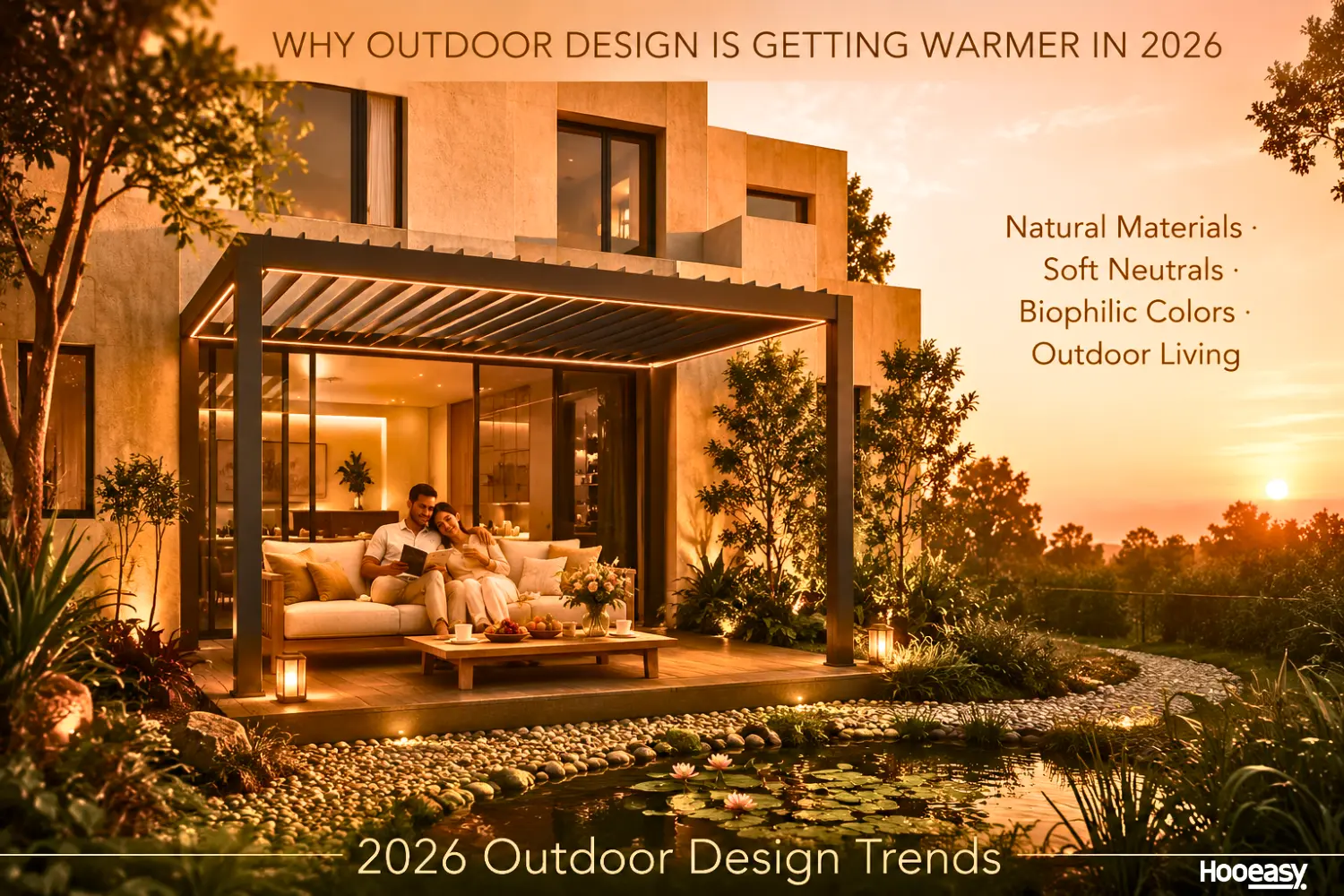
A major part of the current design movement is the rise of warm minimalism outdoor design.
Instead of overly decorative outdoor spaces, designers are increasingly using restrained architectural forms, neutral colors, natural textures, and carefully integrated lighting.
Think warm gray aluminum, beige stone, natural wood furniture, cream-colored cushions, soft landscaping, and subtle warm-white lighting.
The pergola itself should feel architectural rather than visually heavy.
Why Motorized Louvered Pergolas Are Becoming the 2026 Standard
The strongest argument for the modern pergola is simple: one structure can perform multiple functions.
A motorized louvered system combines architectural shading, ventilation, weather protection, and automation into one coordinated product.
One Structure, Multiple Weather Conditions
The traditional choice was often between an open pergola and a fixed roof.
The modern alternative is an adjustable roof system.
During a bright morning, louvers can remain open to bring natural light into the space. During a hot afternoon, they can tilt to reduce direct solar exposure while maintaining airflow. When rain arrives, they can close to create a more protected environment.
In the evening, the louvers can be partially opened while integrated lighting creates a more intimate atmosphere.
This flexibility is especially valuable for restaurants, hotels, resorts, private villas, rooftop terraces, and other spaces where usable outdoor area directly contributes to customer experience.
In other words:
One structure replaces the limitations of fixed roofs and completely open pergolas.
That is one of the reasons the motorized louvered pergola 2026 is increasingly being positioned as a complete outdoor architectural system rather than a premium accessory.
Smart Control Is No Longer Optional
The next major development is automation.
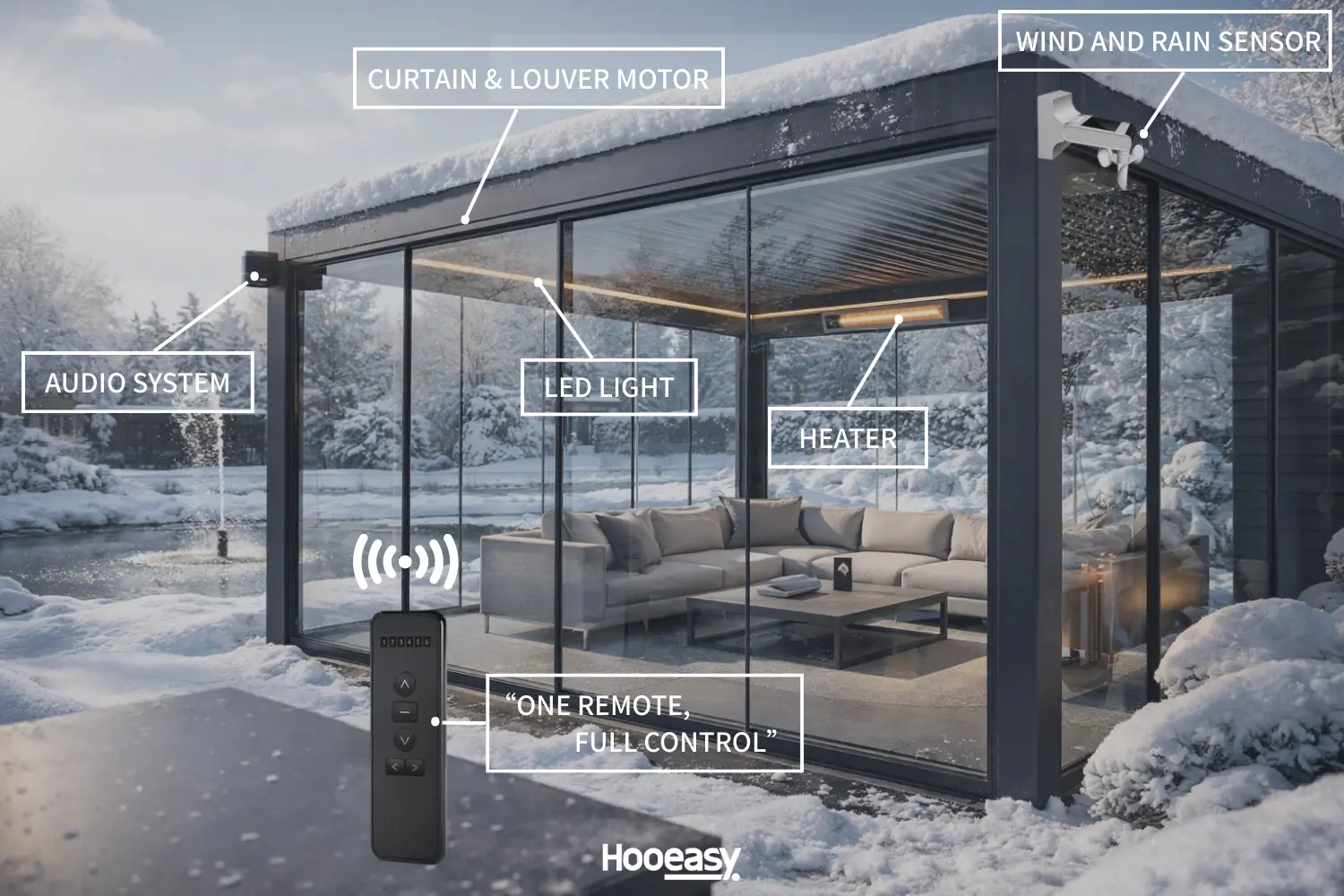
Homeowners already expect smart lighting, smart thermostats, and smart security. Outdoor shading is following the same path, with motorized louvered pergola systems increasingly incorporating connected controls, automation, and weather-responsive features.
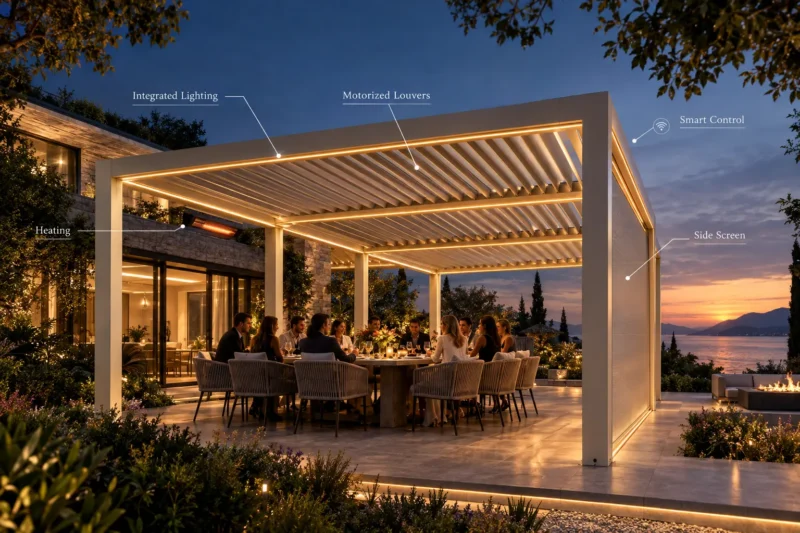
A smart pergola with app control allows users to operate the roof system without manually adjusting individual components.
Depending on the product configuration, smart functionality may include:
• Smartphone App Control
• Remote Control
• Voice Assistant Compatibility
• Rain Sensors
• Wind Sensors
• Sun Sensors
• Timer Automation
• Integrated LED Control
• Side Screen Automation
The value of these functions is not simply technological.
They make the pergola easier to use.
A homeowner can adjust the louvers while sitting at the dining table. A restaurant operator can manage a terrace without sending staff outside repeatedly. A hotel can integrate outdoor shading into a broader property-management or smart-building system.
Current industry content also describes app-based control, scheduling, voice assistants, weather sensors, and whole-home automation as increasingly important capabilities in motorized louvered pergola systems.
For this reason, a smart pergola with app control should be considered not merely an optional gadget but part of the product strategy for next-generation outdoor living systems.
Homeowners already expect smart lighting, smart thermostats, and smart security. Outdoor shading is following the same path.
Pergola Market Size 2026: What Buyers Are Looking For
What Is Driving the Pergola Market in 2026?
Key growth drivers shaping the future of outdoor architectural shade systems
Outdoor Living
Growing demand for seamless indoor-outdoor transition and year-round backyard entertainment spaces.
Smart Automation
Motorized louvers, weather sensors (rain/wind), and integrated mobile/IoT app controls.
Aluminum Durability
Shift toward eco-friendly, zero-maintenance, weather-resistant powder-coated aluminum frames.
Architectural Design
Minimalist bioclimatic aesthetics, custom lighting, and integrated heating boosting curb appeal.
The growth of the pergola industry provides another reason for brands to reconsider their product portfolios.
According to Cognitive Market Research’s 2026 pergola market analysis, the global pergola market was estimated at approximately $3.845 billion in 2026, compared with $2.802 billion in 2021. The report identifies residential and commercial applications, material segments including aluminum, and different pergola product types as important parts of the market structure.
The exact market size reported by research firms can vary because methodologies, product definitions, and geographic coverage differ. Therefore, B2B buyers should treat individual market estimates as directional rather than as a single universally accepted number.
What matters more strategically is the direction of demand.
The pergola market size 2026 discussion reflects several broader changes:
1、Outdoor living is becoming more sophisticated.
2、Customers want higher-quality architectural products.
3、Smart-home expectations are moving outdoors.
4、Low-maintenance materials are becoming more attractive.
5、Residential and commercial projects increasingly require adaptable outdoor spaces.
These trends create opportunities for suppliers that can combine structural performance with technology and design.
What Is Driving the Pergola Market in 2026?
| Market Driver | Why It Matters |
| Outdoor Living | More investment in functional outdoor rooms |
| Smart Automation | Growing demand for connected outdoor systems |
| Aluminum Durability | Lower maintenance and long service life |
| Architectural Design | Pergolas increasingly integrated into building design |
For a deeper look at current market estimates and segmentation, buyers can review the 2026 Pergolas Market Analysis from Cognitive Market Research.
The key takeaway is not simply that the market is growing. It is that the product definition is becoming more sophisticated.
Traditional Wood Pergola vs. Motorized Aluminum Pergola
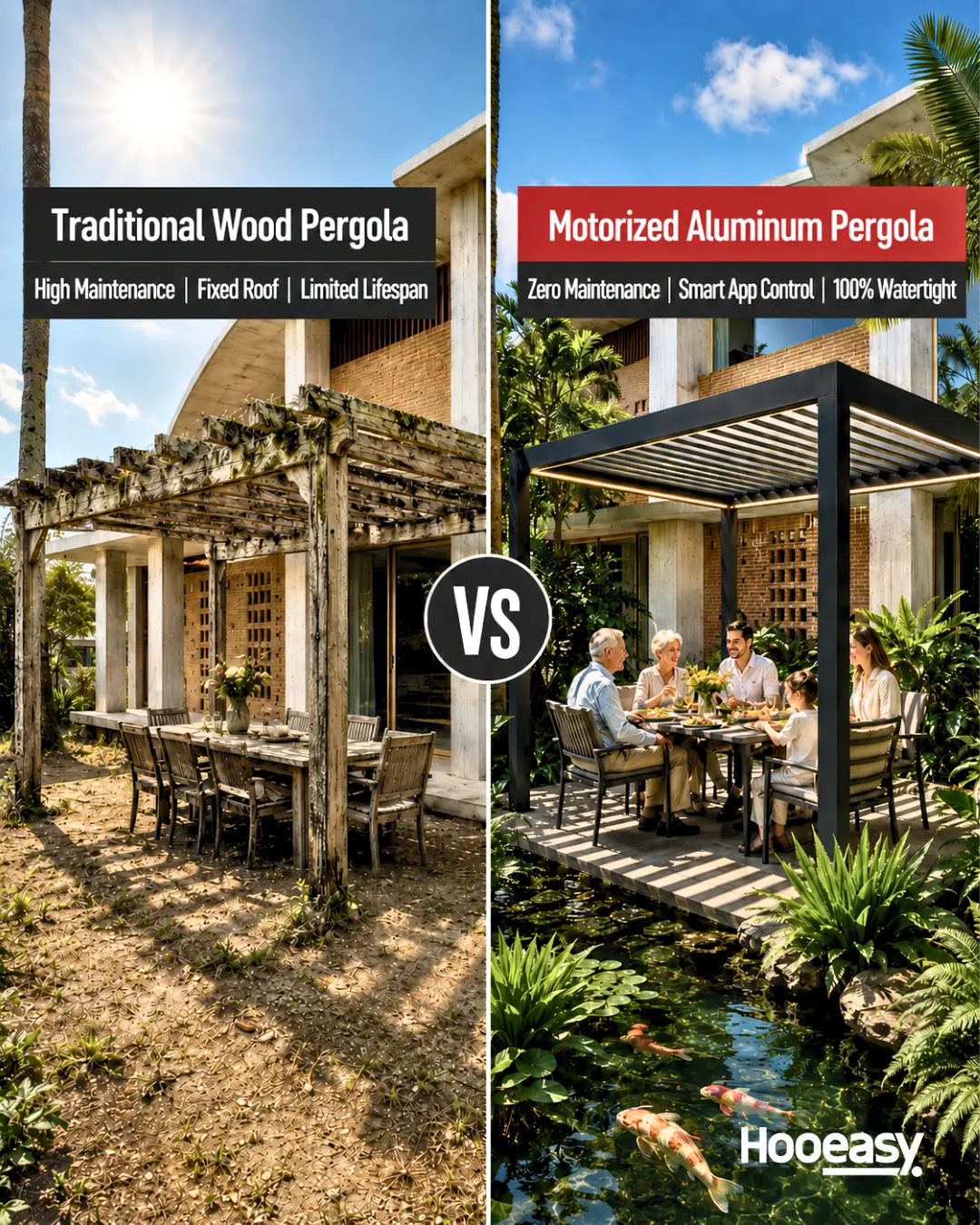
For many years, wood was the default material for pergolas because of its natural appearance and familiarity.
However, modern commercial and premium residential projects increasingly demand predictable performance, lower maintenance, integrated technology, and standardized manufacturing.
| Factor | Traditional Wood Pergola | Motorized Aluminum Pergola |
| Roof Flexibility | Fixed | Adjustable Louvers |
| Maintenance | High | Low |
| Weather Protection | Limited | High |
| Smart Control | No | Yes |
| Lifespan | Moderate | Long |
| Commercial Projects | Limited | Highly Suitable |
For brands and contractors, the difference is particularly important.
A standardized aluminum system can simplify production, installation, replacement parts, and project planning.
For importers, consistent specifications can make it easier to create a repeatable product portfolio.
For contractors, modular systems can provide more predictable installation processes across different projects.
For homeowners, the major benefit is convenience: less maintenance and more control over the outdoor environment.
This is why modern aluminum pergolas are increasingly positioned as architectural products rather than simple garden furniture.
Why Sustainable Aluminum Pergolas Are Winning
Material selection has become increasingly important in outdoor architecture.
Aluminum is particularly attractive because it combines structural performance with a clean architectural appearance.
A sustainable aluminum pergola can provide several practical advantages over materials that require more frequent refinishing or replacement.
1. Long Service Life
A durable aluminum structure can support a long product lifecycle, particularly when the system is correctly engineered and maintained.
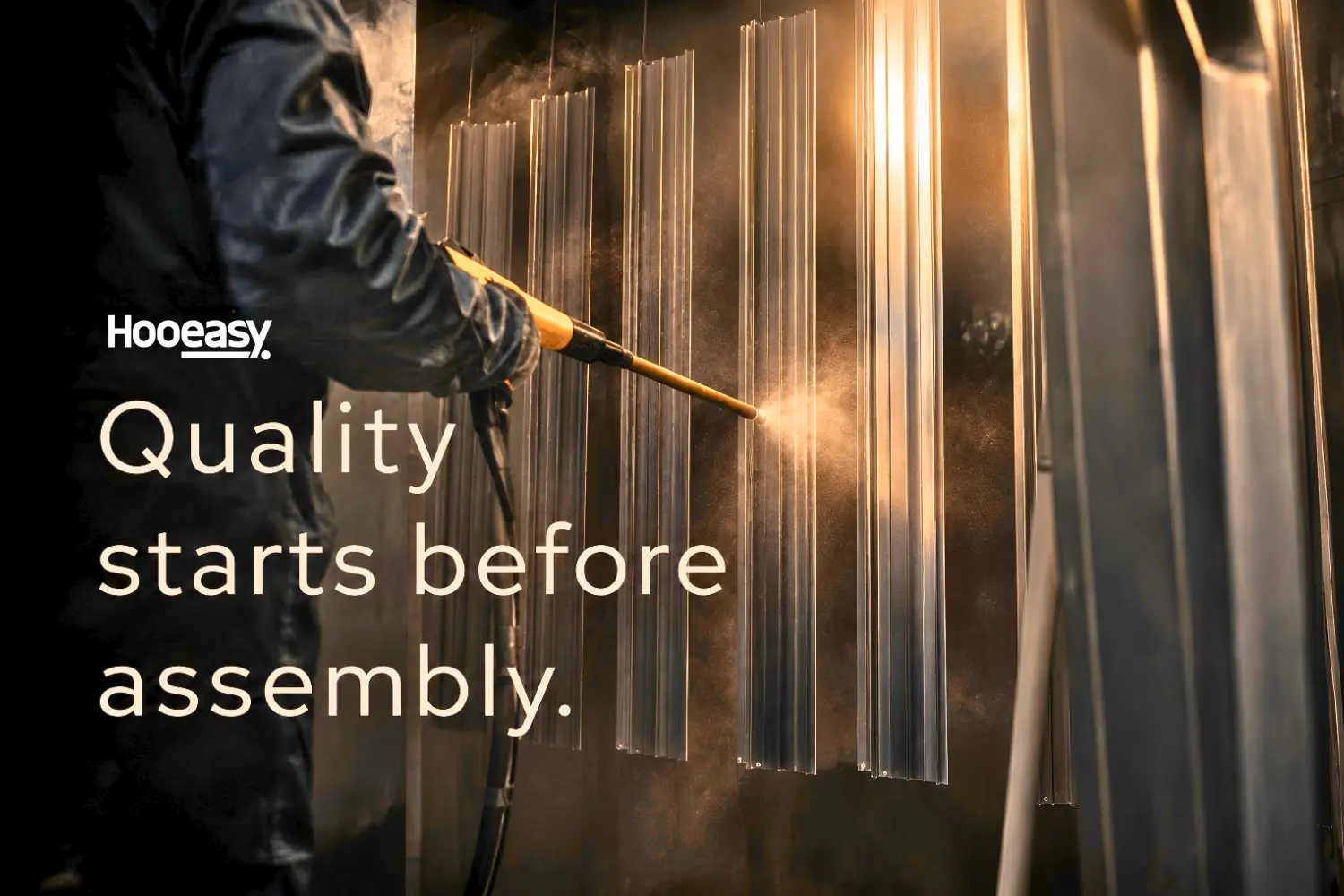
2. Powder-Coated Finish
Modern powder coating provides a consistent architectural finish and allows manufacturers to offer multiple colors to match different building styles.
3. Low Maintenance
Compared with timber structures that may require regular staining, sealing, or repainting, aluminum systems generally require less routine maintenance.
4. Recyclable Aluminum
Aluminum is widely recyclable, which can support more circular material strategies.
However, sustainability claims should be made carefully. Rather than promising that one material is automatically “green,” a more responsible approach is to consider durability, maintenance requirements, material lifecycle, manufacturing processes, and recyclability together.
Compared with structures that require frequent repainting or replacement, durable aluminum systems can support a lower-maintenance product lifecycle.
For buyers evaluating aluminum systems specifically, the aluminum pergola product range provides a useful reference point for understanding how modern aluminum pergolas can combine structure, shading, lighting, and customization.
The Design Trend Behind the Technology
Warm Minimalism Outdoor Design Meets Smart Architecture
Technology becomes much more valuable when it disappears visually.
That is exactly where warm minimalism outdoor design fits into the 2026 pergola trend.
Outdoor architecture is moving away from excessive decoration and toward a more refined combination of:
•Clean architectural lines
•Neutral colors
•Natural textures
•Warm lighting
•Integrated technology
•Concealed drainage
•Minimal structural detailing
•Seamless indoor-outdoor transitions
The goal is not to make the pergola look technologically complicated.
The goal is to make the technology feel effortless.
A contemporary aluminum pergola can therefore use a dark gray or warm neutral frame, integrated LED lighting, concealed drainage, optional side screens, and customized finishes while maintaining a visually restrained appearance.
This approach also makes the pergola easier to integrate with different architectural styles.
A luxury villa may use warm beige stone and natural wood furniture.
A modern restaurant may choose matte black aluminum and minimalist furniture.
A resort may use warm gray frames with tropical landscaping.
The underlying structure can remain similar while the visual identity changes.
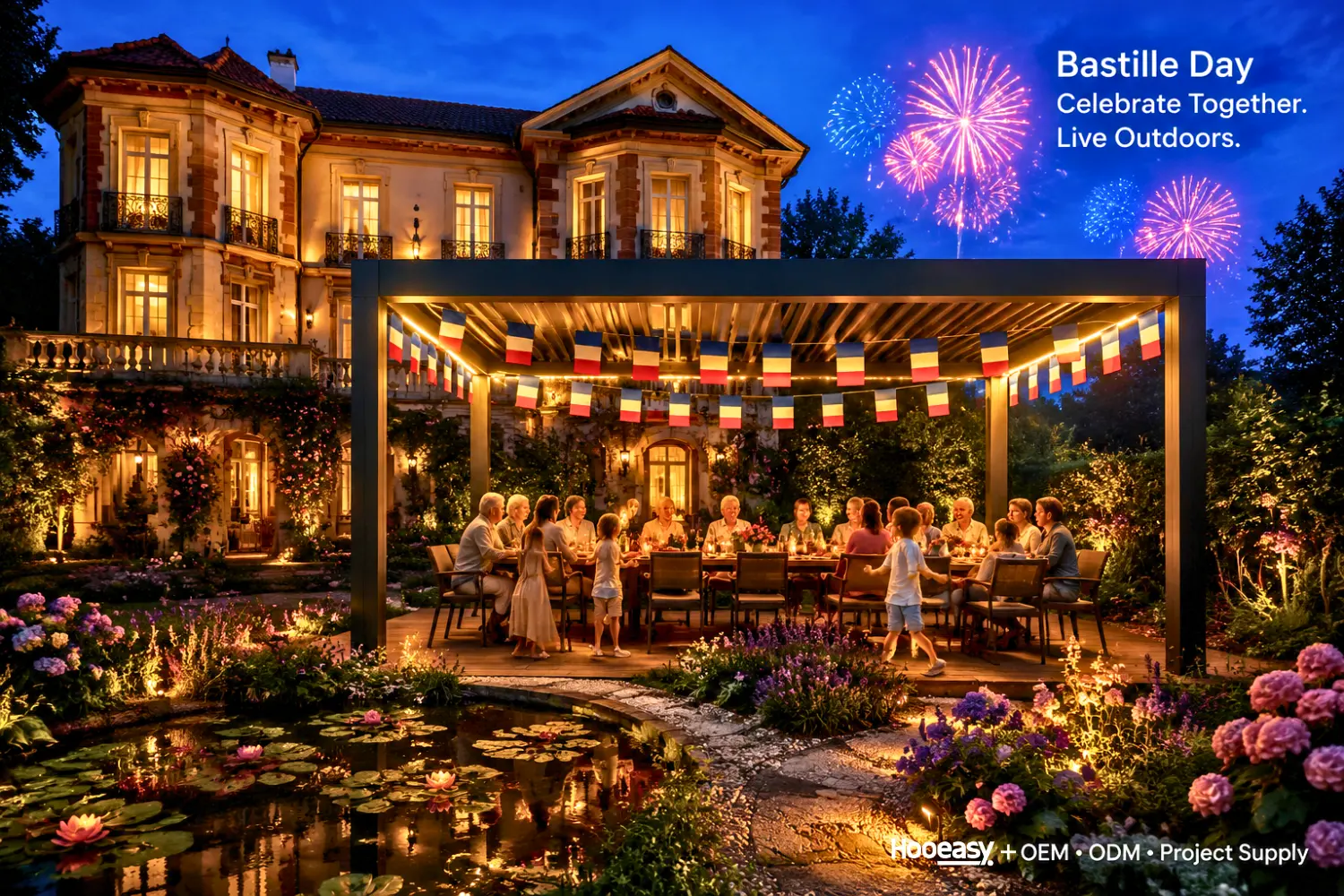
This is particularly important for pergola brands because customization becomes a way to build a product collection rather than selling one standardized appearance. Ultimately, these design choices also highlight the broader for creating comfortable, functional, and visually cohesive outdoor spaces.
What Brand Owners and Contractors Should Look For
The next generation of pergola products needs to satisfy more than end-user expectations.
B2B buyers should evaluate the entire supplier ecosystem.
For Pergola Brands
Brand owners should consider:
- OEM capability
- ODM development
- Private labeling
- Custom packaging
- Custom colors
- Product differentiation
- Modular product ranges
- Technical support
The strongest suppliers can help brands move from simply reselling an existing pergola toward developing a recognizable outdoor living product line.
This can include customized colors, dimensions, accessories, lighting configurations, packaging, branding, and regional product specifications.
For Importers
Importers should prioritize:
- Stable supply
- Quality consistency
- Certifications
- Spare parts availability
- Technical documentation
- Packaging standards
- Production capacity
A competitive product is not enough if the supplier cannot provide reliable after-sales support.
For an importer, the real cost of a pergola includes the complete lifecycle of the product.
For Contractors
Contractors should look for:
- Modular installation
- Engineering drawings
- Wind-resistance options
- Project support
- Installation guidance
- After-sales service
- Replacement components
A supplier that understands project installation can help reduce friction between product specification and real-world construction.

How Hooeasy Supports the Next Generation of Pergola Products
For brands entering or expanding within the outdoor living category, product capability and supply-chain capability need to develop together.
Hooeasy focuses on aluminum pergola systems designed around current outdoor living requirements, including:
- Motorized adjustable louvers
- Smart app control
- Optional weather sensors
- Durable powder-coated aluminum frames
- Integrated drainage
- LED lighting options
- OEM and ODM customization
- Custom branding
- Color customization
- Bulk orders
- Export support
- Quality control
For brands looking for a broader manufacturing partnership, the Hooeasy OEM/ODM pergola solutions can serve as a starting point for discussing customized product development and manufacturing requirements.
The strategic value of OEM and ODM is particularly important in a market where differentiation increasingly depends on more than frame design.
A brand can differentiate through color collections, lighting configurations, screen options, dimensions, accessories, packaging, controls, and project-specific engineering.
For a manufacturer, this means the product should be designed not only for today’s order but also for future product-line expansion.
For a brand owner, that flexibility can make it easier to create a distinctive outdoor living category instead of competing solely on price.
The answer is increasingly yes—but the reason is not one individual feature.
The 2026 pergola market is being shaped by four trends working together:
Outdoor living.
People want outdoor spaces that function like additional rooms.
Smart control.
Consumers are becoming accustomed to connected products and expect convenience to extend beyond the interior of the home.
Sustainable aluminum.
Durable, low-maintenance materials are increasingly attractive for long-term outdoor applications.
Minimalist architecture.
Modern outdoor spaces increasingly favor clean lines, neutral palettes, natural textures, and integrated technology.
Together, these trends explain why the motorized louvered pergola 2026 is moving from a premium option toward a market expectation.
For B2B buyers, that shift represents a product opportunity.
The question is no longer simply whether to offer pergolas.
The more important question is what kind of pergola portfolio will remain competitive over the next several years.
Brands that combine motorization, smart control, durable aluminum construction, architectural design, and customization can position themselves closer to where the market is moving.
And for brands, importers, and contractors looking to expand their outdoor living portfolio, the opportunity is no longer simply to sell a pergola. It is to offer a smarter, lower-maintenance, and more adaptable outdoor living solution that delivers the key benefits of pergola solutions.

Ready to Expand Your Pergola Product Range?
The outdoor living market is changing quickly.
If you are a pergola brand, building-material importer, outdoor living company, or engineering contractor, now is the time to evaluate whether your product portfolio reflects the new expectations of 2026.
Hooeasy works with brands, importers, and contractors to deliver motorized aluminum pergola solutions with OEM and ODM customization.
You can explore the complete aluminum pergola product range, learn more about OEM and ODM manufacturing capabilities, or contact the Hooeasy team to discuss your project requirements.
FAQ: Motorized Louvered Pergolas in 2026
What is a motorized louvered pergola?
A motorized louvered pergola 2026 system is an advanced architectural shade structure equipped with automated rotating roof slats. Instead of relying on a permanently fixed roof, users can adjust the louver angle to control sunlight, airflow, and weather protection.
This makes the pergola suitable for residential terraces, gardens, outdoor kitchens, restaurants, hotels, resorts, and commercial outdoor spaces.
Why are motorized louvered pergolas popular in 2026?
The growing pergola market size 2026 reflects a broader shift toward more functional outdoor environments.
Three major factors are driving interest.
First, outdoor spaces are increasingly designed as extensions of the home.
Second, smart-home technology is moving outdoors, creating demand for connected shading systems.
Third, adjustable louvers provide greater weather flexibility than traditional fixed pergolas.
Together, these features make the modern pergola more adaptable to real-world outdoor living.
Can a smart pergola be controlled by an app?
Yes. A modern smart pergola with app control can allow users to manage louver positions, integrated LED lighting, and other accessories through a smartphone or tablet.
Depending on the system, additional functionality can include remote control, timers, voice assistants, and weather sensors.
The goal is not simply to add technology. It is to make the outdoor space easier and more intuitive to operate.
Are aluminum pergolas more sustainable than wood pergolas?
A sustainable aluminum pergola can provide important lifecycle advantages because aluminum systems can offer durability, low maintenance, and recyclability.
However, sustainability should not be reduced to a single material comparison.
Buyers should also consider manufacturing processes, coating systems, product lifespan, repairability, transportation, and end-of-life recycling.
For long-term outdoor applications, a durable product that requires less frequent replacement or refinishing can support a lower-maintenance lifecycle.
What should importers look for in a pergola supplier?
B2B importers should evaluate suppliers across several areas:
OEM & Customization Capabilities: Can the manufacturer adapt dimensions, colors, accessories, controls, and branding?
Quality Control: Does the supplier have consistent production and testing procedures?
Complete Documentation: Are technical drawings, installation instructions, certifications, and project documentation available?
Reliable Spare Parts Supply: Can motors, sensors, structural hardware, and other components be supplied after the original installation?
End-to-End Project Support: Can the supplier provide engineering assistance, product consultation, and technical support?
These factors often become more important after the first purchase because long-term supplier reliability directly affects a brand’s customer experience.
Final Takeaway
The motorized louvered pergola 2026 is not simply another product trend.
It represents the convergence of four major changes in outdoor architecture: more sophisticated outdoor living, smarter technology, durable aluminum construction, and warmer minimalist design.
For homeowners, the result is a more comfortable and flexible outdoor room.
For architects and contractors, it creates a more adaptable architectural system.
For brands and importers, it creates an opportunity to build a differentiated and scalable product portfolio.
The next generation of pergola products will not compete only on shade.
They will compete on comfort, automation, durability, design, customization, and the ability to make outdoor space genuinely usable.
That is why the motorized louvered pergola is moving closer to becoming the new standard for modern outdoor living.