
Opening: The Pergola Market Is Entering a New Stage of Growth
The global pergola market is entering a new stage of growth.
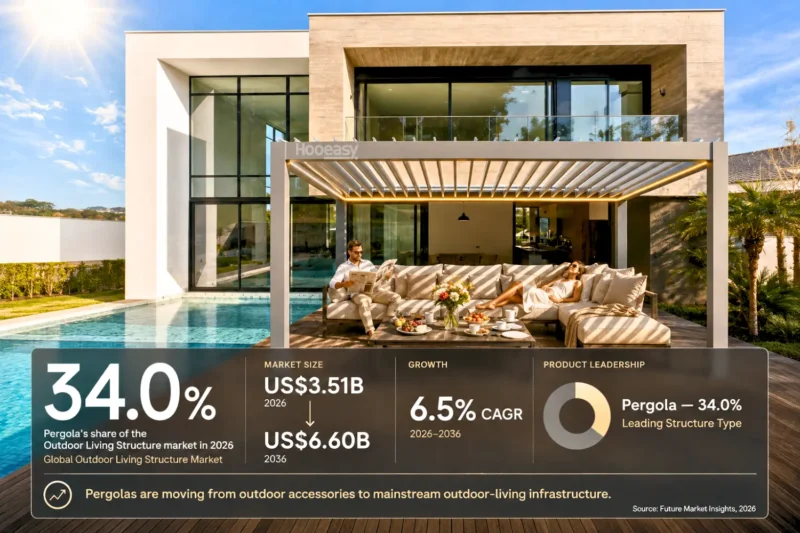
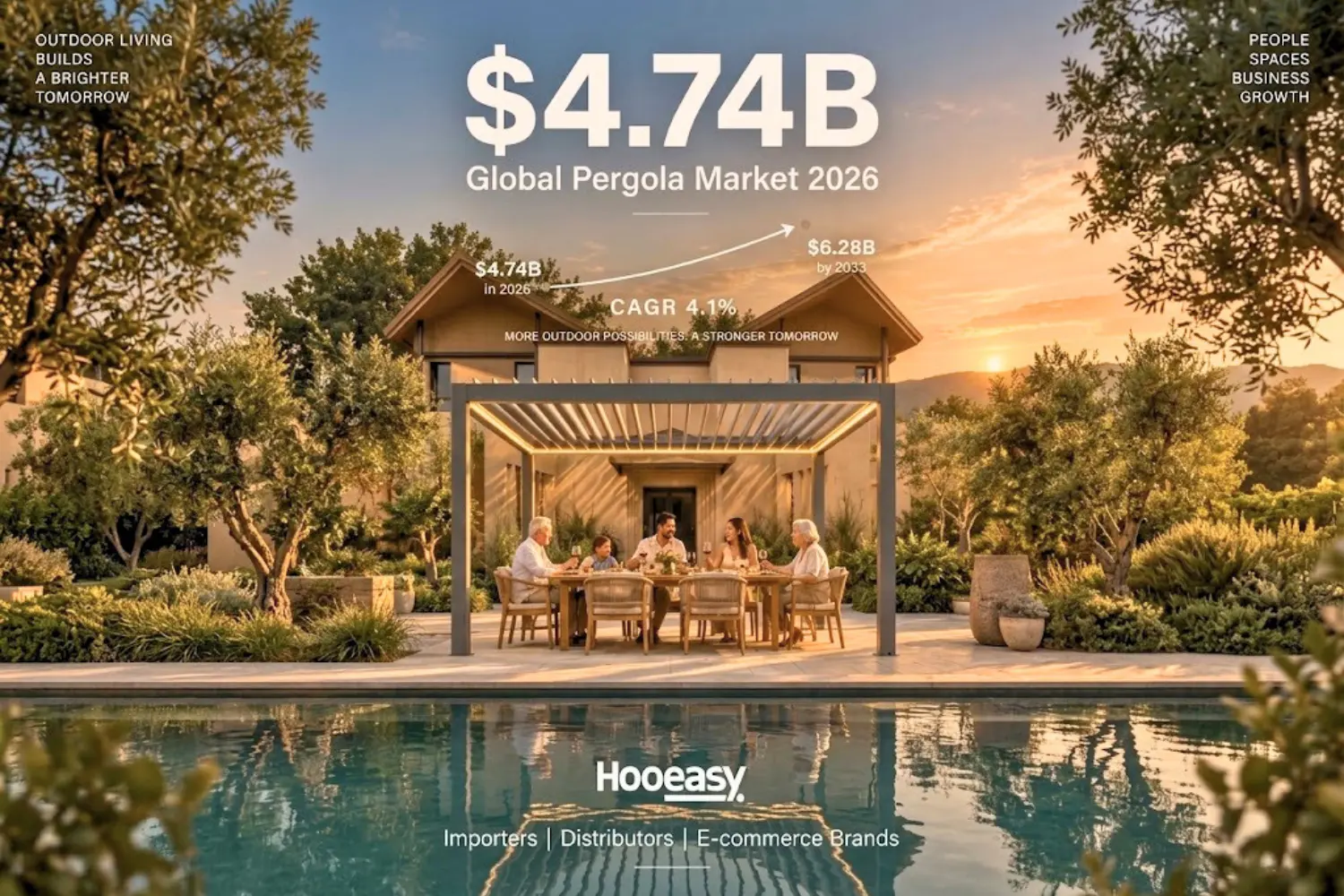
According to a 2026 market analysis from Coherent Market Insights, the global pergolas market is estimated to reach USD 4.74 billion in 2026 and is projected to grow to USD 6.28 billion by 2033, representing a 4.1% CAGR during the forecast period. North America is expected to remain the largest regional market, while Asia Pacific is identified as the fastest-growing region.
But for distributors, importers, building-material suppliers, outdoor-living brands and e-commerce businesses, the more important question is not simply how large the pergola market is.
The real question is:
Where is the next B2B opportunity, what pergola products will buyers demand, and which capabilities should you look for in a manufacturing partner?
The pergola category is moving beyond simple backyard structures. Increasingly, buyers are looking for aluminum pergolas, motorized louvered systems, integrated lighting, privacy solutions, modular configurations and customized OEM/ODM products.
For B2B businesses, this creates an opportunity to build not just a pergola product line, but a broader outdoor living product portfolio.
Global Pergola Market at a Glance
The latest market forecast from the Coherent Market Insights pergola market report provides a useful starting point for understanding the scale and direction of the global pergola industry.
| Market Indicator | 2026 |
|---|---|
| Global Pergola Market Size | $4.74B |
| Forecast Market Size by 2033 | $6.28B |
| CAGR 2026–2033 | 4.1% |
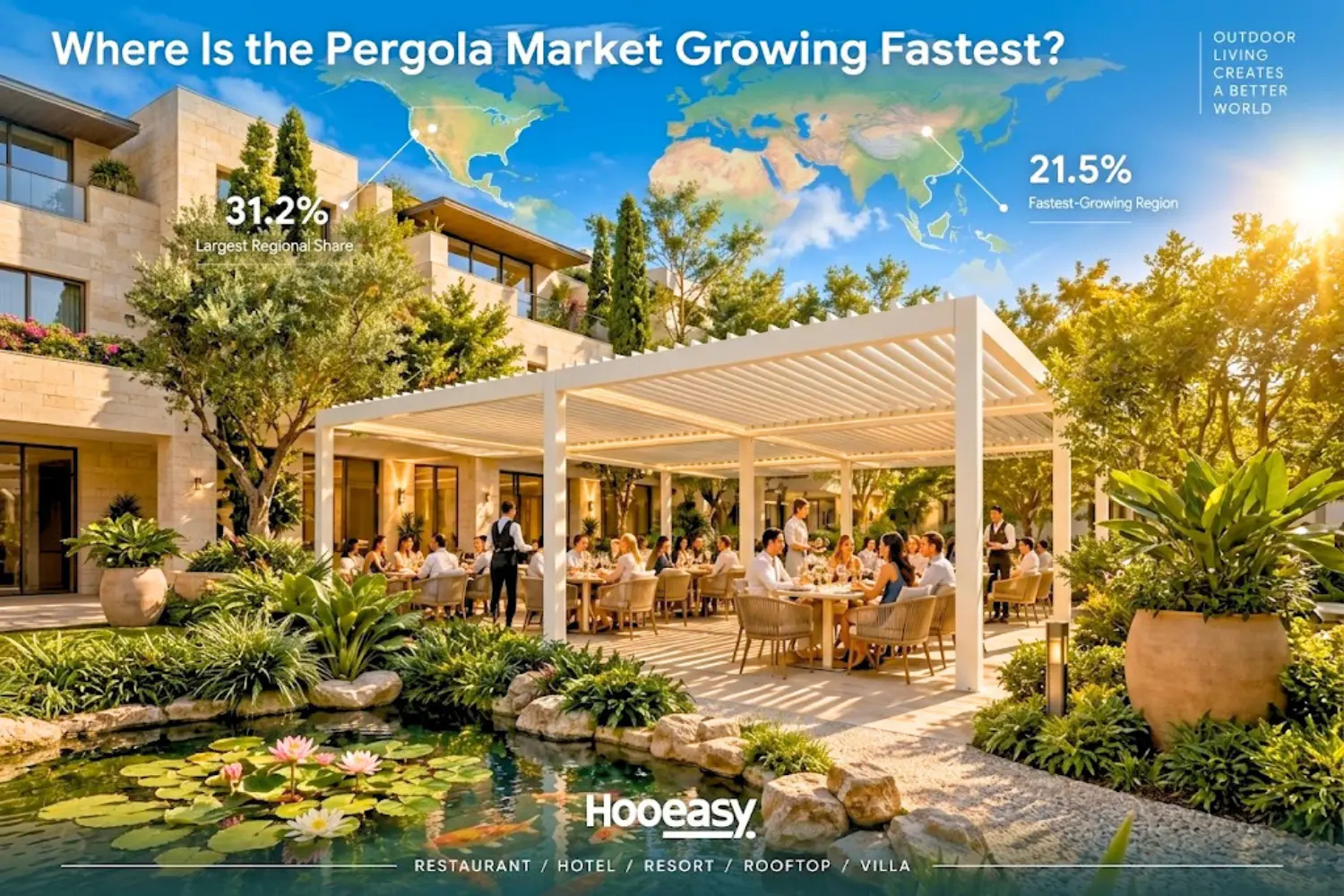
| North America Share | 31.2% |
| Asia Pacific Share | 21.5% |
Source: Coherent Market Insights, Pergolas Market Size and Share Analysis – Growth Trends and Forecasts 2026–2033.
What Is Driving Pergola Market Growth?
Several structural trends are supporting pergola market growth.
1. Outdoor Living Expansion
Outdoor spaces are increasingly being treated as extensions of indoor living environments. Pergolas can create more functional terraces, patios, gardens, rooftops and hospitality spaces.
For B2B buyers, this means the opportunity is not limited to residential backyard products. The same product category can serve residential developments, restaurants, hotels, resorts, cafés and commercial projects.
2. Home Improvement and Property Value
Pergolas can help property owners make outdoor areas more usable while improving the visual appeal of a property.
This creates demand for products that combine appearance with durability, low maintenance and weather resistance.
3. Commercial Outdoor Space Investment
Restaurants and hospitality businesses are increasingly looking at outdoor space as usable commercial infrastructure rather than simply decorative space.
A well-designed pergola can turn an underused patio into a more functional dining, entertainment or guest area.
4. Demand for Weather-Resistant and Smart Solutions
The category is also becoming more technology-driven.
Motorized louvers, remote controls, smart systems, integrated lighting and other accessories are changing what customers expect from a modern pergola.
For B2B buyers, these trends represent expanding product categories, not simply changing consumer preferences.
Why 2026 Could Be a Strategic Window for B2B Buyers
Market growth alone does not automatically create a profitable business opportunity.
The more important change is where pergolas are being used and what customers expect them to do.
1. Pergolas Are Moving Beyond Residential Use
The traditional image of a pergola is a backyard structure.
That definition is becoming increasingly limited.
Today, pergolas can be found across:
- Restaurants
- Hotels
- Resorts
- Cafés
- Rooftops
- Commercial plazas
- Hospitality projects
- Outdoor event spaces
- Luxury residential developments
This expansion creates opportunities for businesses that can supply more than a standard freestanding structure.
For example, a hospitality project may require a large aluminum structure, integrated lighting, privacy screens and motorized controls, while a residential distributor may need several standardized configurations.
The supplier capable of serving both requirements has a broader commercial opportunity.
2. Outdoor Space Is Becoming Commercial Infrastructure
For commercial businesses, the value of a pergola is not only aesthetic.
Consider a restaurant with an underused patio:
Unused patio
↓
Covered outdoor seating
↓
More usable seating capacity
↓
Higher space utilization
A recent analysis from StruXure NorCal highlights how pergolas can support restaurant outdoor space by transforming unused or weather-dependent patio areas into more reliable outdoor seating environments.
The B2B implication is important:
Commercial pergola buyers are purchasing functionality, not just appearance.
Space utilization, customer experience, weather protection and operational flexibility can all influence purchasing decisions.
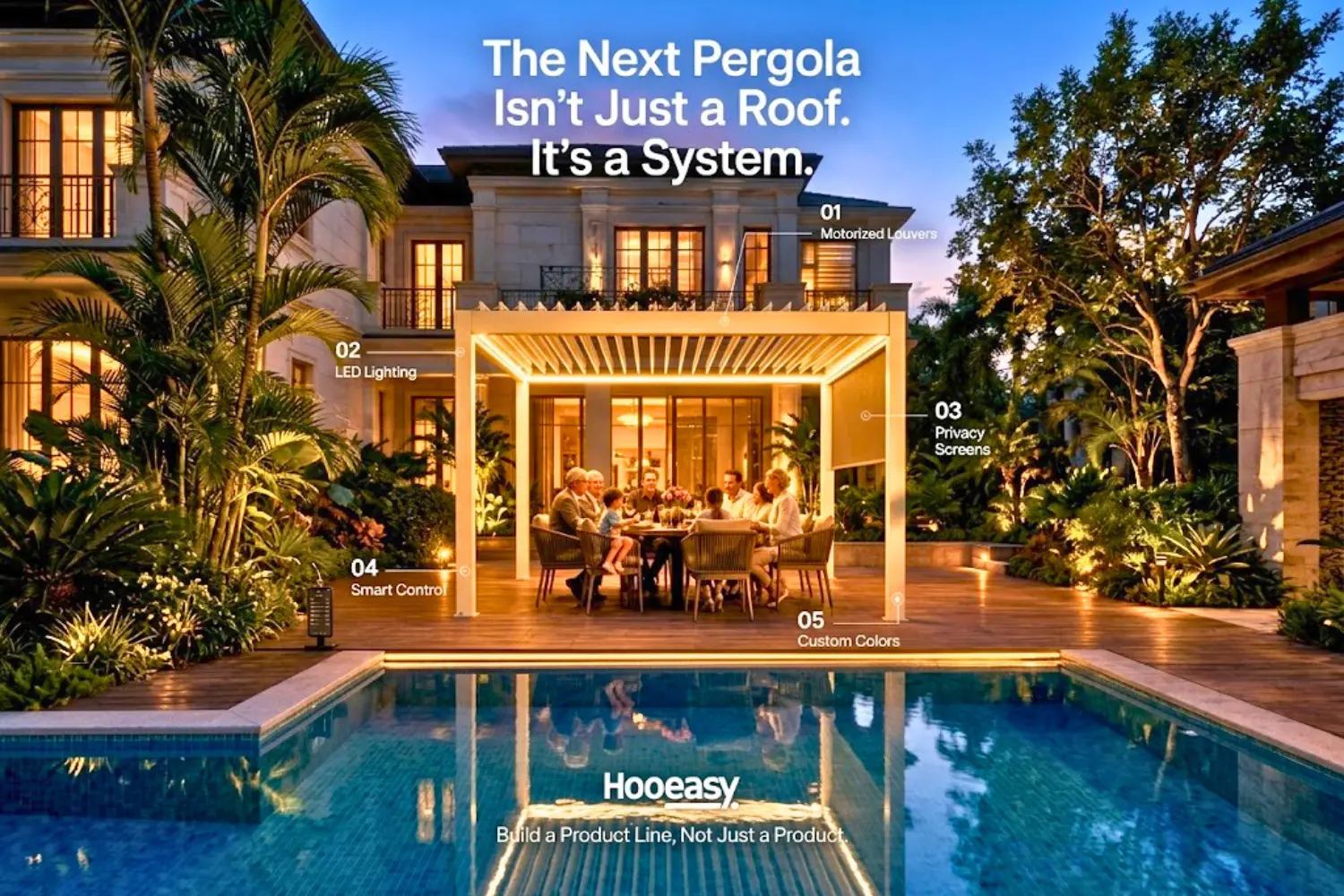
3. Smart Pergola Systems Create Premium Opportunities
The product is also evolving from a static structure into a connected outdoor-living system.
Modern systems can incorporate:
- Motorized louvers
- Remote control
- App control
- Rain sensors
- Wind sensors
- Integrated LED lighting
- Privacy screens
- Sliding doors
- Heating solutions
This changes the commercial proposition.
Instead of selling only “a pergola,” suppliers can offer a complete outdoor living system.
For distributors and brands, that can mean higher product value, more accessory sales and greater opportunities for product differentiation.
Where Is the Pergola Market Growing?
Regional market conditions matter when deciding where to source, distribute and position pergola products.

North America — The Largest Regional Market
North America is projected to account for 31.2% of the global pergola market in 2026, making it the largest regional market in the cited analysis.
Several factors support the region’s demand, including outdoor living culture, home improvement, landscaping and increasing interest in functional outdoor environments.
For B2B buyers, the opportunity extends across both residential and commercial applications.
Distributors and importers can consider:
- Premium aluminum pergolas
- Motorized louvered pergolas
- Modular outdoor structures
- Commercial pergola systems
- Smart outdoor-living accessories
The key is not simply entering the largest market, but selecting products that fit its expectations for quality, customization and functionality.
Asia Pacific — The Fastest-Growing Region
Asia Pacific is projected to hold 21.5% of the global market in 2026 and is identified by CMI as the fastest-growing regional market.
Urbanization, rising disposable incomes, construction activity and increasing investment in outdoor hospitality and residential environments are contributing to the region’s expansion.
For importers, regional distributors, e-commerce sellers and building-material companies, this can create opportunities for early category expansion.
The challenge is to identify scalable products before competition becomes more mature.
Europe — Design, Compliance and Outdoor Living
Europe should be approached somewhat differently.
Rather than focusing on an unsupported market-share figure, B2B buyers should consider the purchasing criteria that commonly influence European projects:
- Design
- Durability
- Weather resistance
- CE compliance
- Sustainability
- Smart control
- Customization
For European buyers, a supplier’s ability to provide documentation, testing information, consistent production and customizable specifications can be as important as the initial product price.
Which Pergola Products Are Creating the Biggest B2B Opportunities?
The growing pergola market does not mean every pergola product will perform equally well.
For B2B buyers, the next step is identifying product categories with broader application potential.
1. Aluminum Pergolas
Aluminum has become an important material option for modern pergola systems because it combines a contemporary appearance with durability and relatively low maintenance requirements.
For distributors and importers, Hooeasy aluminum pergola systems provide a versatile solution for different architectural styles and applications, helping businesses build product portfolios around durable, modern outdoor-living solutions.
Key selling points include:
- Durability
- Low maintenance
- Weather resistance
- Modern appearance
- Long service life
2. Motorized Louvered Pergolas
The growth of smart outdoor living is creating demand for motorized pergolas and louvered pergolas.
Adjustable louvers allow users to manage sunlight, ventilation and rain protection according to changing conditions.
Additional features can include remote control, app integration and lighting.
For B2B buyers, this creates an opportunity to move from selling a basic outdoor structure toward a premium, technology-enabled product.
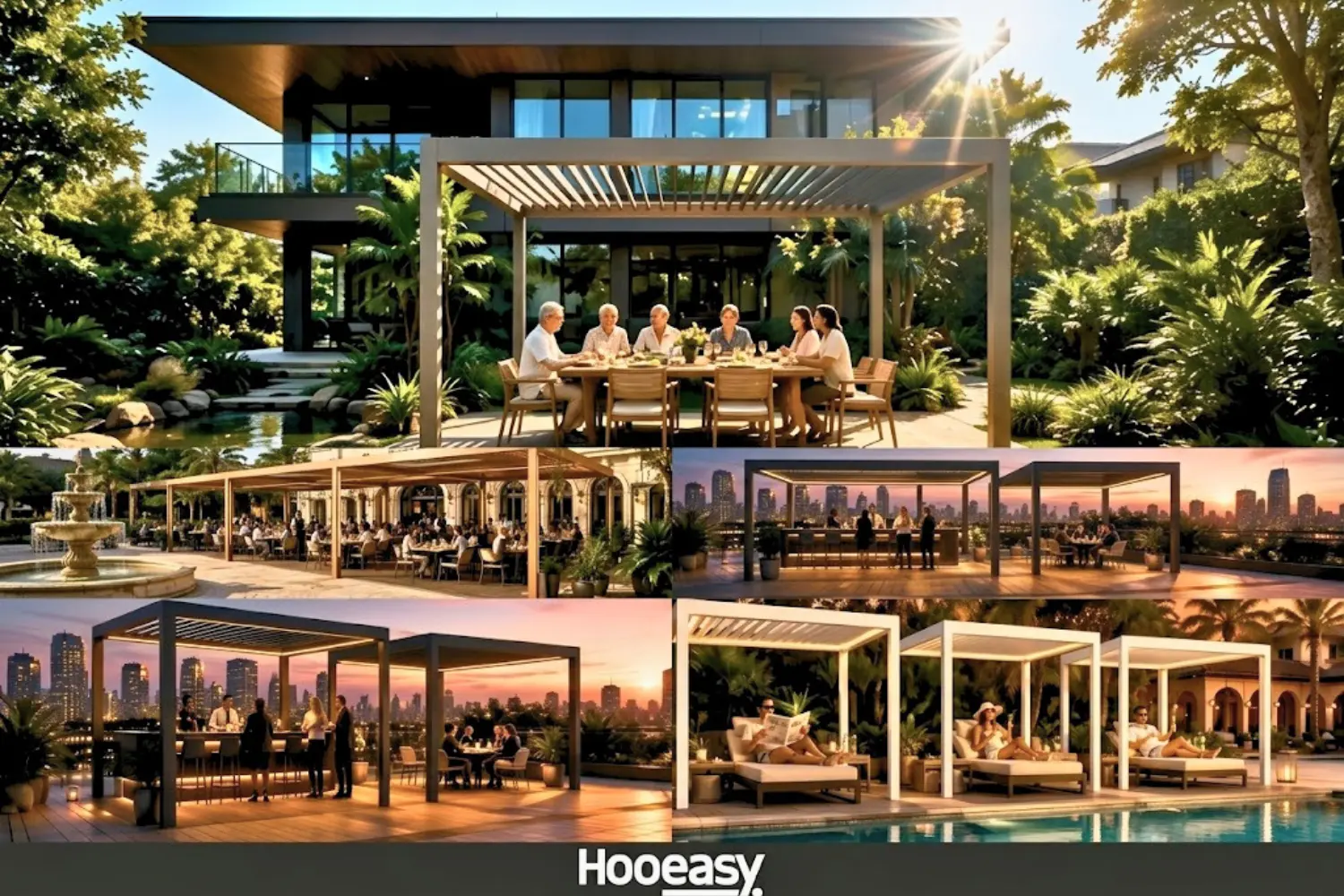
3. Commercial Pergolas
Commercial pergolas are particularly relevant for:
- Restaurants
- Hotels
- Resorts
- Cafés
- Rooftops
- Hospitality projects
The commercial proposition is different from residential selling.
The key benefits are:
Space utilization + customer experience + weather protection
A commercial pergola can therefore become part of a property’s operational strategy rather than simply an architectural feature.
4. Modular Pergola Systems
Modular systems are especially attractive for B2B businesses because they can simplify product management.
Potential advantages include:
- Easier transportation
- Easier warehousing
- Faster installation
- Flexible configurations
- Easier inventory management
This is particularly relevant to importers, distributors and e-commerce sellers, where packaging efficiency, inventory planning and SKU management can directly influence business costs.
5. Custom and OEM Pergolas
Customization is another major opportunity.
A custom pergola manufacturer can support buyers who want to differentiate through:
- Custom dimensions
- Custom colors
- Branding
- Packaging
- Product configurations
- Accessories
- Engineering support
For private-label brands, pergola OEM and ODM capabilities can turn a standardized product into a differentiated market offering.
Hooeasy currently states that it offers more than 1,600 existing RAL colors for pergolas alongside OEM/ODM solutions.
What B2B Buyers Should Look for in a Pergola Supplier
As the market becomes more competitive, supplier selection becomes a strategic decision.
The cheapest quotation is not necessarily the lowest-cost sourcing option.
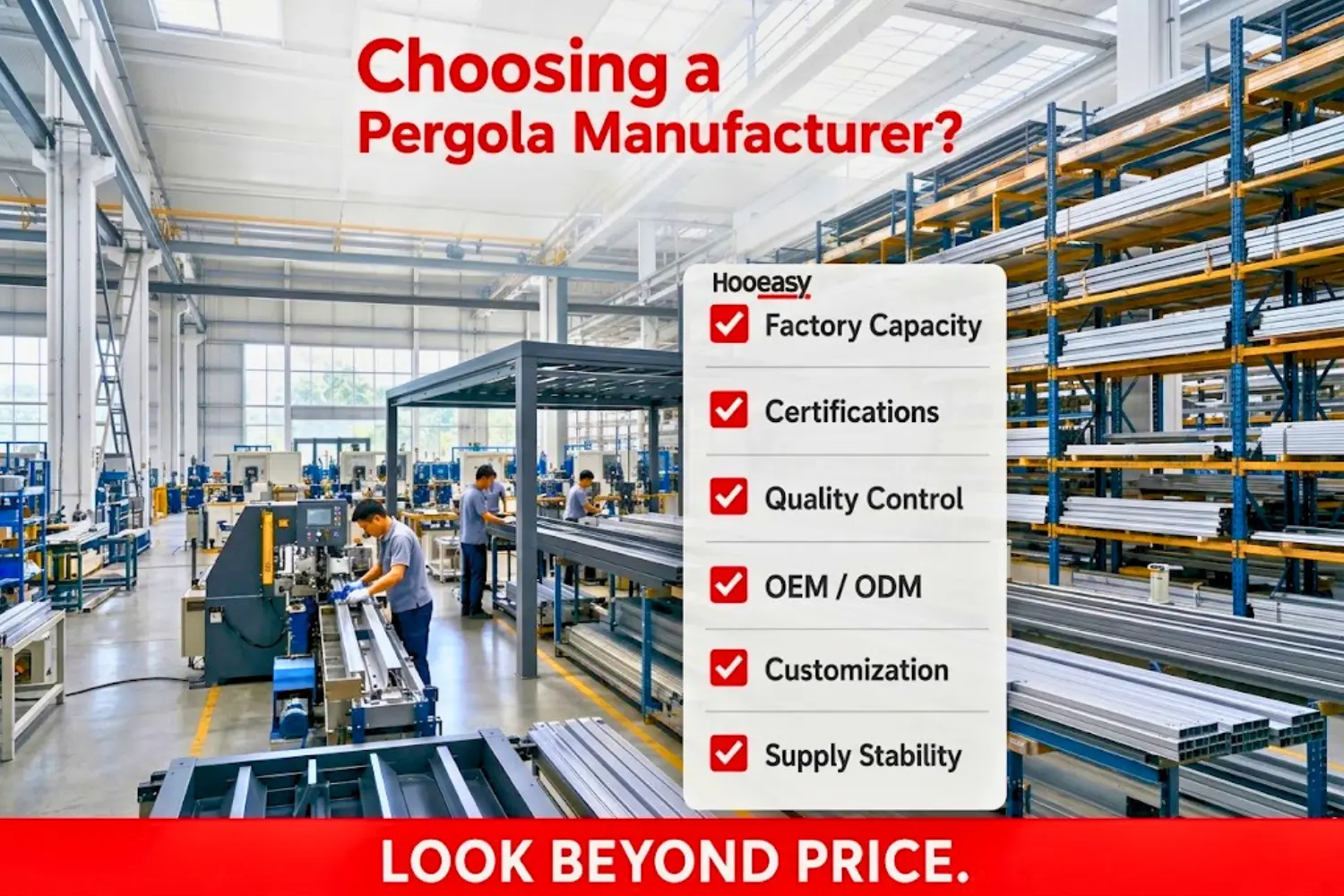
A better evaluation should consider capacity, quality, compliance, customization, testing and supply stability.
1. Manufacturing Capacity
Before choosing a pergola supplier, evaluate:
- Factory size
- Production capacity
- Equipment
- Workforce
- Production stability
- Quality-control systems
A supplier needs enough capacity to support your business not only for a sample order, but also when demand increases.
2. Product Quality and Certifications
International B2B buyers should check whether the supplier has appropriate certifications and third-party testing.
Depending on the destination market, relevant credentials may include:
CE | GS | RoHS | BSCI | ISO9001
For buyers evaluating supplier reliability and market-entry readiness, Hooeasy certifications and quality standards provide a useful reference for understanding its approach to product compliance and quality assurance.
The important point is that certifications should not simply become a “certificate wall.”
They should support:
Compliance + Quality Assurance + Market Entry
3. OEM & ODM Capability
For brands and distributors, customization can determine whether a product becomes a commodity or a differentiated product line.
Ask potential suppliers about:
- Custom dimensions
- RAL colors
- Branding
- Packaging
- Product configuration
- Accessories
- Engineering support
For an e-commerce brand, for example, private-label packaging and custom colors may be important.
For a commercial project supplier, custom dimensions and engineering support may matter more.
4. Testing and Quality Control
A professional supplier should be able to explain how its products are tested.
Relevant areas may include:
- Wind resistance testing
- Rain resistance testing
- Structural testing
- Material inspection
- Production QC
- Motor durability
- Water resistance
Hooeasy states that it operates a dedicated laboratory for pergola and awning performance testing, including wind-resistance, rain-resistance and product-stress testing.
5. Supply Chain and Delivery Stability
A competitive pergola price means little if a supplier cannot maintain stable quality, lead times and production capacity.
For B2B procurement, the complete decision should look more like:
Price → Quality → Capacity → Lead Time → After-Sales
This is particularly important when a distributor or importer is scaling a product category.
Why Hooeasy Is Positioned for the Growing Pergola Market
After evaluating the market opportunity and supplier criteria, it becomes easier to understand where Hooeasy fits into the B2B pergola supply chain.
Rather than simply positioning itself as another pergola manufacturer in China, Hooeasy’s capabilities align with several of the key requirements of the expanding market.
152,000㎡ Manufacturing Facility
Hooeasy currently reports a modern Hooeasy manufacturing facility covering approximately 152,000㎡, with more than 1,000 employees. For distributors and importers, large-scale manufacturing capacity can help reduce supply-chain uncertainty when scaling a pergola business.
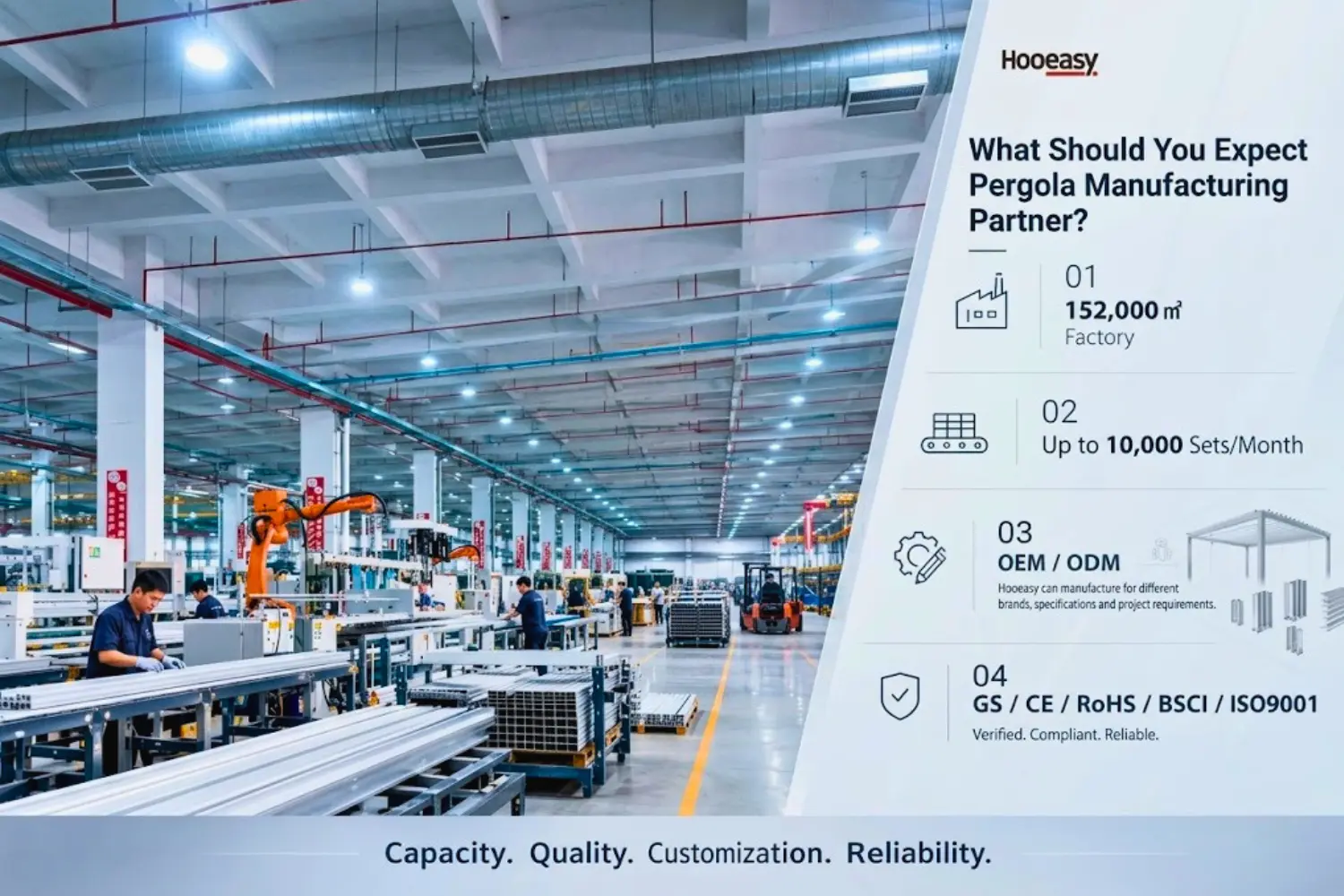
For distributors and importers, large-scale manufacturing capacity can help reduce supply-chain uncertainty when scaling a pergola business.
Up to 10,000 Pergola Sets per Month
Hooeasy’s website currently states a production capacity of up to 10,000 pergola sets per month.
10,000+
Pergola Sets / Month
This capacity is particularly relevant to B2B customers who need a supplier capable of moving from sample development to larger-volume orders.
International Certifications
Hooeasy publicly lists:
GS | CE | RoHS | BSCI | ISO9001
These certifications and third-party testing capabilities can help support international B2B sourcing requirements.
OEM / ODM for Global B2B Buyers
Hooeasy also positions its pergola business around OEM/ODM solutions and customization, including a broad range of RAL color options.
This creates different opportunities for different B2B customers:
Importers
Build your pergola category.
Distributors
Expand your outdoor-living portfolio.
E-commerce Brands
Launch customized pergola products under your own brand.
Building-Material Suppliers
Add a higher-value outdoor-living solution to your product range.
Which B2B Buyers Can Benefit from Pergola Market Growth?
The pergola market can support several different business models.
Importers Without a Brand
Key requirements:
- Stable supplier
- Competitive pricing
- Ready-to-sell products
- Low sourcing risk
- Consistent quality
Private-Label Brands
Key requirements:
- OEM
- ODM
- Custom colors
- Packaging
- Branding
- Product differentiation
Building Material & Outdoor Living Distributors
Key requirements:
- Broad product portfolio
- Multiple configurations
- Stable supply
- Commercial applications
- Product support
E-commerce Sellers
Key requirements:
- Modular products
- Efficient packaging
- Product differentiation
- Custom branding
- Scalable supply
The right supplier can therefore serve as more than a manufacturer.
It can become part of the buyer’s product development and sourcing strategy.
How to Enter the Pergola Market in 2026: A Practical B2B Roadmap
For companies entering or expanding within the category, a simple roadmap can help reduce sourcing risk.
Step 1 — Identify Your Target Market
North America / Europe / Asia Pacific
↓
Step 2 — Select Your Product Positioning
Standard / Premium / Smart / Commercial
↓
Step 3 — Choose the Right Pergola Supplier
Factory + Certifications + Capacity + OEM/ODM
↓
Step 4 — Test the Market
Sample Orders / Pilot Projects / E-commerce Launch
↓
Step 5 — Scale
Bulk Orders → Customization → Private Label → Product Expansion
This approach helps businesses avoid committing too early to large inventories before validating product-market fit.
Pergola Market 2026: Key Takeaways for B2B Buyers
01 — The market is growing
The global pergola market is estimated at $4.74B in 2026 and projected to reach $6.28B by 2033.
02 — North America leads
North America is projected to account for 31.2% of the market in 2026.
03 — Asia Pacific is accelerating
Asia Pacific is projected to hold 21.5% of the market and is identified as the fastest-growing region.
04 — Commercial applications matter
Restaurants, hotels, resorts and other hospitality projects are expanding their use of outdoor spaces.
05 — Supplier selection is becoming strategic
Capacity + quality + compliance + customization + supply stability increasingly matter alongside price.
Frequently Asked Questions About the Pergola Market
How big is the pergola market in 2026?
The global pergola market is estimated at approximately USD 4.74 billion in 2026, according to the cited Coherent Market Insights forecast.
How much will the pergola market be worth in 2033?
The global pergola market is projected to reach approximately USD 6.28 billion by 2033.
What is the CAGR of the pergola market?
The cited market forecast projects a 4.1% CAGR from 2026 to 2033.
Which region has the largest pergola market?
North America is projected to have the largest regional share, at approximately 31.2% in 2026.
Which region is growing fastest in the pergola market?
Asia Pacific is identified as the fastest-growing region in the cited 2026 market analysis, with a projected 21.5% market share.
What should I look for when choosing a pergola manufacturer?
B2B buyers should evaluate manufacturing capacity, certifications, product quality, OEM/ODM capability, customization, testing, lead times, supply stability and after-sales support.
The lowest unit price should not be the only criterion.
A supplier with stronger production capacity and quality systems may provide better long-term sourcing value.
Is pergola a good product category for importers and distributors?
The growing market, expansion of outdoor living and increasing demand for commercial outdoor spaces create opportunities for importers and distributors.
However, profitability depends on several factors, including market positioning, product selection, sourcing costs, logistics, competition and supplier reliability.
The opportunity is therefore real, but it requires a clear product and sourcing strategy.
Ready to Build Your Pergola Product Line?
The global pergola market is becoming more sophisticated.
For B2B buyers, the opportunity is no longer simply to find a pergola wholesale supplier offering competitive prices. Explore Hooeasy pergola systems to see how a broader product portfolio can support different market needs.
The bigger opportunity is to build a differentiated product portfolio around aluminum pergolas, motorized louvered systems, commercial applications, modular designs and OEM/ODM solutions.
Hooeasy supports global B2B buyers with:
- 152,000㎡ Manufacturing Facility
- Up to 10,000 Pergola Sets/Month
- OEM & ODM Solutions
- GS / CE / RoHS / BSCI / ISO9001
- Custom Colors & Configurations
For distributors, importers and brands looking to expand their range, Learn about Hooeasy and explore the manufacturing capabilities behind its pergola solutions.
If you are evaluating products for a new collection or market launch, Request a pergola catalog to review available models, configurations and customization options.
For businesses looking for customized or private-label solutions, Get an OEM/ODM quote based on your target market and product requirements.
If you are evaluating suppliers for your next pergola product line, start with the capabilities behind the product—not just the product price. Talk to our pergola team to discuss your sourcing needs and potential cooperation.