
How to Verify a Pergola Manufacturer in China Before Placing an Order
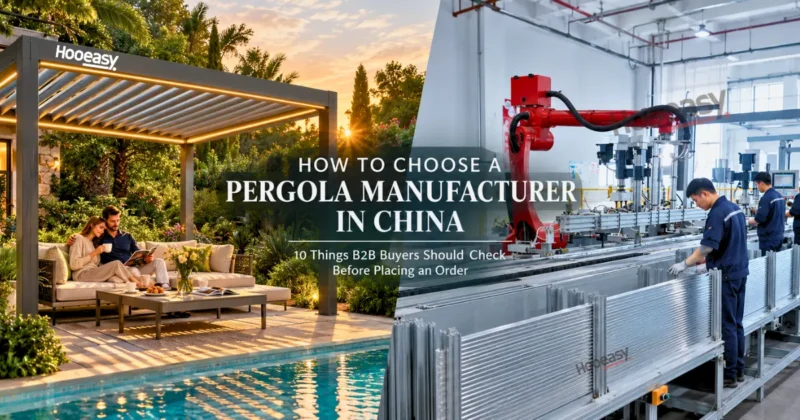
Choosing a pergola manufacturer in China can offer B2B buyers access to competitive pricing, OEM/ODM customization, large production capacity, and a wide range of aluminum outdoor living solutions.
But one important question should be answered before discussing price:
Is the supplier actually capable of producing the pergola system they are selling?
A professional website, attractive product photos, and a low quotation do not necessarily prove that a supplier is a reliable manufacturer.
For importers, distributors, contractors, outdoor-living brands, and retailers, supplier verification should be treated as a due-diligence process, not simply a price comparison.
Before placing a bulk order, buyers should verify at least these areas:
- Company identity and business scope
- Actual factory ownership or manufacturing capability
- Production facilities and capacity
- Product certifications and test documentation
- Quality-control procedures
- Pergola structural and functional testing
- Sample quality and consistency
- OEM/ODM engineering capability
- Previous export and project experience
- Pre-shipment inspection and order-control procedures
This guide explains how to check each area before committing to a China pergola manufacturer.
1. Verify That the Supplier Is a Real Manufacturing Company
The first step is surprisingly simple:
Verify who you are actually buying from.
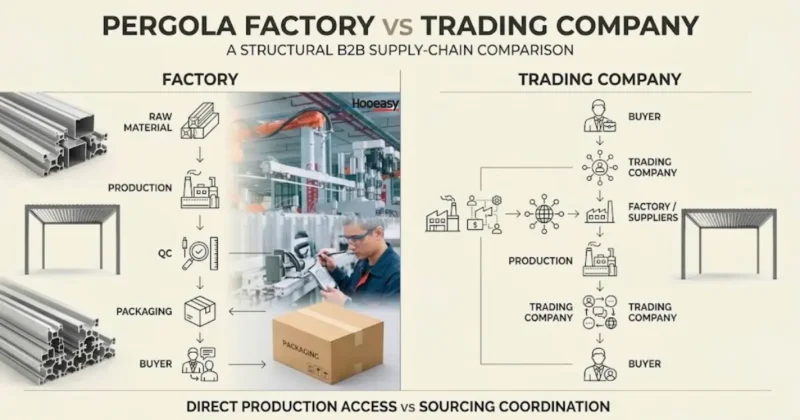
Some companies operate as manufacturers, while others primarily act as trading companies or sourcing intermediaries.
Neither model is automatically unsuitable. However, B2B buyers should understand the difference because it can affect:
- Product customization
- Engineering communication
- Production control
- Lead times
- Quality management
- After-sales support
- Cost structure
- Responsibility for product defects
A manufacturer should be able to clearly explain:
- Legal company name
- Factory location
- Manufacturing scope
- Main product categories
- Production facilities
- Quality-control system
- R&D capabilities
- Export markets
What should buyers request?
Ask the supplier to provide:
Company registration information + factory address + product catalog + factory photos/videos + certification documents.
Then cross-check whether these details are consistent.
A basic supplier-verification principle is to confirm the company’s legal identity, actual manufacturing capability, factory existence, and documentation before making a deposit. You can also learn more about our pergola manufacturing capabilities to better understand how a qualified producer operates.
2. Check Whether the Factory Actually Produces Pergolas
A supplier may show dozens of pergola models on its website.
That does not necessarily mean all of them are manufactured in-house.
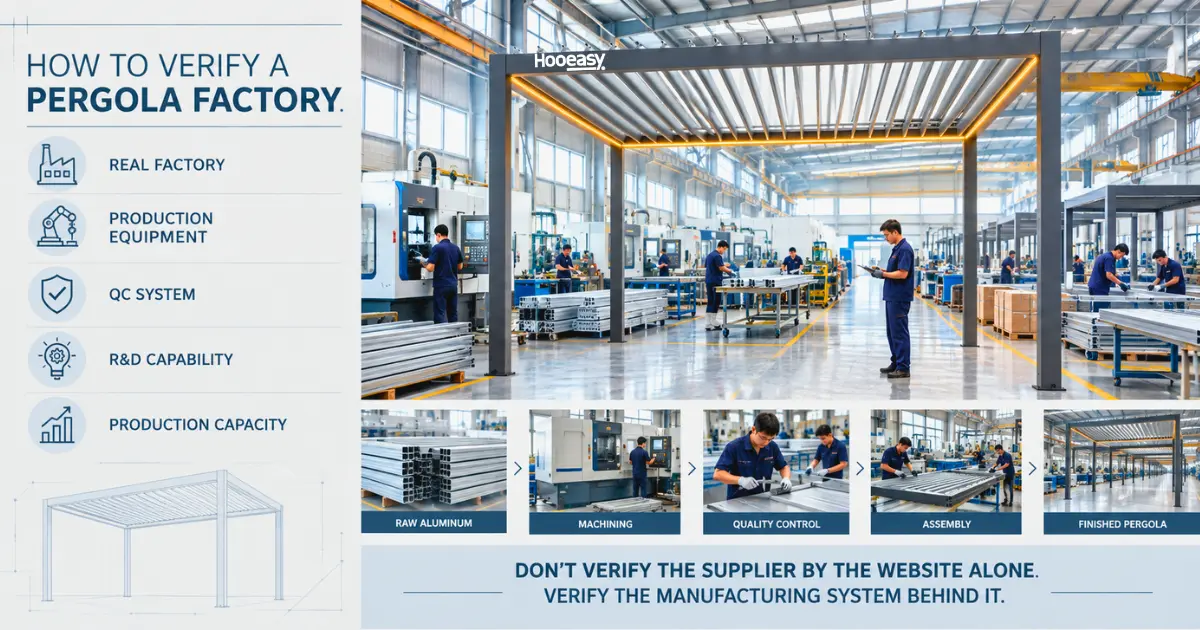
For a pergola manufacturer, buyers should look beyond product photography and examine the manufacturing process.
A genuine manufacturing operation should be able to demonstrate relevant production areas such as:
- Aluminum profile processing
- CNC or precision machining
- Cutting and drilling
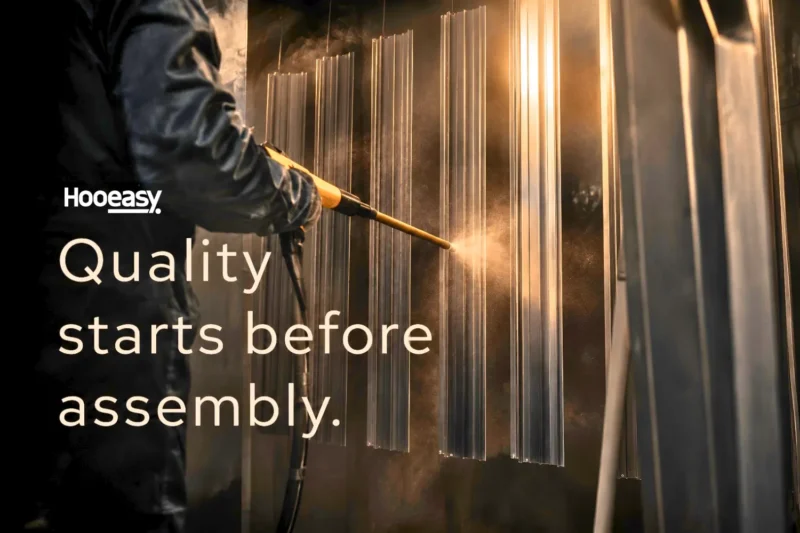
- Surface treatment
- Powder coating
- Motor and electrical assembly
- Louvers assembly
- Structural assembly
- Packaging
- Quality inspection
For larger projects, buyers should also ask:
Which parts of the pergola system are manufactured in-house, and which components are sourced from third parties?
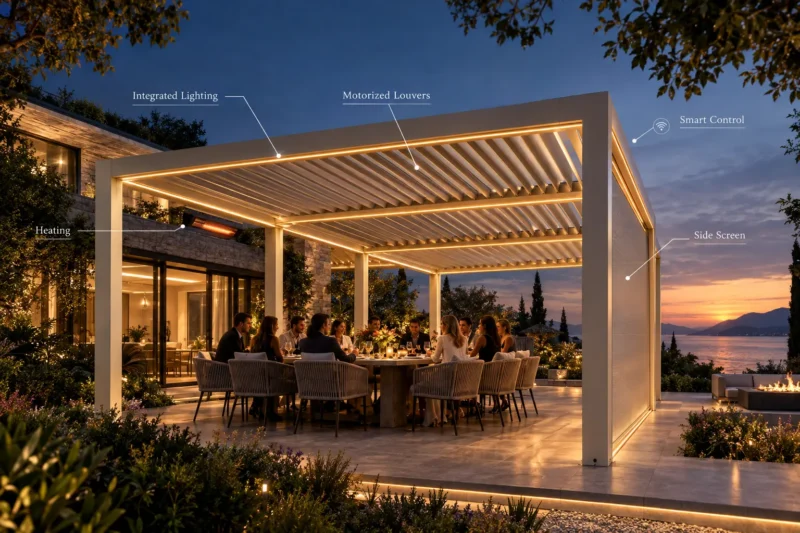
This is particularly important for motorized louvered pergolas.
A pergola is not simply an aluminum frame.
The complete system can include:
Aluminum Profile → Louvers → Motor → Control System → Drainage → Fasteners → Surface Finish → Structural Connections
The reliability of the final product depends on how these components work together.
Recommended Visual 1 — Factory Verification
3. Evaluate Production Capacity — Not Just Factory Size
A large factory does not automatically mean better quality.
What matters is whether the manufacturer’s production capacity matches your order requirements.
For example, ask:
- What is the monthly pergola production capacity?
- What is the normal MOQ?
- What is the typical lead time?
- How many production lines are available?
- How are peak-season orders handled?
- What happens if your order volume suddenly increases?
- Can the supplier maintain the same specifications across multiple batches?
For B2B buyers, production scalability is especially important.
A supplier may be able to produce 20 units for a sample project but struggle when the order increases to 200 or 500 units.
Therefore, ask the manufacturer to explain its production process from:
Raw Material → Processing → Assembly → Testing → Packaging → Shipment
This gives buyers a better understanding of whether the supplier can support long-term business rather than simply fulfill one small order.
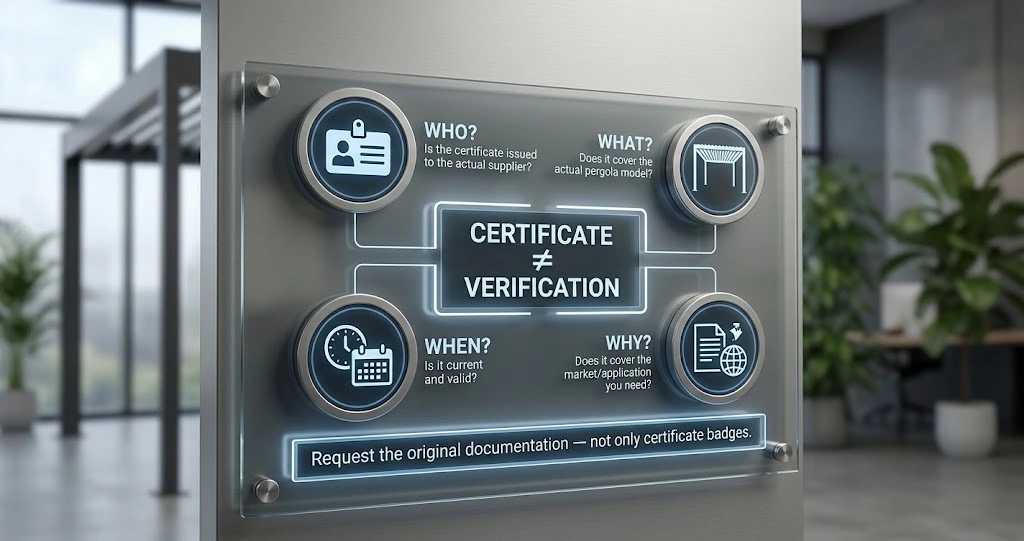
4. Verify Certifications — But Don’t Stop at the Certificate Logo
Certifications are important, but buyers should not simply look for logos on a website.
Ask for the actual documentation.
Depending on the target market and product configuration, relevant documents may include:
- CE
- GS
- RoHS
- ISO 9001
- BSCI
- Product-specific test reports
- Electrical safety documentation
- Structural testing documentation
- Wind-resistance testing
- Rainwater/drainage testing
The key question is:
Does the certificate or test report actually apply to the product you are purchasing?
Check:
- Company name
- Product name
- Model number
- Certification body
- Issue date
- Validity period
- Scope of certification
- Relevant testing standards
A certificate that belongs to another company, another product, or another model should not be treated as evidence for your specific order.
Recommended Visual 2 — Certification Verification
5. Ask How the Manufacturer Controls Product Quality
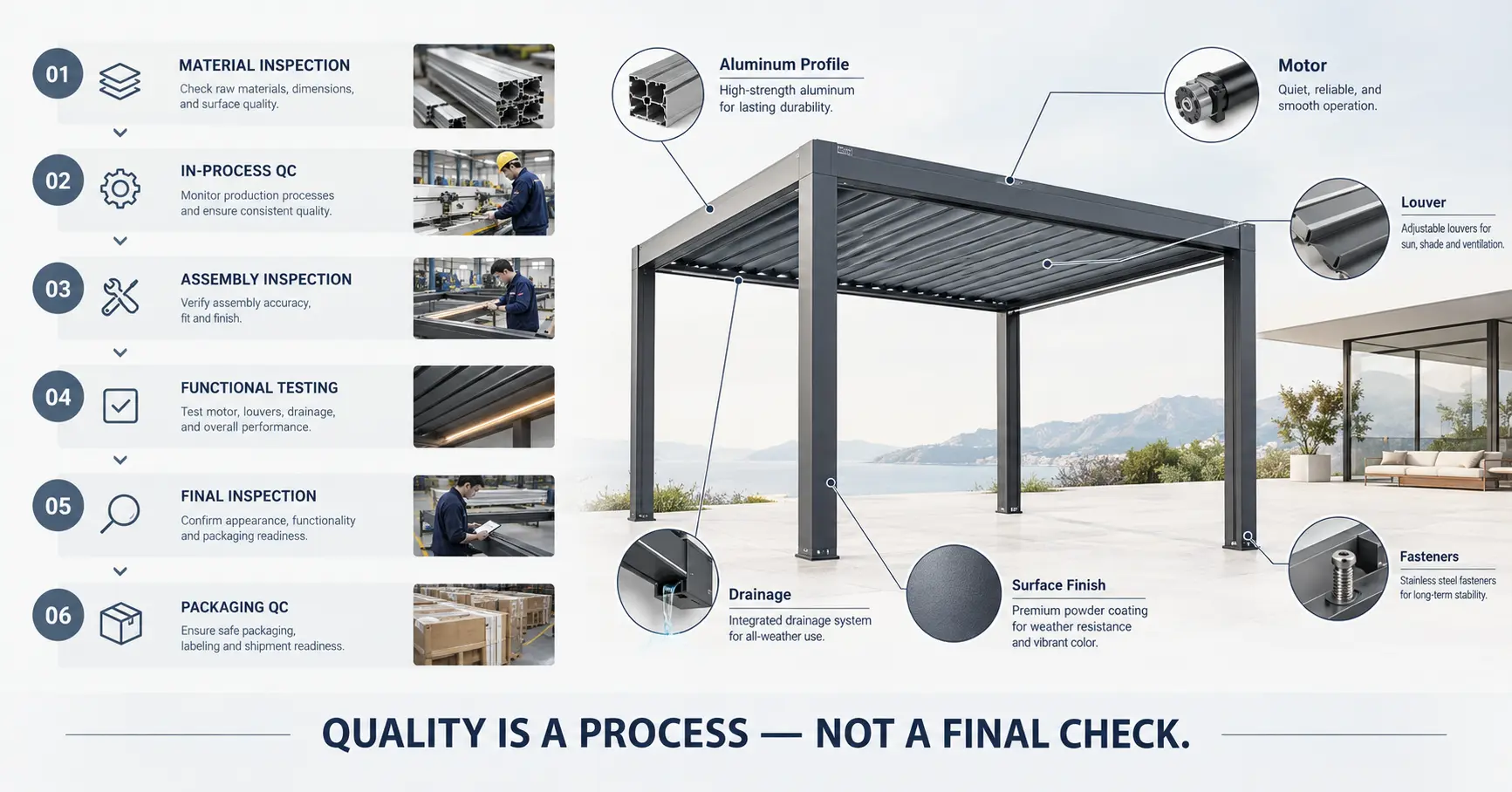
Quality control should be a process, not a final inspection performed after everything has already been produced.
Ask the manufacturer to explain its quality-control checkpoints.
A professional pergola QC system may include:
1. Material Inspection
Check aluminum profiles, motors, fasteners, fabrics, electrical components and other incoming materials.
↓
2. In-Process QC
Inspect dimensions, machining accuracy, coating quality and assembly processes.
↓
3. Assembly Inspection
Check frame alignment, louver installation, motor installation and drainage connections.
↓
4. Functional Testing
Test opening/closing, motor operation, control systems and other functional components.
↓
5. Final Inspection
Check appearance, dimensions, accessories, packaging and order specifications.
↓
6. Packaging QC
Verify protection against damage during transportation.
This process is particularly important for B2B buyers because a product can look good in photographs while still having problems that only become apparent during installation.
Recommended Visual 3 — Quality-Control Process
6. Check Structural and Functional Testing
For an aluminum pergola, appearance is only one part of product quality.
Buyers should understand how the manufacturer evaluates performance.
Depending on the design and target market, ask about testing related to:
Wind Resistance
Ask:
- What wind-load conditions has the system been tested under?
- Is the test based on a specific standard?
- What is the tested configuration?
- What anchoring conditions were used?
- Does the result apply to the complete pergola system?
Rain Resistance
Ask:
- How is water drained from the roof?
- What drainage capacity does the system have?
- Has the system undergone rain testing?
- What happens at the connections between louvers and frame?
Motorized System
For motorized pergolas, also verify:
- Motor manufacturer
- Motor specifications
- Opening/closing cycles
- Remote-control system
- Smart-home compatibility
- Manual override
- Electrical safety
- Replacement-part availability
This information helps buyers distinguish between a product photo and an engineered outdoor living system.
7. Always Request a Sample Before Bulk Production
A sample is one of the most useful verification tools available to a B2B buyer.
Do not evaluate only:
“Does the sample look good?”
Evaluate whether it matches the specifications you intend to purchase.
Create a sample evaluation checklist covering:
| Category | What to Check |
|---|---|
| Aluminum | Profile thickness, dimensions, finish |
| Louvers | Fit, alignment, rotation |
| Motor | Smooth operation, noise, response |
| Drainage | Water-flow design |
| Fasteners | Material and corrosion resistance |
| Surface | Color consistency, coating quality |
| Assembly | Connection accuracy |
| Packaging | Protection and labeling |
| Documentation | Manuals, specifications, certificates |
For OEM customers, also verify whether the sample reflects the final customized specification rather than a standard showroom model.
8. Verify OEM/ODM Capability Before Discussing Customization
Many suppliers claim to offer OEM or ODM.
However, customization can mean very different things.
A real OEM/ODM pergola manufacturer should be able to discuss:
- Custom dimensions
- RAL colors
- Branding
- Packaging
- Product configuration
- Motor options
- Lighting
- Accessories
- Structural modifications
- Installation requirements
- Technical drawings
- Product development
For a B2B brand, ask:
Can you customize the product itself, or can you only customize the logo and packaging?
This is an important distinction.
Example
Basic customization
Logo + packaging + color
versus
Product-level OEM/ODM
Product dimensions + structural design + configuration + components + finish + branding + packaging
The second model requires substantially more engineering and manufacturing capability.
Hooeasy publicly describes its pergola business as providing OEM/ODM solutions and customized outdoor-industry products.
9. Ask for Evidence of Export and Project Experience
Another useful verification step is to understand whether the manufacturer has experience supplying customers similar to your business.
Ask about experience with:
- Importers
- Distributors
- Outdoor-living brands
- Building-material suppliers
- Contractors
- Retailers
- E-commerce brands
- Commercial projects
You do not necessarily need the names of confidential customers.
Instead, ask for anonymized project information such as:
Market: Germany
Customer Type: Outdoor-living distributor
Product: Motorized louvered pergola
Quantity: XXX units
Customization: RAL color + branded packaging
Project Duration: XX months
This can tell you whether the supplier has experience handling the type of B2B requirements you have.
10. Check Whether the Manufacturer Can Support After-Sales Requirements
A supplier’s responsibility does not end when the container leaves the factory.
For motorized pergolas, after-sales support can become particularly important.
Before ordering, ask:
- Are spare motors available?
- Can replacement louvers be ordered?
- Are spare parts stocked?
- How are warranty claims handled?
- Is technical support available?
- Are installation manuals provided?
- Are installation videos available?
- Can replacement components be identified by model number?
- How quickly can technical questions be answered?
For distributors and brands, this can directly affect the customer experience.
Therefore, don’t evaluate a manufacturer only by:
FOB Price
Also evaluate:
Product Quality + Documentation + Engineering Support + Spare Parts + After-Sales Support
11. Conduct a Factory Audit Before a Large Order
If the order value is significant, a factory audit can provide another layer of verification.
A factory audit can examine areas such as:
Company
- Legal identity
- Ownership
- Business scope
Factory
- Facility size
- Production equipment
- Production lines
- Storage
Quality
- Incoming inspection
- Process inspection
- Final inspection
- Testing equipment
Production
- Capacity
- Workforce
- Lead-time management
- Production planning
Compliance
- Certifications
- Safety
- Social compliance
Documentation
- QC records
- Inspection reports
- Production records
A buyer can conduct an audit directly through a factory visit, live video inspection, or an independent third-party inspection company.
The objective is not simply to ask:
“Is this a good factory?”
Instead, build a checklist and verify each requirement against observable evidence.
12. Use a Pergola Manufacturer Verification Scorecard
Before placing an order, buyers can create a simple supplier verification matrix.
| Verification Area | Questions | Evidence |
|---|---|---|
| Company | Is the company legally registered? | Registration documents |
| Factory | Is there an actual manufacturing facility? | Factory audit/video |
| Capacity | Can production meet the required volume? | Capacity data |
| Certifications | Are certificates valid and relevant? | Original documents |
| QC | Is QC performed throughout production? | QC records |
| Testing | Is the pergola performance tested? | Test reports |
| Sample | Does the sample match specifications? | Sample inspection |
| OEM/ODM | Can the supplier customize the product? | Drawings/prototypes |
| Export | Does the supplier have relevant export experience? | Project evidence |
| After-sales | Are spare parts and support available? | Service policy |
This approach turns supplier selection from a subjective discussion into a documented procurement process.
What Documents Should You Ask a Pergola Manufacturer for?
Before placing a bulk order, a professional B2B buyer can request a document package containing, where applicable:
Company Documents
- Business registration information
- Factory address
- Company profile
Product Documents
- Product specification sheet
- Technical drawings
- Installation manual
- Product catalog
Compliance Documents
- CE documentation
- GS documentation
- RoHS documentation
- ISO 9001 documentation
- BSCI or relevant social-compliance documentation
Testing Documents
- Wind-resistance test
- Rain-resistance test
- Structural test
- Motor/electrical testing
- Relevant laboratory reports
Commercial Documents
- Quotation
- Proforma invoice
- Warranty terms
- Lead time
- Packaging specifications
- Spare-parts policy
The exact documents required depend on the destination market, product configuration, applicable regulations, and buyer’s contractual requirements.
10 Questions to Ask a Pergola Manufacturer Before Ordering
If you want a simple procurement checklist, ask these ten questions:
1. Are you the actual manufacturer or a trading company?
2. Where is your pergola factory located?
3. What parts of the pergola are manufactured in-house?
4. What is your monthly pergola production capacity?
5. Which certifications and test reports apply to this exact model?
6. How do you control quality during production?
7. What structural and functional tests have been performed?
8. Can you provide a production sample before bulk manufacturing?
9. What OEM/ODM customization can you support?
10. How do you handle spare parts, warranty claims and after-sales support?
If a supplier cannot clearly answer these questions, buyers should request additional documentation before making a purchasing decision.
How Hooeasy Approaches Pergola Manufacturing
For buyers evaluating Hooeasy as a potential China pergola manufacturer, the same verification framework can be applied.
Hooeasy states that its manufacturing operation covers 152,000 m², with dedicated production facilities, R&D capabilities, quality systems and a testing laboratory for awning and pergola performance. The company also states that it has certifications including GS, CE, RoHS, BSCI and ISO 9001, and reports a stated pergola production capacity of up to 10,000 sets per month. Detailed information can be found on Hooeasy manufacturing capabilities.
Hooeasy also describes its pergola offering—including motorized louvered pergola systems—as supporting OEM/ODM pergola solutions, including customized solutions for customers in the outdoor industry.
For buyers, however, the most useful approach is not simply to accept these claims. The same principle applies to every manufacturer:
Request the relevant documentation, verify the product specification, inspect the sample, and evaluate the manufacturing process before placing a large order.
That is how supplier verification should work.
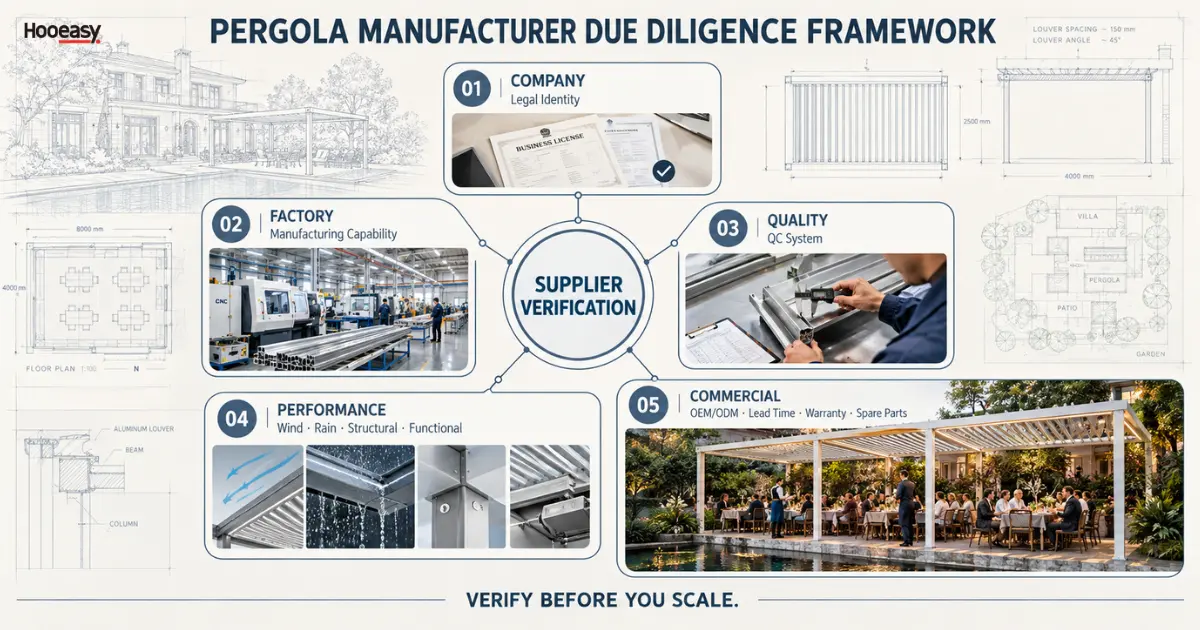
Pergola Manufacturer Verification: A Practical Pre-Order Checklist
Before signing a purchase contract, make sure you can answer YES to the following:
☐ Company identity verified
☐ Factory location verified
☐ Manufacturing capability verified
☐ Production capacity confirmed
☐ Certifications checked
☐ Test reports reviewed
☐ QC process understood
☐ Sample inspected
☐ OEM/ODM capability confirmed
☐ Packaging requirements confirmed
☐ Warranty terms reviewed
☐ Spare-parts policy confirmed
☐ Factory audit completed for major orders
☐ Pre-shipment inspection arranged
If several boxes remain unchecked, the supplier verification process is not finished.
FAQ: Verifying a Pergola Manufacturer in China
How can I verify a pergola manufacturer in China?
Start by checking the company’s legal identity, factory location, manufacturing capability, certifications, testing documents, production capacity, quality-control system, samples, and previous export experience. For larger orders, consider a factory audit or third-party inspection.
How do I know if a China pergola supplier is a real factory?
Ask for the factory address, production videos, manufacturing equipment, production process, capacity information, and evidence of in-house manufacturing. A live factory video inspection or third-party audit can provide additional verification.
What certificates should a pergola manufacturer have?
The relevant certificates depend on the product and destination market. Buyers may need to review documents such as CE, GS, RoHS, ISO 9001, BSCI, and product-specific structural, wind, rain, or electrical test reports.
Should I order a sample before a bulk pergola order?
Yes. A sample allows buyers to evaluate materials, dimensions, surface finish, louver operation, motor performance, drainage, assembly quality, packaging, and documentation before committing to larger production.
How do I verify a pergola manufacturer’s OEM capability?
Ask whether the manufacturer can modify product dimensions, structure, colors, components, motor systems, accessories, branding, packaging, and technical specifications—not just add a logo.
What should I check before paying a deposit to a China pergola manufacturer?
Verify the company, factory, product specifications, certifications, sample, quotation, payment terms, production schedule, quality requirements, warranty, packaging, and inspection arrangements before making the deposit.
Is the lowest pergola quotation always the best option?
Not necessarily. B2B buyers should compare the complete supplier package, including product specifications, quality controls, certifications, testing, customization capability, lead time, packaging, spare parts, warranty, and after-sales support.
Final Takeaway
Verifying a pergola manufacturer in China should not be based on price, product photos, or a company website alone.
A more reliable procurement process is:
VERIFY THE COMPANY
↓
VERIFY THE FACTORY
↓
VERIFY THE CAPACITY
↓
VERIFY THE CERTIFICATIONS
↓
VERIFY THE QC SYSTEM
↓
VERIFY THE TESTING
↓
VERIFY THE SAMPLE
↓
VERIFY THE OEM/ODM CAPABILITY
↓
VERIFY THE COMMERCIAL TERMS
↓
INSPECT BEFORE BULK SHIPMENT
For B2B buyers, the real question is not simply:
“Who offers the lowest price?”
It is:
“Can this manufacturer consistently deliver the product, quality, documentation, customization, and support that my business requires?”
That is the question worth answering before placing the order.